
What Is GEO? Generative Engine Optimization for Business Owners
GEO is the work of getting your business found, described accurately and cited when people ask AI assistants instead of searching. Here is where the term came from, what the work involves, what it cannot do and how to start without wasting money.
Key takeaways
- GEO, or generative engine optimization, is the work of making your business easy for AI assistants such as ChatGPT, Perplexity, Gemini, Copilot and Google’s AI Overviews to find, describe accurately and cite as a source.
- The term comes from a research paper by Pranjal Aggarwal and five co-authors, first posted in November 2023 and published at the KDD 2024 conference. In its tests, adding quotations, statistics and source citations raised a page’s visibility in AI answers; keyword stuffing did not.
- Google says optimizing for its AI features is “still SEO”: no special files, schema or rewriting are required, but a page must be indexed and eligible to show a snippet.
- In practice GEO is five jobs: letting AI search crawlers in, keeping your business facts consistent, publishing specific answer-ready content, earning genuine mentions elsewhere, and tracking how often you appear.
- No one can guarantee a mention. SparkToro’s January 2026 study found ChatGPT and Google’s AI repeated the same list of brands less than once in 100 runs, so measure how often you appear, not a “rank”.
On this page
What is GEO, in plain English?
GEO, short for generative engine optimization, is the work of making sure AI assistants know your business exists, describe it correctly and point to your website when they answer questions in your field. “Generative engine” is the researchers’ name for a search system that retrieves web pages and then writes one answer from them, with sources, instead of handing you a list of links.
Think of the difference between a phone book and a well-connected friend. SEO has long been about your listing in the phone book: where you appear when someone searches. GEO is about what the friend says when asked “Who should I call?”, and whether they hand over your number.
A concrete case. A restaurant owner in Denver asks an assistant which accountants nearby handle sales tax for a business with two locations. The answer might name three firms, summarize what each does and link a source for each claim. GEO covers everything that influences whether your firm is one of the three, whether the summary is right, and whether the link goes to your site or to a directory page that describes you badly.
Success shows up in three separate ways, and it pays to keep them apart. A mention is your name in the answer. An AI citation is your page linked as a source. Accuracy is whether what the answer says about you is true. You can be mentioned without being cited, or cited for one service while the assistant gets your hours wrong.
Where does the term GEO come from?
It comes from an academic paper. “GEO: Generative Engine Optimization” by Pranjal Aggarwal, Vishvak Murahari, Tanmay Rajpurohit, Ashwin Kalyan, Karthik Narasimhan and Ameet Deshpande was first posted to arXiv on November 16, 2023. It was accepted to KDD 2024, the Association for Computing Machinery’s data mining conference, held in Barcelona in August 2024.
You will see the authors’ affiliations described differently around the web, and both versions are on the record. The first version lists Princeton University, Georgia Tech, the Allen Institute for AI and IIT Delhi. The final version lists Princeton, IIT Delhi and two independent researchers.
The researchers’ concern was practical: if AI answers replace lists of links, website owners lose visibility and have little say in how they appear. So they built a test set called GEO-bench, with 10,000 queries across 25 subject areas, and measured how much of an AI answer each source “owned” before and after its content was edited in nine different ways.
What the paper found
- Quotations worked best. Adding relevant quotations from credible sources improved visibility by up to 41% on the paper’s main measure, a word count weighted by where in the answer a source appears.
- Statistics and citations helped too. Adding numbers and citing sources were close behind.
- Keyword stuffing failed. The old SEO trick of repeating search terms offered little to no improvement.
- Lower-ranked pages gained most. Citing sources lifted pages in fifth position by 115.1%, while the same change lowered top-ranked pages by 30.3%.
- A live engine behaved similarly. On Perplexity, adding quotations improved visibility by about 22%.
What the paper does not tell you
It is a lab benchmark run on 2023-era systems, and its metrics measure share of the answer, not phone calls or sales. Take the direction as the lesson: specific, evidence-backed writing gets used, and padding with keywords does not. Our view: the finding that weaker pages benefited most is the encouraging part for smaller businesses. A page that cannot outrank a national brand can still be the clearest source for one specific claim.
The industry adopted the term quickly. Microsoft described the AI Performance report it added to Bing Webmaster Tools as “an early step toward Generative Engine Optimization (GEO) tooling.” Google’s “Do you need an SEO?” page, updated in June 2026, now lists optimizing for generative AI among the services an SEO may offer. It tells you to check whether a vendor’s “AEO” or “GEO” advice is aligned with Google’s guidance.
Why does GEO matter for a business now?
Because more people now get answers from AI tools, and those answers send fewer clicks to websites. A buyer can read a shortlist, a price range and a comparison before visiting a single site, so being on that shortlist counts for more than it used to.
Pew Research Center’s survey, fielded in February 2026, found that 44% of US adults have used ChatGPT, up from 18% in 2023, and 55% of adults aged 30 to 49. Pew notes the 2026 question was worded differently, so treat the trend as approximate.
Pew’s earlier study tracked 900 adults’ real Google searches in March 2025. When a search showed an AI summary, people clicked a regular result in 8% of visits, against 15% when there was no summary. They clicked a link inside the summary in about 1% of visits, and about 18% of searches showed a summary at all.
Two honest caveats. Google says clicks from results pages with AI Overviews “are higher quality,” meaning people tend to spend more time on the site; that is Google’s observation, not independent data. And in our experience, classic Google results and map listings still drive most leads for local and service businesses. Our view: GEO is an addition to SEO, not a replacement, and it pays off fastest for businesses whose basics are already in order.
How do AI assistants build their answers?
In two ways: from memory, and by looking things up. A large language model (LLM) learns patterns from huge amounts of text during training, so it can describe well-known brands without searching. For current, local, comparative or commercial questions, assistants increasingly search first and write from what they find.
Google calls the second route retrieval-augmented generation, also known as grounding: its core ranking systems pull pages from the search index, and the answer links to the pages that support it. Google also describes query fan-out, where the model generates “a set of concurrent, related queries” to gather more results. Your page competes not only for the words a buyer typed but for the follow-up questions the assistant asks on their behalf.
Our explainer on how AI assistants choose the sources they cite walks through each step, platform by platform. The key point here is simpler: you cannot edit what a model memorized, but you can influence what it finds when it searches. That is where GEO does most of its work.
Memory still matters at the margins. Training data comes from the same public web, so consistent information about your business across many sites is what makes a model “know” you at all. Nobody can promise when, or whether, that shows up in answers.
What does GEO involve in practice?
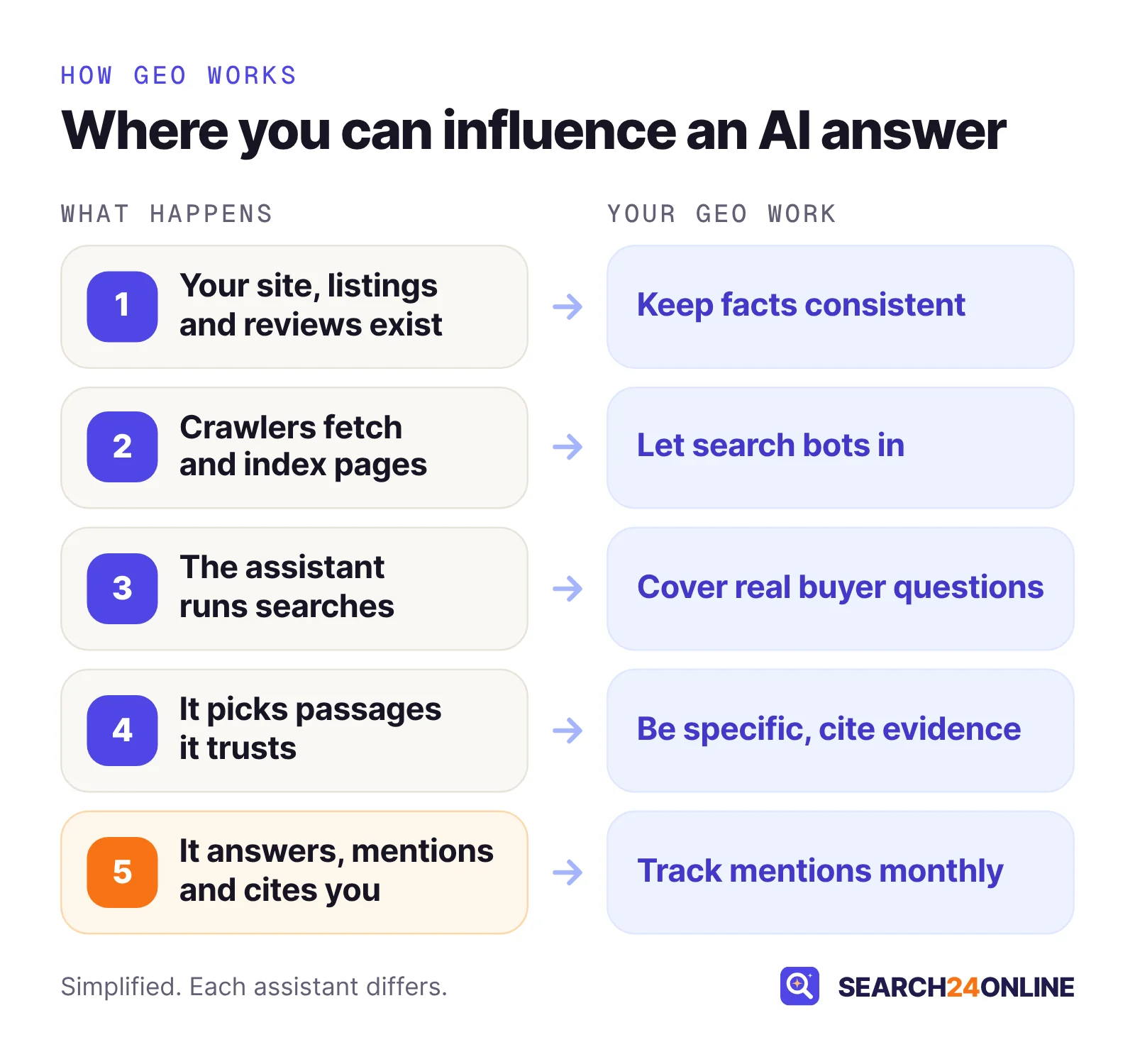
Five jobs, in roughly this order: crawler access, consistent business facts, answer-ready content, genuine mentions elsewhere, and tracking. None is exotic. Each is ordinary good practice, pointed at how AI systems read.
1. Let AI search crawlers in
An assistant can only cite pages its search system is allowed to fetch. OpenAI, Anthropic and Google each document separate controls for search and for model training, and the difference matters. Blocking a training bot keeps your content out of future training sets; blocking a search bot takes you out of that assistant’s answers. OpenAI says sites that disallow OAI-SearchBot will not appear in ChatGPT search answers, though they can still show up as navigational links.
| Company | Search and answer bots (block these and you can’t be cited) | Training bot (your choice) |
|---|---|---|
| OpenAI | OAI-SearchBot (ChatGPT search); ChatGPT-User (visits pages a user asks about) | GPTBot |
| Anthropic | Claude-SearchBot (indexing for search); Claude-User (fetches for a user’s question) | ClaudeBot |
| Perplexity | PerplexityBot (search results); Perplexity-User (fetches for a user’s question) | None listed: Perplexity says neither bot collects content for training foundation models |
| Googlebot (AI Overviews and AI Mode use the regular Search index) | Google-Extended, which Google says governs AI training and grounding in some of its other systems |
Google lists, among its best practices for AI features, “ensuring that crawling is allowed in robots.txt, and by any CDN or hosting infrastructure.” That second half matters: in audits we often find bot protection at the host or content delivery network (CDN) blocking crawlers that robots.txt welcomes. Our guide to AI crawlers and whether to block them covers each bot.
2. Keep your business facts consistent
Assistants describe a business by combining what many sources say about the same entity: your company as one distinct thing with a name, address, services, people and reviews. When those sources disagree, answers mix them up. Bing’s February 2026 guidance asks site owners to keep text, images and video consistent in how they describe the same entities, and tells local businesses to keep Bing Places details current. Google says Merchant Center feeds and Google Business Profiles can help your products and services appear in AI responses.
A common situation: a physical therapy practice moved two years ago. The website is current, but an old directory listing, a forgotten duplicate Google profile and a chamber of commerce page still show the old address and a retired phone number. An assistant asked about physical therapy in the old neighborhood may confidently send patients to an empty building. The fix is unglamorous: one agreed set of facts, updated everywhere it appears. Our guide to entity SEO goes further.
3. Publish answer-ready, specific content
Google says content people find “unique, compelling, and useful” will likely influence your presence in its AI features more than anything else. It contrasts that with commodity content based on common knowledge that could come from anyone. Bing suggests clear headings, tables and FAQ sections so key information is easy to extract, and backing claims with examples, data and sources, which fits the GEO paper’s results on statistics and citations.
Note what Google does not ask for. You don’t need to break content into tiny pieces, use special phrasing or add extra long-tail keywords, and Google says there is no ideal page length. Our reading: write each important section to answer one question, under a heading that says what it covers, with the specifics only you know. Those are prices or price ranges, service areas, turnaround times, standards you meet and who does the work.
In audits we often find the opposite: a services page built from words like “trusted” and “quality solutions,” pricing hidden behind a contact form, and the useful detail locked in a PDF brochure. There is nothing there for an assistant to quote. See how to write content AI assistants want to quote.
4. Earn genuine mentions on other sites
AI answers draw on far more than business websites: reviews, news coverage, industry directories, forum threads and videos. Google notes that its AI features can show what people say about products across blogs, videos and forums, then warns that “seeking inauthentic ‘mentions’ across the web isn’t as helpful as it might seem.”
So paid spots in thin “best of” lists and planted forum posts are out. Real reviews, coverage in trade or local press, expert comment and accurate profiles on the directories your customers use are in. Our guide on getting your business mentioned in ChatGPT covers the specifics.
5. Track how you appear
Measurement is improving but still partial. Google points site owners to the Generative AI performance report in Search Console for how content performs in AI features in Search and Discover. Bing’s AI Performance report, launched in public preview in February 2026, shows how often your pages are cited in Copilot and Bing’s AI summaries, with a sample of the searches behind those citations.
In Google Analytics 4, the AI Assistant channel groups visits from sources such as ChatGPT, Gemini and Copilot, but Google’s help page says it excludes AI Overviews and AI Mode. For assistants that offer no reports, you ask the questions yourself, repeatedly. Our guide to tracking brand visibility in AI answers shows a simple setup.
How is GEO different from SEO?
Less than the marketing suggests. Google’s guide says optimizing for generative AI search “is optimizing for the search experience, and thus still SEO.” The same foundations decide both: pages that can be crawled, are indexed, answer real questions and come from a business others vouch for.
The differences are in emphasis:
- What counts as success. Being mentioned, cited and described correctly, not only ranking and winning the click.
- Where you compete. Several assistants with different indexes and crawlers, not one search engine.
- How much your reputation elsewhere shows. An assistant summarizes what others say about you, so reviews and third-party coverage appear in the answer itself.
- How you measure. Answers vary between runs and most platforms share little data, so you track patterns, not positions.
Our team brings over 20 years of digital marketing experience and has served 500+ brands, and the pattern we see is consistent. Businesses missing from AI answers usually have ordinary SEO problems. Important pages are not indexed. Several pages target the same phrase and compete with each other, which is called keyword cannibalization. Content is thin or out of date, internal linking is weak, and structured data is missing or doesn’t match the page.
Fixing those helps on Google and in AI answers at the same time. Our full comparison of SEO vs GEO covers where budgets and skills differ.
What can GEO not do?
It cannot guarantee that any assistant will mention or cite you. Google says “No one can guarantee a #1 ranking on Google,” and its AI guide adds that “indexing and serving aren’t guaranteed.”
SparkToro’s January 2026 study, run with Gumshoe.ai, had about 600 volunteers run 12 brand and product prompts 2,961 times in ChatGPT, Claude and Google’s AI. ChatGPT and Google’s AI returned the same list of brands less than once in 100 runs, and the same list in the same order about once in 1,000. Yet some brands recurred: in a follow-up test with 142 differently worded headphone prompts, Bose, Sony, Sennheiser and Apple appeared in 55% to 77% of the 994 answers. The lesson is to measure how often you appear across many runs, not to chase a position.
GEO also cannot:
- Rewrite what a model already learned. Corrections reach answers through retrieval or future training, on each vendor’s schedule, not yours.
- Make up for a weak offer. If your reviews are poor or your prices out of line, an honest summary will reflect it.
- Work through a magic file or markup. Google says you don’t need new machine-readable files, AI text files or special schema for its AI features. Other services may read llms.txt, but it is not a shortcut.
Promises of a “#1 spot in ChatGPT”, AI “rankings” reported to the decimal place, or tools said to use Google data no one else has. Google tells site owners to be wary of third-party tools that promise ranking success or claim to use “internal” Google metrics. More in our list of SEO promises that mean you should walk away.
How should a business start with GEO?
Measure where you stand first, then fix access and facts before writing anything new. In our experience the first pass takes a small business a few weeks of focused work, and after that it becomes a monthly routine.
- List 20 to 30 questions buyers really askPull them from sales calls, emails and reviews, and include cost, comparison and “near me” questions.
- Ask the assistants, several times eachRun each question in ChatGPT, Perplexity, Gemini, Copilot, Claude and Google AI Mode. Record whether you are mentioned, cited and described correctly, and which other sites get cited.
- Check crawler access and indexingReview robots.txt and your host’s bot settings, then confirm your key pages are indexed in Google Search Console and Bing Webmaster Tools.
- Fix your facts everywhereWebsite, Google Business Profile, Bing Places and the main directories in your industry: one name, address, phone number, set of hours and service list.
- Upgrade your five most important pagesAnswer the main question first, add specifics, sources and dates, and move key details out of PDFs and images.
- Earn real mentionsAsk happy customers for reviews, offer useful data or expert comment to local and trade press, and correct your profiles on the sites assistants cite in your field.
- Re-run your questions monthlyTrack the share of runs that mention you on each assistant, alongside Search Console, Bing’s AI Performance report and GA4’s AI Assistant channel.
OpenAI says robots.txt changes take about 24 hours to affect ChatGPT search. Google says recrawling can take “anywhere from several days to several months.” Judge content changes over weeks, not days.
If you want a starting point, our free SEO + GEO report analyzes your website and gives you password-protected dashboard access to view it within 24 hours. For ongoing work, our SEO + GEO services track 25, 75 or 200 AI questions depending on the plan, from Google’s AI and ChatGPT on Starter up to Perplexity, Gemini, Copilot and Claude on Authority; see pricing for details. Nobody can promise you a place in an AI answer. You can make sure your business deserves one and is easy to find.
Common questions
Is GEO the same as AEO?
Mostly, yes. AEO (answer engine optimization), LLMO and “AI SEO” are other names for the same goal: being found, described correctly and quoted in AI-generated answers. Google’s own guide mentions AEO and GEO side by side and treats both as part of SEO.
Do I still need SEO if I invest in GEO?
Yes. Google’s AI Overviews and AI Mode take their supporting links from pages that are indexed and eligible to show a snippet in regular search, and other assistants also search an index before they cite anything. GEO on a site that is hard to crawl or poorly indexed has nothing to work with.
How long does GEO take to work?
There is no reliable timeline, and anyone who quotes one with certainty is guessing. A technical fix such as unblocking OpenAI’s search crawler takes about 24 hours to register, according to OpenAI, while content changes wait on recrawling, which Google says can take from several days to several months.
Is GEO only worth it for big brands?
No. In the original GEO research, lower-ranked pages gained the most from adding citations, quotations and statistics, and Google says Google Business Profiles can help a business’s products and services appear in AI responses. Big brands start with more mentions; specific, well-sourced pages are how smaller businesses compete.
Does llms.txt or special schema markup help with GEO?
Not for Google. Google says you do not need new machine-readable files, AI text files or special schema markup to appear in its AI features. Structured data still helps with rich results and other services may read llms.txt, but neither is a shortcut into AI answers.
Sources
- Aggarwal et al., GEO: Generative Engine Optimization (arXiv, first posted November 2023; KDD 2024)
- Google Search Central: Optimizing your website for generative AI features on Google Search
- Google Search Central: AI features and your website
- Google Search Central: Do you need an SEO?
- Bing Webmaster Blog (February 10, 2026): Introducing AI Performance in Bing Webmaster Tools Public Preview
- OpenAI: Overview of OpenAI crawlers
- Claude Help Center: Does Anthropic crawl data from the web, and how can site owners block the crawler?
- Perplexity documentation: Perplexity crawlers
- Pew Research Center (July 22, 2025): Google users are less likely to click on links when an AI summary appears in the results
- Pew Research Center (June 17, 2026): Majorities of adults under 50 now use ChatGPT
- SparkToro (January 27, 2026): AIs are highly inconsistent when recommending brands or products
- Google Analytics Help: Default channel group
See how ready your site is for AI answers — free.
We’ll analyze your website, create your SEO + GEO report and give you password-protected dashboard access to view it.
Free · No obligation · We only review your public pages.