
SEO vs Google Ads: Where Should a Small Business Spend First?
An honest comparison of cost, speed, control and click behavior in 2026, the situations where paying for ads first is the smarter move, and how to run both so each one makes the other cheaper.
Key takeaways
- Neither channel wins by default. Start with Google Ads if you need leads within weeks, are testing an offer or sell something seasonal; start with SEO if you can wait months and clicks in your industry are expensive compared with what a customer is worth.
- WordStream and LocaliQ’s 2026 benchmarks, drawn from 13,474 US search campaigns, put the median cost per click at $5.42 and the median cost per lead at $66.69, with legal services the most expensive industry at $9.87 a click.
- Paying for ads does not help organic rankings. Google says advertising with it “won’t have any effect on your site’s presence in our search results.”
- AI Overviews take clicks from both sides: Ahrefs estimated a roughly 58% lower click-through rate for the top organic result when one appears, and Seer Interactive found paid CTR of 16.21% on such queries versus 21.85% without one (February 2026).
- The cheapest long-term setup usually uses both: ads show you which searches turn into customers, and SEO turns those searches into pages that earn clicks without a charge for each one.
On this page
- The short answer
- How do SEO and Google Ads differ in practice?
- What does Google Ads cost a small business in 2026?
- What does SEO cost, and why does it pay back differently?
- Clicks and AI Overviews
- When should Google Ads come first?
- When should SEO come first?
- Using both together
- Splitting your budget
- Common questions
- Sources
Should a small business start with SEO or Google Ads?
Start with Google Ads if you need leads in the next month or two, you are testing a new offer, or your demand is seasonal. Start with SEO if you can wait several months, people already search for what you sell, and clicks in your industry cost a lot compared with the value of a customer. Most businesses end up using both; the real question is which one gets the first dollar.
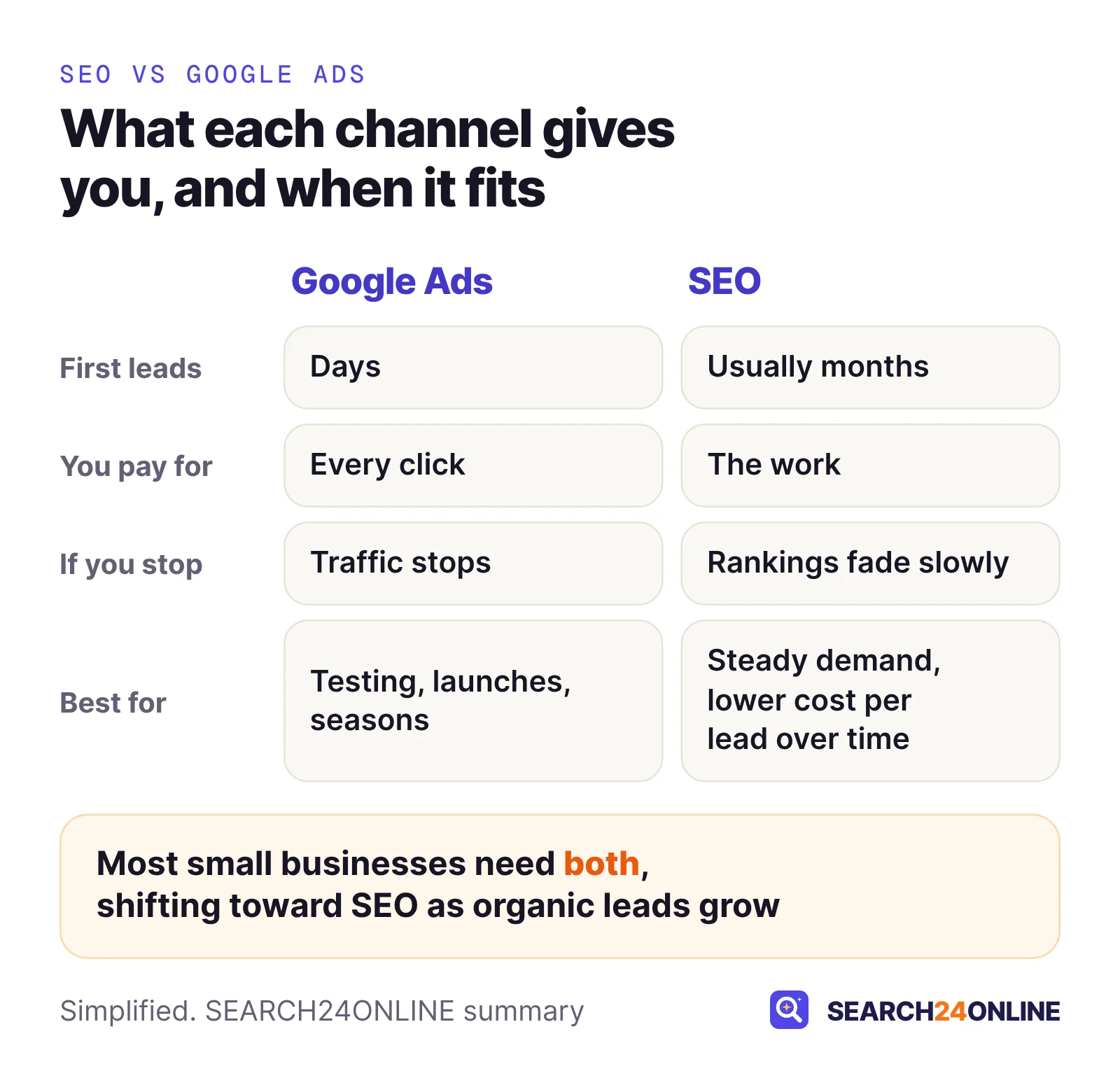
The difference comes down to how you pay. With Google Ads you rent visibility: every click has a price, and when the budget stops, the traffic stops the same day. With SEO you build something: it costs time and money before it returns much, and then each extra visit costs nothing more. One is a faucet, the other is a well that takes a while to dig.
Our view, from auditing many small business websites: the most expensive mistake is not picking the “wrong” channel. It is sending paid traffic to a site that neither converts visitors nor shows up in organic results, so you pay full price for every visit and build nothing you keep. The sections below put numbers on both options so you can decide on your own figures.
How do SEO and Google Ads differ in practice?
Google Ads is an auction where you pay each time someone clicks; organic rankings cannot be bought at all. Google’s own SEO guidance says it “never accepts money to include or rank sites in our search results,” so the two channels run on separate systems even though they share the same results page.
On the paid side, you set a maximum bid, but Google Ads Help explains that you are often charged less: only what is “minimally required to clear the Ad Rank thresholds.” Ad Rank combines your bid with your ad’s quality and other signals. Budgets are flexible within limits. A campaign may spend up to twice its average daily budget on a busy day, but by the end of the month you will have spent no more than 30.4 times that daily figure.
On the organic side, your position depends on how relevant and useful your page is, whether Google can index it, and how much trust your site has earned. You pay for the work, not the clicks.
| Google Ads | SEO | Both together | |
|---|---|---|---|
| Time to first clicks | Days, once ads are approved | Usually months for competitive searches | Ads cover the gap while SEO builds |
| What you pay for | Each click, at auction prices | The work: content, fixes, links | A fixed SEO cost plus a variable ad budget |
| When you stop paying | Traffic stops the same day | Rankings fade gradually | You can trim ads as organic grows |
| Control | Exact message, landing page, location, schedule | Google picks the page and the snippet | Test messages in ads, use winners on pages |
| What it teaches you | Which searches convert, within weeks | Which topics earn visibility, over months | Ad data picks the SEO targets |
| Biggest risk | Paying for clicks that never convert | Waiting months on the wrong keywords | Overlap you never measure |
What does Google Ads cost a small business in 2026?
Expect anywhere from under $2 to about $10 per click, depending mostly on your industry. The most useful public numbers come from WordStream and LocaliQ, which analyzed 13,474 US search campaigns running between April 2025 and March 2026. Their figures are medians, which keeps a few extreme accounts from skewing the picture.
Across all industries, the median click-through rate was 6.64%, the median cost per click $5.42, the median conversion rate 8.18% and the median cost per lead $66.69. The spread between industries is large, and it is the number that matters for your decision.
Median Google search cost per click by industry, US, April 2025 to March 2026
Bars scaled to $10. Source: WordStream by LocaliQ, 2026 Google Ads benchmarks (13,474 US search campaigns, medians).
Cost per lead tells a fuller story than cost per click. In the same data, dentists pay $8.00 a click but convert 10.67% of clicks, for a median cost per lead of $72.97. Attorneys pay $9.87 a click and convert 5.55%, so a lead costs $131.63. Restaurants sit at the other end, with leads at $30.57.
Benchmarks are averages across many markets, and a big metro can run well above them. Before you commit, check your own area in Keyword Planner, which is free inside a Google Ads account. Its “top of page bid” shows a low range (roughly the 20th percentile of what advertisers have paid for a top-of-page spot) and a high range (roughly the 80th percentile) for your chosen location.
A worked example
Say a remodeling contractor budgets $1,500 a month. At the home improvement median of $8.33 a click, that buys about 180 clicks. At that industry’s 8.05% conversion rate, it means around 14 leads, or about 16 if you divide by the $90.92 median cost per lead instead (medians do not multiply neatly). If the average job is worth $4,000 and the contractor closes one lead in four, those leads are worth roughly $14,000 in revenue, and the ads pay for themselves. If the average job were $250, the same budget would lose money every month.
Small budgets are the hard case. At $500 a month in the same industry you get about 60 clicks and perhaps five leads. That is too little data to tell a good keyword from a bad one within a quarter, which undercuts one of Google Ads’ biggest strengths: fast learning.
What does SEO cost, and why does it pay back differently?
SEO costs a fixed monthly amount for the work, not a fee per visitor, so its cost per lead falls as your organic traffic grows. Our own plans run from $500 to $2,000 a month; our guide to what SEO costs compares market rates and what each budget realistically buys.
The catch is time. Early signs such as newly indexed pages and rising impressions can show within weeks, but steady leads from competitive searches usually take much longer, often six months to a year in our experience. We break down why in how long SEO takes to work. During that wait, SEO costs more per lead than ads, because the traffic has not arrived yet.
Once it arrives, the math flips. A service page that ranks for “water heater replacement” plus your city can bring calls every month with no click charge. It is not free forever: competitors publish, content ages and site changes break things, so rankings need upkeep. But maintenance usually costs far less than buying the same clicks at $8 each.
Why the organic side often leaks before it can compound
In audits we regularly find businesses paying for ads on terms their own website could rank for, if the site were not working against itself. A common situation: a roofing company runs ads for “roof replacement” in its city, while its own roof replacement page is missing from Google’s index and three older blog posts compete for the same phrase. That second problem is called cannibalization: your pages split the signals between them, and none ranks well.
Other patterns we see again and again: thin service pages with a paragraph of text, poor internal linking that buries key services several clicks deep, and pages written around keywords rather than what the searcher actually wants. Each of these is mostly a one-time fix. Unlike ad spend, a fix you pay for once keeps helping every month after it.
What happens to ad and organic clicks when AI Overviews appear?
Both lose clicks, organic informational results lose the most, and short commercial searches are the least exposed. AI Overviews, the AI-written summaries at the top of many Google results, answer part of the question on the page itself, so fewer people need to click anything.
The broad trend is clear. SparkToro, using Similarweb’s US clickstream panel, estimated that 68.01% of Google searches ended without a click from January to April 2026. Its 2024 figure was 60.45%, from a different panel, so treat the change as directional. Pew Research Center tracked the browsing of 900 US adults in March 2025. People clicked a traditional result on 8% of visits when an AI summary appeared, against 15% when none did, and clicked a link inside the summary on just 1%. We cover what that means for your strategy in zero-click search.
The organic side
Ahrefs studied 300,000 keywords using aggregated Search Console data and found the top organic result’s click-through rate was about 58% lower in December 2025 when an AI Overview appeared than it would otherwise have been. The figure is desktop-only and based on a forecast, and Ahrefs describes it as a correlation, but it lines up with what most site owners see on informational pages.
The paid side
Seer Interactive tracked 53 brand accounts (2.43 billion organic and 296.9 million paid impressions) from January 2025 to February 2026. In February 2026, paid CTR was 16.21% on queries showing an AI Overview versus 21.85% on queries without one; organic CTR was 2.36% versus 3.82%. Seer reports that brands cited inside the AI Overview generally saw higher paid CTR than uncited ones through 2025, often by four points or more (its own monthly table shows exceptions), though stronger brands are also more likely to be cited.
A caution: Seer’s organic CTR averages every ranking position, so it is not comparable with paid CTR, and its accounts are large brands with many branded searches. For a small advertiser, WordStream’s 6.64% median CTR is the more realistic benchmark.
Ads now appear inside AI answers too
According to Google Ads Help, ads can show within AI Overviews and AI Mode in English in the US and several other markets. They can also appear above or below AI Overviews wherever those exist. Existing Search, Shopping and Performance Max campaigns are eligible automatically. Exact and phrase match keywords qualify only when a query shows direct commercial intent, while broad match and AI Max can also match broader questions. You cannot opt out of these placements separately from Search, and their results are folded into your standard reports, not shown as a separate segment.
In Pew’s March 2025 data, AI summaries appeared on 8% of one- or two-word searches but 60% of searches starting with a question word such as “what” or “why”. Treat that as a pattern rather than a current rate. Short, ready-to-buy searches like “emergency plumber” are less exposed, which helps both ads and local SEO. If your traffic depends on how-to questions, plan for fewer organic clicks and aim to be cited in the answer instead; see how to appear in AI Overviews.
When should Google Ads come first?
Put Ads first when speed or learning is worth more to you than a low cost per lead. These are the situations where we would tell a client to start paying for clicks, even though we sell SEO.
A new business or a brand-new website
A new domain with no history or links will not rank for competitive searches for months. If you need revenue now, ads are the only way onto page one this quarter. The same logic applies to a new location. Start SEO foundations alongside, so the site is not still invisible a year later.
Seasonal or time-limited offers
An air-conditioning tune-up push before summer, tax preparation in early spring, a holiday menu: by the time a new page ranks, the season is over. Ads switch on and off with demand, and the budget controls let you spend more during peak weeks.
Testing keywords and offers before investing in content
A quality service page takes real hours to research and write, and ranking it takes months. A few weeks of ads can tell you whether a search like “same-day crown” actually produces patients before you commit to a content plan. This is where Ads earns its keep even for businesses committed to SEO.
Without conversion tracking for calls and form submissions, you cannot tell which keywords pay, and automated bidding has no conversions to aim for. Track phone calls, forms and bookings first, and send ads to a page built for that specific search, not your home page.
When should SEO come first?
Put SEO first when you have some runway and the long-run cost per customer matters more than speed. That is the usual case for an established local business with steady demand.
- Your clicks are expensive relative to your margins. At $131.63 per legal lead, a firm needs high case values for ads alone to stay profitable. Every lead SEO brings in avoids that charge.
- Your existing site is underperforming. If you already have a domain with history and reviews, fixing indexing, internal links and thin pages is often the cheapest growth available. Paid traffic would land on the same weak pages anyway.
- Local map results drive your calls. Your Google Business Profile is free, and the unpaid map listings cost nothing per click. Our local SEO guide covers how to compete there.
- Buyers research before they buy. For high-consideration services, people read comparisons and guides over weeks. Useful content can reach them at each step, and it is also what AI assistants draw on.
- Your budget is too small for Ads to learn. If you can only afford 60 clicks a month, a focused SEO program will usually do more with the money.
One warning. Do not switch off profitable ads the day you start SEO. Keep them running until organic leads are measurably replacing them.
How do you use both so each makes the other cheaper?
Use Ads to find out which searches turn into customers, then use SEO to win those searches without paying per click. Two free Google reports do most of the work: the search terms report in Google Ads, and the paid and organic report you get by linking Search Console to your Ads account.
- Track conversions firstCalls, forms and bookings, tied to keywords. Without this, everything below is guesswork.
- Link Search Console to Google AdsThe paid and organic report then shows paid and organic clicks for the same query side by side. Organic data only starts from the day you link, so do it early.
- Run a tight test on high-intent searchesOur view: 60 to 90 days on a handful of buying-intent keywords tells you more than a year of broad campaigns on a thin budget.
- Mine the search terms reportIt lists the actual searches that triggered your ads. Searches that convert become briefs for service pages and articles; searches that waste money become negative keywords and topics you skip.
- Check the overlapGoogle suggests filtering the paid and organic report for queries where you appear organically but show no ad. Also look for terms where you rank near the top: test lower bids there and watch total clicks, not just paid ones.
- Rebalance every quarterAs organic leads grow on a topic, move that ad money to new services, seasonal peaks or searches where you still do not rank.
One limit: the search terms report leaves out searches with too little volume to meet Google’s privacy standards, so some long-tail ideas will be missing. And remember the benefit runs through what you learn, not through any ranking boost.
How should you split a small marketing budget between the two?
There is no universal ratio, but there is a sensible sequence: lean on ads while organic visibility is weak, then shift money toward SEO as it starts producing leads. Our view: let your data set the split, reviewed quarterly.
Three phases
- Launch (roughly the first six months): most of the budget on ads for high-intent searches, with enough SEO to fix technical problems, rewrite core service pages and set up your Google Business Profile.
- Build: keep ads on the searches that convert, and grow SEO content around the terms the search terms report proved valuable.
- Mature: ads cover seasonal peaks, new services and valuable searches where you still do not rank; SEO carries the steady base.
A worked example
Take a dental practice with $3,000 a month. It puts $2,000 into ads: at the $8.00 median dental click, that is 250 clicks, and at the 10.67% median conversion rate, about 27 new patient inquiries, which matches what the $72.97 median cost per lead predicts. The other $1,000 goes to SEO (what our Growth plan costs, for reference): fixing service pages, building out the local profile and writing content around the searches the ads proved valuable.
At the six-month review, the practice compares cost per new patient from each channel. If organic search is now bringing a steady flow of inquiries for, say, implant searches, it can cut implant ad spend and move that money to a service that does not rank yet. Our guide to measuring SEO ROI explains how to track this from lead to revenue. If you are not sure your site is ready to receive paid traffic or to rank, our free SEO + GEO report analyzes your website, and you get password-protected dashboard access within 24 hours.
Compare cost per customer, not clicks or rankings. A $9 ad click that books a $5,000 job beats a free organic visit that never calls. Put both channels in one monthly sheet: spend, leads, customers, revenue.
Common questions
Does running Google Ads help my organic rankings?
No. Google states that advertising with Google won’t have any effect on your site’s presence in its search results, and that it never accepts money to include or rank sites. Ads can still help SEO indirectly, because their search terms and conversion data show you which topics deserve a proper page.
How much should a small business spend on Google Ads per month?
Enough to buy the number of clicks you need to learn something, which depends on your click price. At the 2026 median search CPC of $5.42 reported by WordStream and LocaliQ, 200 clicks cost about $1,080; at the $9.87 legal-services median, the same 200 clicks cost about $1,970. Below a few hundred clicks a month it is hard to tell good keywords from bad ones.
Is SEO cheaper than Google Ads?
Over time it often is per lead, but not at the start. SEO costs a fixed monthly amount whether it brings ten visitors or ten thousand, so its cost per lead falls as rankings grow, while each ad click keeps its price. In the first months SEO usually costs more per lead than ads, because the traffic has not arrived yet.
Can I stop SEO once my pages rank?
You can scale it down, but rankings tend to fade if you stop completely. Competitors keep publishing and earning links, content goes out of date and technical problems creep in after site changes. A lighter maintenance budget usually protects the traffic you paid to build.
Can my ads appear inside Google’s AI Overviews?
Yes, in English in the US and a number of other markets, according to Google Ads Help. Search, Shopping and Performance Max campaigns are eligible automatically, you cannot opt out of AI placements separately from Search, and results are reported together with your other Search results rather than as a separate segment.
Sources
- Google Ads Help: Actual cost-per-click (CPC), definition
- Google Ads Help: About overdelivery and your average daily budget
- Google Ads Help: About ads and AI Overviews
- Google Ads Help: About Keyword Planner forecasts
- Google Ads Help: About the search terms report
- Google Ads Help: About measuring paid and organic search results
- Google Search Central: Do you need an SEO?
- WordStream by LocaliQ: 2026 Google Ads benchmarks
- Seer Interactive: AIO impact on Google CTR, 2026 update (April 2026)
- Ahrefs: Update, AI Overviews reduce clicks by 58% (February 2026)
- Pew Research Center: Google users are less likely to click on links when an AI summary appears (July 2025)
- SparkToro: In 2026, less than one third of Google searches still send a click (June 2026)
Is your site ready for ads, SEO, or both?
We’ll analyze your website, create your SEO + GEO report and give you password-protected dashboard access, so you can see the indexing, content and AI-visibility gaps before you spend on either channel.
Free · No obligation · We only review your public pages.