
SEO vs GEO: What Is the Difference and Do You Need Both?
SEO wins rankings and clicks; GEO wins mentions and citations inside AI answers. Most of the work is the same, but not all of it. Here is where the two overlap, where they split, how to divide your effort by business type and what to measure.
Key takeaways
- SEO earns rankings and clicks in search results; GEO earns mentions, citations and accurate descriptions inside AI answers. Most businesses need both, run as one program with the shared SEO foundations first.
- The overlap is built in: Google says a page must be indexed and eligible for a snippet to appear in its AI features, Microsoft says Copilot in Microsoft 365 sends its searches to Bing, and OpenAI says a site must allow its OAI-SearchBot crawler to be eligible for ChatGPT search.
- The overlap is not total. Ahrefs found in March 2026 that only 37.9% of URLs cited in AI Overviews ranked in Google’s top 10 for the original query.
- GEO adds work SEO rarely covers: earning brand mentions on other sites, keeping business facts consistent, answering follow-up questions in clear passages, allowing AI search crawlers and checking what answers say about you.
- Measure the two separately: clicks and rankings for SEO; AI impressions, citations, AI referral visits and how often you appear across repeated prompts for GEO.
On this page
What is the difference between SEO and GEO?
SEO (search engine optimization) is the work of earning rankings and clicks in search results: Google’s and Bing’s links and map listings. GEO (generative engine optimization) is the work of getting your business mentioned, cited and described correctly inside answers written by AI assistants such as ChatGPT, Perplexity, Copilot, Gemini, Claude and Google’s AI Overviews. Different scoreboards, largely the same playing field.
If you want the full background on GEO, where the term came from and what the work involves, our guide What is GEO? covers it. This article is the decision piece: what is genuinely different, what is the same work under a new name, and how to split a finite budget between them.
Google doesn’t draw a hard line. Its guide to generative AI features says that optimizing for generative AI search “is optimizing for the search experience, and thus still SEO.” Our view: that is right about the foundations and incomplete about the scoreboard. A business can rank well and still be missing from AI answers, and a brand can be named in an answer without any of its pages ranking for the question.
How do SEO and GEO compare side by side?
They differ most in what counts as winning and how you measure it, and least in the technical foundations. The table compares them on the points that affect budgets and reporting.
| SEO | GEO | |
|---|---|---|
| Goal | Rank for a search and win the click | Be named, cited and described correctly in the answer |
| Where it shows | Google and Bing results, map listings | AI Overviews, AI Mode, ChatGPT, Perplexity, Copilot, Gemini, Claude |
| What competes | Whole pages, for the words a person typed | Passages and brands, for the many related searches an assistant runs |
| Signals weighted most | Relevance, intent match, links, crawlable and fast pages | All of those, plus brand mentions, consistent business facts and self-contained answers |
| Crawlers to allow | Googlebot, Bingbot | Those, plus OAI-SearchBot, PerplexityBot and Claude-SearchBot |
| Main reports | Search Console and Bing Webmaster Tools performance data, organic conversions | Search Console’s Generative AI report, Bing’s AI Performance report, GA4’s AI Assistant channel, prompt checks |
| How stable results are | Positions move, but gradually | Answers change from one run to the next |
The last row matters more than it looks. SparkToro’s January 2026 study had 600 volunteers run 12 prompts through ChatGPT, Claude and Google’s AI 2,961 times. ChatGPT and Google’s AI returned the same list of brands less than once in 100 runs, and the same list in the same order less than once in 1,000. A ranking report can tell you that you are third; an AI visibility report can only honestly tell you how often you appear.
Why do SEO and GEO overlap so much?
Because AI assistants that link to sources mostly find them through search indexes, the same indexes SEO has always worked on. When an assistant decides a question needs current information, it runs searches, pulls candidate pages from an index that a crawler built and writes from the best passages. If your page is not in that index, nothing about your writing comes into play. Our explainer on how AI assistants choose the sources they cite walks through each step.
Here is what each platform says about where its sources come from, checked against their own documentation in November 2026:
- Google AI Overviews and AI Mode. Google says a page must be “indexed and eligible to be shown in Google Search with a snippet” to appear. Its guide adds that your site must be included in Search generative AI features in Search Console.
- Microsoft Copilot. Microsoft’s documentation for Copilot in Microsoft 365 (work accounts), updated October 29, 2026, says it turns your prompt into a short search query, sends it to the Bing search service and uses what comes back to compose the answer. That page does not name the consumer Copilot app, but Bing’s AI Performance report counts citations in Microsoft Copilot.
- ChatGPT. OpenAI’s help article on searching the web with ChatGPT says it typically rewrites your question into one or more targeted searches and sometimes partners with other search providers, which it does not name. To be eligible, a site must allow OpenAI’s own search crawler, OAI-SearchBot. Sites that opt out of it “will not be shown in ChatGPT search answers.”
- Perplexity. It runs its own index. Its September 2025 engineering post says the index tracks over 200 billion unique URLs, and that its systems prioritize documents from authoritative domains.
- Claude. Anthropic runs Claude-SearchBot to improve its search results and says blocking it may reduce your visibility and accuracy in Claude’s search results. Its help pages do not name an outside provider for text results.
- Gemini app. Google has not published how the consumer Gemini app selects its sources.
The practical consequence most businesses miss: Bing matters far more than its share of searches suggests, because, as we read the evidence, it feeds Copilot and Bing’s own AI summaries. In audits we often find sites that have never been verified in Bing Webmaster Tools, with sitemaps Bing has never seen. Fixing that is an SEO task with a direct GEO payoff.
Overlap is not the same as identical
Ranking gets you into the pool of candidates, not into the answer. Ahrefs analyzed 863,000 keyword result pages and about 4 million AI Overview citations for a study published in March 2026. It found that 37.9% of cited URLs ranked in Google’s top 10 for the original query, 31.2% ranked in positions 11 to 100 and 31.0% ranked beyond the top 100.
Ahrefs’ July 2025 study had put the top-10 share at about 76%, though it changed its parsing method in between, so the size of the drop is uncertain. Ahrefs links the change to query fan-out, where the AI runs many related searches and picks sources from those results too. Our reading: SEO earns the ticket to the room, and the GEO work decides whether you are picked once you are there.
Where does GEO need work that SEO doesn’t cover?
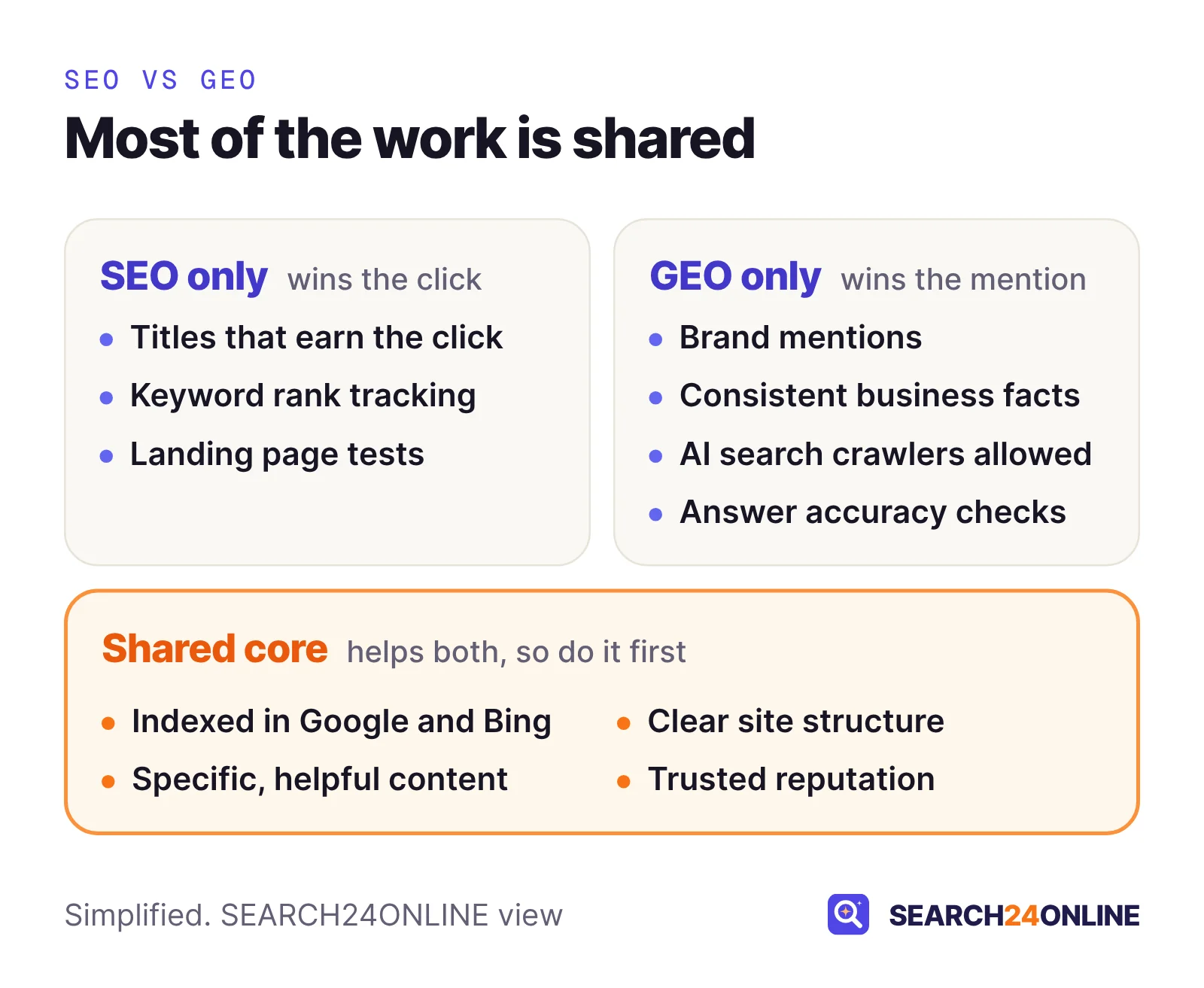
In five places: brand mentions, consistent business facts, answers to follow-up questions, access for more crawlers, and checking what the answers say. None of it is exotic, but most SEO programs we review don’t do these jobs deliberately.
1. Brand mentions, not only links
Classic link building chases links. AI answers seem to care more about how often and how widely your brand is discussed, linked or not. Ahrefs’ study of 75,000 brands found branded web mentions had the strongest correlation with AI Overview brand visibility (0.664). Branded anchor text came next (0.527), then branded search volume (0.392), Domain Rating (0.326), referring domains (0.295) and backlinks (0.218).
Ahrefs is clear that correlation is not causation. Still, the spread is wide: brands in the top quarter by web mentions averaged 169 AI Overview mentions, while those in the bottom half averaged 0 to 3. Reviews, trade press, podcasts, forum discussions and genuine roundups all count. Google warns that “seeking inauthentic ‘mentions’ across the web isn’t as helpful as it might seem,” so planted posts are out. See how to get your business mentioned in ChatGPT.
2. Consistent business facts
An assistant describes you by combining what many sources say about the same entity: your business as one distinct thing, with a name, address, services and people. When sources disagree, answers blend them. Bing’s February 2026 guidance asks site owners to keep text, images and video consistent about the same entities, and to keep address, hours and contact details current in Bing Places for location-based AI answers. Google says Business Profiles can help your products and services appear in AI responses.
A common situation: a dental practice moves to a new suite across town. The website is updated the same week, but a duplicate Google profile, two directory listings and an old insurance-network page keep the old address for years. In search results, people skip the wrong listing. In an AI answer, the wrong address can be stated as fact. Our guide to entity SEO covers the cleanup.
3. Passages that answer the follow-up questions
Google defines query fan-out as “a set of concurrent, related queries generated by the model.” Perplexity says it splits documents into “self-contained spans, each of which can be individually retrieved and ranked.” So a page built to rank for one main phrase can lose the citation to a page with a clean answer to one sub-question, such as cost, timing or how to compare options.
Google also says you don’t need to break content into tiny pieces or write in a special way for AI. The GEO work here is coverage and clarity, not formatting tricks: make sure the questions buyers ask next have clear answers somewhere on your site, under headings that say what they answer.
4. Access for more crawlers
SEO has always cared about Googlebot and Bingbot. GEO adds OAI-SearchBot, PerplexityBot and Claude-SearchBot, which are separate from the training crawlers (GPTBot, ClaudeBot) many sites block. In audits we often find a host’s or CDN’s bot protection rejecting AI search crawlers that robots.txt allows. Our guide to AI crawlers lists each bot and what blocking it does.
5. Checking what the answer says about you
SEO rarely asks whether a search result describes you correctly; the snippet is usually your own text. An AI answer summarizes you in its own words, from whatever it found, so GEO includes regular checks for wrong prices, retired services, old addresses and competitors credited with your work.
It runs the other way too. In our experience, some SEO work barely registers in AI answers: title tags and meta descriptions written to win the click, keyword-by-keyword rank tracking and landing page conversion tests. Those still pay off on Google; just don’t count them as GEO.
Where should you put your effort first?
On the shared core, because GEO-specific work has nothing to stand on without it. Our team brings over 20 years of digital marketing experience and has served 500+ brands, and the businesses missing from AI answers usually have the same problems that keep sites off page one. Work in this order:
- Get important pages indexed in Google and BingCheck Search Console’s Page indexing report and URL Inspection, and the same in Bing Webmaster Tools. Accidental noindex tags, wrong canonical tags and pages with no internal links are the usual causes.
- Fix structure and competing pagesMerge pages that target the same phrase (keyword cannibalization) and link related pages so each topic has one clear home.
- Upgrade thin and outdated contentReplace vague claims with prices or ranges, service areas, standards, turnaround times and dated, sourced figures.
- Add structured data that matches the pageIt helps machines read your business details. Google says it isn’t required for its AI features, so treat it as a clarity aid.
- Then add the GEO layerAllow AI search crawlers, align your business facts everywhere, earn mentions and start tracking prompts.
A common situation: a regional law firm has six pages that all target “personal injury lawyer” with slightly different wording. None ranks well, because they compete with each other, and none answers what clients ask next: fees, timelines, what a case is worth, what to bring to a consultation. Consolidating them into one strong page plus distinct pages for those questions helps rankings and AI citations with the same work.
Paying for AI visibility tracking or “GEO content” while key service pages are not indexed means paying to measure an absence. Check indexing in Google and Bing before anything else.
How should you split effort by business type?
By where your buyers ask their questions and how much a wrong AI answer would cost you. The splits below are our own starting points, not formulas or industry data. The percentages refer only to work that is specific to one side; the shared core counts for both and always comes first.
| Business type | SEO emphasis | GEO emphasis | Starting split (SEO / GEO) |
|---|---|---|---|
| Local services (trades, dental, legal, clinics) | Google Business Profile, map listings, local service pages, reviews | Bing Places, consistent name, address and phone, accurate hours and services in answers | 80 / 20 |
| E-commerce | Category structure, product pages, crawl control for filters | Accurate Merchant Center feeds, reviews and comparisons on other sites | 70 / 30 |
| B2B, SaaS and professional firms with long research cycles | Solution, pricing and comparison pages, technical health | Mentions in trade press and review sites, correct pricing and features in answers | 60 / 40 |
| Publishers and information sites | Original reporting, topical depth, news and Discover visibility | Being the cited source for facts, brand recognition | 60 / 40 |
Why local businesses lean on SEO
In our experience, calls for local service businesses still come mostly from map listings and local results, so the Google Business Profile and local pages carry the load. The GEO share goes on facts: if Copilot pulls your hours from Bing Places, those hours need to be right. Our local SEO guide covers the SEO side.
Why B2B firms shift toward GEO
Buyers with long, considered purchases ask comparison questions such as “best payroll software for a 50-person company”, the kind of research AI assistants handle well. Being on the shortlist the answer gives counts for a lot, and that shortlist leans on reviews and coverage outside your site. High-stakes fields such as health, legal and finance should also check answers more often, because a wrong claim about your services carries more risk.
When to change the split
Revisit it after three to six months of data. If AI referral visits convert well and citations are growing, shift effort toward GEO. If AI traffic stays tiny and your leads come from map listings, keep the weight on SEO. Either way, a budget split on paper should never mean two teams redoing the same technical work.
What should you measure for SEO and for GEO?
Keep separate scoreboards with one bottom line: leads and revenue. For SEO, the familiar measures still apply: clicks, impressions and average position in Search Console and Bing Webmaster Tools, indexing coverage, and conversions from organic search. GEO needs its own set, and every source is partial.
- Search Console’s Generative AI performance report. It counts how often links to your site were shown in AI Overviews and AI Mode, by page, country, date and device. It reports impressions only, and may not appear at all if your site has too few.
- Bing’s AI Performance report. Launched in public preview in February 2026, it counts citations across Copilot, Bing’s AI summaries and select partners, cited pages, and a sample of grounding queries (the phrases the AI searched). It does not show where in the answer you appeared.
- GA4’s AI Assistant channel. It groups visits from sources such as ChatGPT, Gemini, Deepseek, Copilot and Grok. It excludes Google’s AI Overviews and AI Mode, which GA4 counts as Organic Search. Our guide to AI traffic in GA4 shows the setup.
- A prompt panel. 25 to 50 real buyer questions, each run several times per assistant every month. Record the share of runs that mention you, cite you and describe you correctly, and which competitors and sites appear instead.
SparkToro’s Rand Fishkin concluded that “visibility % across dozens to hundreds of prompts run multiple times is a reasonable metric,” and called tools that report an AI “ranking position” “full of baloney.” We agree. Our guide to tracking brand visibility in AI answers covers building the panel.
Put leads at the top, then organic clicks, AI impressions, Bing citations, AI referral visits and your prompt-panel share. Seeing them side by side shows whether a drop in clicks is offset by AI visibility, or whether both are falling.
Do you need both SEO and GEO?
Yes, for almost every business that wants to be found online, but as one program rather than two. The shared core serves both, and the GEO-specific work is a layer on top that grows as your buyers use AI tools more. If budget forces a choice, start with SEO: it builds the indexed, trustworthy site every AI answer draws on. For the wider debate about whether AI is ending search, see Is SEO dead because of AI?
When you evaluate a provider, watch for two opposite warning signs. One is a “GEO agency” that never mentions indexing, site structure or Bing. The other is an SEO agency that treats AI answers as a passing trend and can’t tell you whether OAI-SearchBot can reach your site. Promises of a “#1 spot in ChatGPT” are a red flag on either side.
How we handle it: our SEO + GEO services run both from one plan, and every plan tracks AI questions alongside rankings. Starter tracks 25 (Google AI and ChatGPT), Growth 75 (adding Perplexity, Gemini and Copilot) and Authority 200 (adding Claude); details are on our pricing page. To see where your site stands first, our free SEO + GEO report analyzes your website and gives you password-protected dashboard access within 24 hours. Nobody can promise a place in Google’s results or in an AI answer, but you can make sure your business deserves one and is easy to find.
Common questions
Is GEO replacing SEO?
No. AI assistants that link to sources mostly pull them from search indexes, so the crawling, indexing and content work of SEO is what makes GEO possible. GEO adds jobs on top, such as earning brand mentions and checking what AI answers say about you.
Can I do GEO without doing SEO?
Not effectively. Google says a page must be indexed and eligible to show a snippet before its AI features can link to it, and ChatGPT, Copilot, Perplexity and Claude also search an index before they cite anything. A page no search engine has indexed cannot be cited.
If I rank number one on Google, will ChatGPT mention my business?
Not necessarily. Ranking gets you into the pool of candidates, but Ahrefs found in March 2026 that about 62% of URLs cited in Google’s own AI Overviews did not rank in the top 10 for the original query. ChatGPT draws on its own crawler and on other search providers that OpenAI does not name.
Should I hire a separate agency for GEO?
Usually not. Because most of the work is shared, two vendors tend to duplicate the technical and content work and argue over credit. One team that covers both, and reports SEO and AI visibility separately, is simpler and cheaper for most businesses.
How much of my budget should go to GEO?
For most businesses, a minority of the effort on top of a shared core. Our starting points range from about 20% GEO-specific work for local service businesses to about 40% for B2B firms whose buyers research with AI tools, adjusted after a few months of measurement.
Sources
- Google Search Central: Optimizing your website for generative AI features on Google Search
- Search Console Help: Generative AI performance report (Search)
- Microsoft Learn (updated October 29, 2026): Data, privacy, and security for web search in Microsoft Copilot and Microsoft Copilot Chat
- Bing Webmaster Blog (February 10, 2026): Introducing AI Performance in Bing Webmaster Tools Public Preview
- OpenAI Help Center: Searching the web with ChatGPT
- OpenAI: Overview of OpenAI crawlers
- Perplexity (September 25, 2025): Architecting and evaluating an AI-first search API
- Claude Help Center: Does Anthropic crawl data from the web, and how can site owners block the crawler?
- Ahrefs (March 2, 2026): How many AI Overview citations come from top-10 rankings
- Ahrefs: An analysis of AI Overview brand visibility factors (75K brands studied)
- Google Analytics Help: Default channel group
- SparkToro (January 27, 2026): AIs are highly inconsistent when recommending brands or products
See how your site does on Google and in AI answers — free.
We’ll analyze your website for both the shared SEO foundations and the GEO basics, create your SEO + GEO report and give you password-protected dashboard access to view it.
Free · No obligation · We only review your public pages.