
SEO for Dentists: Getting Found on Google and in AI Answers
A practical guide for US dental practices: how patients search, how to set up your Business Profile by specialty, what treatment pages and dentist bios need, how to answer reviews without a HIPAA problem, and how to track the calls and bookings that matter.
Key takeaways
- SEO for dentists is local SEO plus the trust bar of health content: a Business Profile set up for your specialty, one page per treatment, dentist bios with real credentials, reviews answered without disclosing patient information, and tracking of calls and bookings.
- Google says its systems give “even more weight” to strong E-E-A-T on topics that could significantly affect health, and that such content must be highly accurate and consistent with expert consensus.
- HHS settled with a California dental practice for $23,000 in 2022 after it revealed patients’ names, treatment and insurance details in replies to online reviews. A reply should never confirm that the reviewer is a patient.
- A March 2026 KFF poll found 32% of US adults used AI chatbots for health information in the past year. Google says AI Overviews and AI Mode need no special optimizations: indexed, clear, accurate pages are the way in.
On this page
How do patients look for a dentist today?
Patients search in three different situations, and each is won by a different asset. Someone with a cracked molar on a Saturday wants a practice that is open, close and answers the phone. A family that just moved wants a dentist who takes their plan and has good reviews. Someone weighing implants or aligners wants to understand the treatment, the cost and who will do it before booking anything.
| Situation | Typical search | What decides the click | What wins it |
|---|---|---|---|
| Urgent | “emergency dentist open now”, “tooth pain Saturday” | Hours, distance, a phone that answers | Business Profile with accurate hours, an emergency page, a working call button |
| Routine | “family dentist [town]”, “dentist near me that takes my PPO” | Plans accepted, reviews, new-patient openings | Profile and reviews, an insurance page, online booking |
| Researched | “implant vs bridge”, “clear aligners cost”, “does a root canal hurt” | A clear explanation, a price range, who performs it | Treatment pages, dentist bios, honest answers to common questions |
The researched group increasingly asks an AI assistant first. KFF’s Tracking Poll on Health Information and Trust, published March 25, 2026 and based on 1,343 US adults, found that 32% had turned to AI chatbots for health information in the past year. Of those, 41% said a major reason was to look up information before deciding whether to see a provider. Your pages decide whether that answer points to you.
The general mechanics, such as how Google weighs relevance, distance and prominence, are in our complete local SEO guide. This guide covers what is different for a dental practice.
Which Business Profile categories should a dental practice choose?
Choose one primary category that says what the practice is, add secondary categories only for services or departments that really exist, and confirm the exact label in the Business Profile editor. Google says the categories you select affect your local ranking. Its guidelines say a category should complete the sentence “This business IS a”, not “HAS a”, and ask for as few categories as possible, as specific as possible. Adding or editing one can trigger re-verification.
Google does not publish its category list as a help page, and the labels change and vary by country. Third-party category references, such as GBPly’s (last reviewed August 2026), list US labels including Dentist, Cosmetic dentist, Orthodontist, Dental implants periodontist and Emergency dental service. For other specialties, type the specialty into the category field and pick the label Google suggests. Don’t copy a label from a blog post, this one included, without checking it in the editor.
| Practice type | Primary category | Secondary, only if true |
|---|---|---|
| General or family practice | Dentist | Cosmetic dentist if cosmetic work is a real focus; Emergency dental service only if you see same-day emergencies during listed hours |
| Orthodontic practice | Orthodontist | Usually none |
| Periodontal or implant practice | The periodontics label Google offers | Dental implants periodontist |
| Pediatric practice | The pediatric dentistry label Google offers | Usually none |
| Multi-specialty group | What most patients come for | One per specialty department that is staffed |
A word on “specialist”. The ADA’s National Commission on Recognition of Dental Specialties and Certifying Boards recognizes 12 specialties, including endodontics, oral and maxillofacial surgery, orthodontics, pediatric dentistry, periodontics and prosthodontics. A general dentist who places implants is not a periodontist. Use a specialty category only when someone in the practice holds that specialty, and check your state dental board’s advertising rules before using the word specialist anywhere.
Profiles for individual dentists
Google lets a practitioner have their own profile if they work in a public-facing role and can be contacted at the verified location during stated hours. In a practice with several dentists, the practice keeps its location profile and each dentist’s profile uses only their name, with a title or credential such as “Dr.” allowed. A sole dentist at a branded practice shares one profile, named in the format “[Practice]: [Dentist name]”. Google rules out one profile per specialization and profiles for support staff.
A four-dentist practice where an associate left two years ago, but her practitioner profile still shows the practice’s address and phone number. Patients who search her name call the old office, and the profile collects reviews nobody answers. Check every profile at your address once a year, not just the practice’s own.
Verification, the description, photos, hours and posts are covered step by step in our guide to optimizing your Google Business Profile. One dental-specific point: Google says health and beauty businesses can add a booking button, so connect your online scheduling if you offer it.
What makes a treatment page rank and convert?
Give every treatment patients search for its own page, written for the patient who is deciding, and make it specific to your practice. A single “Services” page listing 20 treatments gives Google and AI assistants nothing to match to “same-day crowns in [town]” or “sedation for wisdom teeth removal”.
Start with the treatments that bring searches and revenue: implants, clear aligners, crowns, root canals, wisdom teeth, veneers and whitening, dentures, emergency care, children’s dentistry and sedation. Each page needs eight things:
- The answer firstWhat the treatment is and who it is for, in two sentences.
- What happensNumber of visits, time in the chair, numbing or sedation options, recovery.
- Risks and alternativesHonest trade-offs, such as an implant versus a bridge for one missing tooth.
- Cost and coverageA realistic range or what drives the price, how insurance usually treats it, and a link to financing.
- Who does it hereThe dentist’s name and training, linked to their bio, and equipment only if you really have it.
- ProofBefore-and-after photos used with written authorization, and relevant reviews.
- Questions patients askFour to six real questions collected from the front desk, each answered in a short paragraph.
- Reviewed by and datedWhich dentist reviewed the page, and when.
In audits of dental sites we often find two problems together. The first is thin template copy: a 200-word “Root Canal Therapy” page that appears almost word for word on other practices’ sites because it came with the website package. The second is keyword cannibalization, meaning pages that compete with each other: an implant service page, an ads landing page and three blog posts all targeting “dental implants [city]”, with none clearly the best answer.
The fix is one main page per treatment. Merge the overlapping posts into it, or rewrite them to answer distinct questions such as how long implants last, and link them to the main page. Keep ads landing pages out of the index with a noindex tag so they stop competing with the page you want to rank.
Why do dentist bios and credentials matter for SEO?
Because dental content is health content, and Google holds health content to a higher bar. Google’s helpful content guidance says its systems give “even more weight to content that aligns with strong E-E-A-T” on topics that could significantly affect health, which it calls “Your Money or Your Life” (YMYL) topics. E-E-A-T stands for experience, expertise, authoritativeness and trust, and Google says trust matters most. It also asks whether bylines lead to background information about the people who wrote the content.
For a practice, the dentists are the expertise. Yet in audits we often find bios that say “Dr. Smith loves helping patients smile” and nothing about where Dr. Smith trained. A bio that does its job lists:
- The degree (DDS or DMD), dental school and graduation year.
- The state license, with a link to the state board’s public license lookup.
- Any residency, specialty program or board certification.
- The treatments they perform, and continuing education relevant to them.
- Professional memberships, languages spoken and a real, current photo.
- Links to the treatment pages and articles they have reviewed.
Then connect the pieces. Each treatment page names who performs it and links to that bio, and each clinical article carries a line such as “Reviewed by Dr. Ana Ruiz, DMD, November 2026”, but only if she actually reviewed it. Google’s guidance treats deceptive authorship as a sign of low quality. Structured data can describe each dentist and location for machines; Google’s AI features guidance asks that it match the visible text on the page.
In September 2025, HHS’s Office for Civil Rights announced a $182,000 settlement with Cadia Healthcare Facilities, a group of Delaware care providers. A website “success story” showed a patient’s name, photograph and treatment details without a valid written HIPAA authorization, and OCR found the information of 150 patients had been disclosed through the same program. The same rule applies to before-and-after photos and patient videos.
Medical clinics face the same trust rules with more specialties and more regulation; see our guide to SEO for medical clinics and healthcare practices.
How do you reply to reviews without breaking HIPAA?
Reply to reviews, but never confirm in public that the reviewer is a patient, and never mention their care, insurance or bill. How to earn more reviews within Google’s rules and the FTC’s is covered in our guide to getting more Google reviews; this section is about the replies.
HHS has enforced this against a dental practice. In December 2022 its Office for Civil Rights announced that New Vision Dental in California would pay $23,000 and follow a corrective action plan for two years. The practice had disclosed patients’ names, treatment information and insurance information in responses to online reviews. The OCR director put it plainly: “Providers cannot disclose protected health information of their patients when responding to negative online reviews.”
The trap is setting the record straight. A reviewer complains about a bill, and someone replies: “Our records show you missed two appointments and your insurer denied the claim.” Every clause in that sentence is protected health information.
Replies that are safe to post
- Positive review: “Thank you for taking the time to write this. We’ll share it with the team.” Not “So glad your implant healed well”, which confirms treatment.
- Negative review: “We take every concern seriously. Privacy rules stop us from discussing anyone’s care online, but our practice manager would like to talk. Please call [number].”
- Suspected fake review: post the same neutral reply and report the review to Google. Saying “you were never our patient” means you checked your records and are sharing the result.
Our rule for practices: one trained person posts replies, from a written policy. That mirrors what OCR required in the Cadia settlement: written policies, and training for the whole workforce, marketing staff included.
What insurance and financing content should you publish?
Publish what patients ask the front desk: which plans you are in network with, what happens if you are out of network, what common treatments cost, and how financing works, including the catch. These pages answer searches with high intent, such as “dentist near me that takes [plan]”, and they remove the most common reason people hesitate to book.
- An insurance page: list the carriers and specific networks you are in, with a “last checked” date. Explain whether you file claims for out-of-network patients, and say plainly if you accept Medicaid or CHIP.
- An uninsured section: describe your in-house membership plan if you have one, with what it covers.
- Prices: give ranges or starting prices for common treatments, or at least explain what moves the price. Our view: practices that publish honest ranges are the ones able to answer “how much does an implant cost in [city]” for patients and for AI assistants.
Financing needs the most care. The Consumer Financial Protection Bureau’s May 2023 report on medical credit cards found the typical card charged a 26.99% APR. Many offer deferred interest: if the balance is not paid in full by the end of the promotional period, interest is charged on the original amount from the purchase date. The report’s own example is a $2,400 root canal and crown on a six-month promotion. It also cites a 2013 New York Attorney General document stating that about 65% of medical credit cards are opened in providers’ offices.
If a plan uses deferred interest, don’t call it “interest-free”. One plain sentence (“If the balance isn’t paid in full by the end of the promotion, interest is charged from the purchase date”) and a link to the lender’s terms protect patients and the practice’s reviews.
Which local links help a dental practice?
The links worth having come from real relationships: specialists who refer to you, schools and teams you support, local media that quote your dentists, and professional bodies you belong to. Citations and directory listings, the basics, are covered in the local SEO guide; these are the dental-specific sources.
- Referral partners: endodontists, oral surgeons, orthodontists and pediatricians you send patients to and receive them from. A “practices we work with” page is useful to patients and earns links in return.
- Training and membership: dental school and residency alumni pages, and state or local dental society member directories.
- Community: school oral-health talks, mouthguard fittings for local sports teams, and sponsorships that come with a real page about what you did.
- Local media: offer a dentist for seasonal stories, such as back-to-school checkups, Halloween candy or sports injuries.
Avoid link packages. In audits we often find dental sites with hundreds of links from unrelated blogs and foreign directories, and almost none from their own town. That unnatural backlink profile adds risk and does little for a practice whose patients live nearby.
What do patients ask AI assistants, and how do you show up?
Patients ask AI assistants the questions they hesitate to ask at the front desk, and local questions with conditions attached. Questions such as “Does getting a crown hurt?”, “Is an implant or a bridge better for one missing back tooth?”, “Which dentists near me are open Saturday and take my PPO?” and “Is there a kid-friendly dentist nearby who offers sedation for anxious children?” are typical.
Google says there are “no additional requirements to appear in AI Overviews or AI Mode, nor other special optimizations necessary.” A page must be indexed and eligible to show in Search with a snippet. Google’s best-practice list for these features includes structured data that matches the visible text and an up-to-date Business Profile.
Our view: the practices that appear in these answers are the ones whose pages answer the question in plain words, and whose facts (hours, plans accepted, treatments, dentists) are identical on the website, the Business Profile and the main directories. When they disagree, none of them looks reliable.
- Answer the real questionsAdd the front-desk questions to each treatment page, with direct answers.
- Say when to come inKFF found 42% of people who asked chatbots about physical health didn’t follow up with a health professional. State clearly which symptoms need a same-day visit.
- Keep facts identical everywhereSame hours, plans and dentist names on site, profile and directories.
- Ask the questions yourself monthlyRun ten patient questions in ChatGPT, Gemini, Perplexity and Google AI Mode, and note which practices and pages are cited.
How do you track calls and bookings from search?
Count what a practice cares about, new-patient calls and booked appointments, from three places: Business Profile performance, website analytics and your practice management system. And keep patient information out of advertising and analytics tools.
Business Profile performance counts calls as clicks on the call button, plus direction requests and website clicks. Bookings appear only when they are managed through a booking provider, and the search terms people used update at the start of each month. Add UTM tags (tracking parameters) to the profile’s website link so analytics separates profile visits from other Google traffic. To see visits from ChatGPT and other assistants, follow our guide to AI traffic in GA4.
Where HIPAA meets analytics
HHS’s bulletin on online tracking technologies, first issued in 2022, still applies in part. On June 20, 2024, a federal court in Texas vacated the portion saying that connecting a visitor’s IP address to a visit to an unauthenticated public page about health conditions or providers triggers HIPAA. HHS appealed, then voluntarily dismissed the appeal on August 29, 2024, so that ruling stands. What remains says tracking on logged-in pages such as patient portals must follow HIPAA, and that pages used to schedule appointments can involve protected health information. Cookie banners do not count as authorizations, and a tracking vendor that qualifies as a business associate needs a business associate agreement.
No advertising pixels on booking forms, appointment requests or the patient portal. Count a booking as an anonymous event on a thank-you page with no names or reasons for the visit in the URL, then compare monthly with new-patient numbers in your practice management system. Keep the main office number on the profile, since Google requires a number under your direct control that connects to the location, and check any setup with your HIPAA counsel.
Where should a dental practice start?
Start with what loses patients today: a profile with the wrong category or a stale listing, then missing or thin treatment pages, then the trust signals, links and AI visibility. The checklist below is the order we work in.
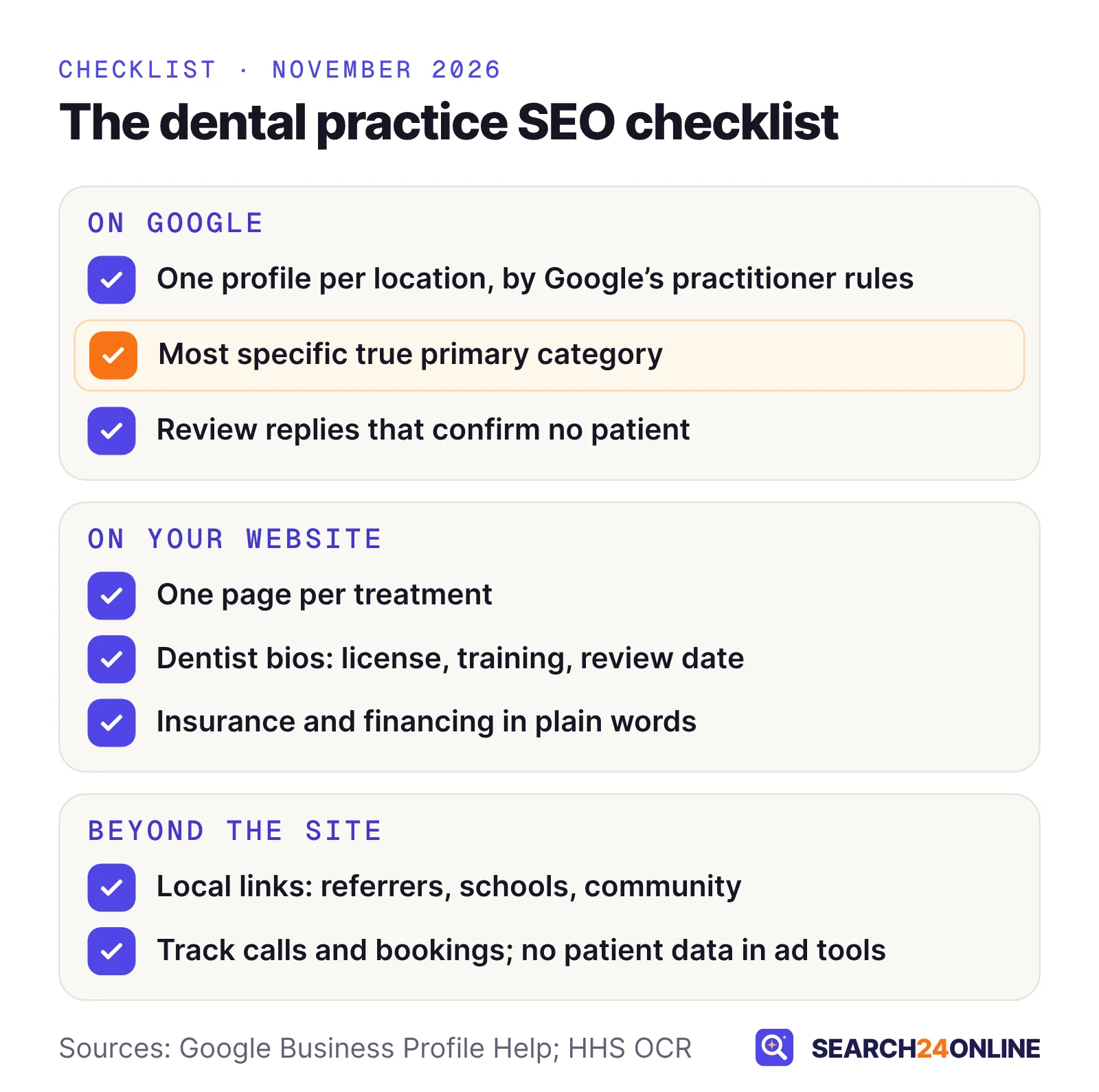
Our team has served 500+ brands, and the most common pattern we see is a business with good services but poor visibility because of fixable gaps in technical setup, site structure and content. A dental practice is no exception. No one can promise a map pack position or an AI mention. You control whether your practice is accurately described, easy to verify and the clearest answer to your patients’ questions.
To see where your site stands, our free SEO + GEO report analyzes your website, including indexability, structured data, click-to-call, business details and trust pages, and gives you password-protected dashboard access within 24 hours. For ongoing work, see our SEO + GEO services.
Common questions
Should every dentist in our practice have their own Google Business Profile?
Only dentists who see patients and can be reached at your verified address during your listed hours qualify, under Google’s guidelines for individual practitioners. Their profile uses their own name (a title or credential such as Dr. is allowed), not the practice name, and the practice keeps its own location profile. A solo dentist at a branded practice shares one profile named in the format Practice name: Dentist name.
Is replying to a Google review a HIPAA violation?
No, replying is allowed; disclosing protected health information in the reply is not. HHS fined a California dental practice $23,000 in 2022 for naming patients and mentioning their treatment and insurance in review replies. Keep replies general, never confirm that the reviewer is a patient, and move the conversation to a phone call.
Can we post patient before-and-after photos on our website?
Yes, with the patient’s valid written HIPAA authorization for that marketing use, obtained before you post. In September 2025 HHS announced a $182,000 settlement with a group of Delaware care providers that published a patient’s name, photo and treatment details in a website success story without one.
Do dentists need special schema or an llms.txt file to appear in AI answers?
No. Google says there are no additional requirements or special optimizations for AI Overviews or AI Mode; a page must be indexed and eligible to show with a snippet. Clear treatment pages, consistent practice details and structured data that matches the visible text are what we recommend.
Can a general dentist call themselves an implant or cosmetic specialist?
Be careful: the ADA’s national commission recognizes 12 dental specialties, and cosmetic dentistry is not one of them. Describe what a general dentist does and the training they have, and check your state dental board’s advertising rules before using the word specialist.
Sources
- HHS Office for Civil Rights (December 14, 2022): Settlement with dental practice over disclosures of patients’ protected health information
- HHS Office for Civil Rights (September 30, 2025): OCR settles HIPAA case with Cadia Healthcare Facilities
- HHS: Use of Online Tracking Technologies by HIPAA Covered Entities and Business Associates
- American Bar Association Health Law Section (September 2024): HHS voluntarily dismisses appeal in online tracking technology lawsuit
- Google Business Profile Help: Guidelines for representing your business on Google
- Google Business Profile Help: Manage your business category
- Google Business Profile Help: Business Profile performance
- GBPly: Google Business Profile categories (industry examples, reviewed August 2026)
- Google Search Central: Creating helpful, reliable, people-first content
- Google Search Central: AI features and your website
- National Commission on Recognition of Dental Specialties and Certifying Boards: Recognized dental specialties
- KFF (March 25, 2026): Poll: 1 in 3 adults are turning to AI chatbots for health information
- Consumer Financial Protection Bureau (May 2023): Medical credit cards and financing plans
Is your practice’s website ready for new patients? Check it free.
We’ll analyze your website, including click-to-call, business details and structured data, create your SEO + GEO report and give you password-protected dashboard access to view it.
Free · No obligation · We only review your public pages.