
SEO for Accountants and CPA Firms: Service Pages, Tax-Season Content and Trust
A practical plan for tax, bookkeeping and advisory practices: the pages to build, when to publish, how to show credentials, and the advertising rules your website, reviews and AI visibility have to respect.
Key takeaways
- SEO for an accounting firm means one page per service and per client type, a Google Business Profile that meets Google’s eligibility rules, content published ahead of each tax deadline, and wording that stays within professional advertising rules.
- Demand for professional help builds late: IRS filing statistics show self-prepared returns led through February 27, 2026, but from February 28 to April 17 tax professionals e-filed 49.8 million returns against 37.0 million self-prepared.
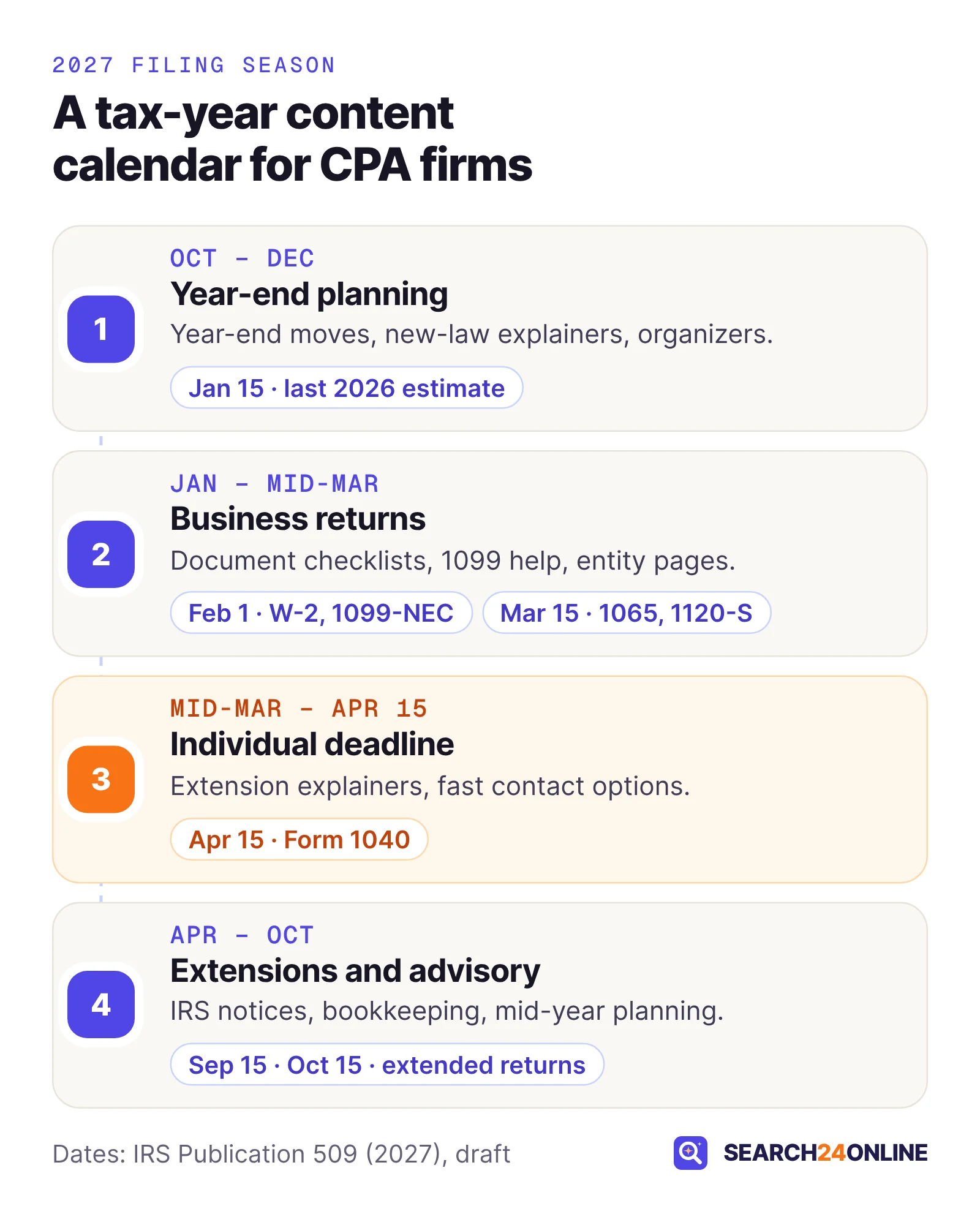
- For the 2027 filing season, the IRS draft tax calendar lists February 1 for W-2s and 1099-NEC, March 15 for partnership and S corporation returns, and April 15 for individual returns.
- The AICPA Code’s advertising rule (ET 1.600.001), your state board’s rules and Circular 230 §10.30 all bar false, misleading or deceptive claims, and in our reading they reach your website and online ads, not just print.
- AI chatbots still get tax details wrong: a March 2026 NerdWallet test of ChatGPT, Gemini and Perplexity found outdated and faulty information, which makes dated, specific pages from credentialed authors more valuable.
On this page
What does SEO look like for an accounting firm?
For a CPA or accounting firm, SEO comes down to four jobs. Give each service and each type of client its own page, make the firm eligible and visible in Google’s local results, publish content before each tax deadline rather than during it, and show the credentials behind the advice. All of it has to stay within the advertising rules your profession already lives by.
Accounting is also a trust purchase. Google says its systems give extra weight to experience, expertise, authoritativeness and trust on topics that “could significantly impact the health, financial stability, or safety of people,” and tax advice is squarely in that group. A prospect handing over bank statements and Social Security numbers behaves the same way: they check who you are before they call.
When we audit accounting websites, the same handful of problems comes up. There is one “Services” page that lists tax preparation, bookkeeping, payroll and advisory in a single block, so no page clearly matches any one search. The blog is full of posts about tax rules from several years ago, with old amounts and no update date. Industries the firm specializes in appear only as logos or a line on the About page. And the Business Profile, the site and the directories list slightly different names and suite numbers. None of these is hard to fix, but together they explain why a well-regarded firm can be close to invisible in search.
How should you structure tax, bookkeeping and advisory pages?
Build one page per service, because the people searching for each one want different things and buy at different times. Someone searching for tax preparation in February needs to know whether you have capacity, what to bring and roughly what it costs. Someone searching for an outsourced CFO wants proof you understand businesses like theirs, and will take weeks to decide.
| Tax preparation | Bookkeeping and payroll | Advisory and CFO services | |
|---|---|---|---|
| Typical searcher | Individuals and small business owners, often local | Owners whose books are behind or growing | Owners and finance leads of established businesses |
| When demand peaks | January to April, again before extended deadlines | Year-round, with spikes before filing deadlines | Year-round; planning questions in the fall |
| What the page must answer | Who you serve, documents needed, timeline, how fees work | Software you support, cleanup vs monthly service, what is included | Problems you solve, industries, how engagements run, who does the work |
| Best next step | Book an appointment or upload documents | Request a quote after a short form | A scoping call with a named partner |
Advisory sits in the highlighted column because it usually has the highest value per client and the weakest pages. Firms describe it in abstract terms (“strategic guidance to help you grow”) that match nothing anyone types. Describe the problems instead: cash-flow forecasting, pricing for a second location, preparing for a bank loan, choosing an entity. Advisory is closer to B2B selling than to retail tax prep, with several decision makers and a long consideration period; our guide to B2B SEO covers how to build pages for that kind of buyer.
Fees on service pages
Prospects want a price signal, and a “starting at” figure filters out poor fits. Two rules shape how you word it. Circular 230 §10.30, which covers practitioners before the IRS, lets you publish fixed fees, hourly rates and fee ranges, but says published rates must be honored for at least 30 days after they were last published. Texas’s board rule on advertising lists fee statements that leave out variables likely to affect the final fee among its examples of misleading claims. In practice: state what the starting price includes, name what raises it (extra schedules, multiple states, prior-year cleanup), and date the page.
How do you position by industries served without thin pages?
Pick the two to five industries where you already have real client depth, and give each one a page that shows knowledge a generalist could not fake. Industry positioning is often the fastest way for a firm to stand out, because “CPA for dentists” or “accountant for construction companies” faces far fewer competitors than “CPA near me”, and those searchers arrive half-convinced.
A useful industry page names the specific issues that sector brings to you: job costing and retainage for contractors, multi-state payroll for remote-first companies, the new tips deduction for restaurant staff, grant accounting for nonprofits. It explains how your process adapts, which software you work in, and who on the team leads that niche. It links to two or three in-depth articles on that industry’s recurring questions. If you can describe a typical engagement in anonymized terms, do so, and keep it accurate.
The thin version is a template with the industry name swapped in: same paragraphs, same stock photo, a list of generic services. Ten of those add little and, in our experience, weaken the site as a whole. A common situation we see: a firm with twelve industry pages, nine of them near-identical, and the three it actually specializes in buried among them. Cutting to the real three and making them substantial usually does more than adding a thirteenth.
How do you plan content around the tax calendar?
Our rule of thumb: publish each seasonal piece four to eight weeks before the deadline it serves, then refresh it every year with new dates and amounts. Search engines need time to find and rank a page, and a deadline guide that goes live the week of the deadline mostly helps next year’s site.
The IRS’s own figures show when people turn to professionals. In the 2026 filing season, self-prepared returns were ahead through February 27: 27.8 million e-filed self-prepared returns against 23.1 million from tax professionals. By April 17 the picture had flipped, with 72.8 million returns e-filed by professionals and 64.8 million self-prepared. Our calculation from those two IRS releases shows how the share moved.
Share of e-filed individual returns submitted by tax professionals, 2026 filing season
SEARCH24ONLINE calculation from IRS cumulative filing season statistics for the weeks ending February 27 and April 17, 2026 (23.1M of 50.9M e-filed returns, then 49.8M of 86.7M). Individual returns only.
The practical reading: early filers with simple returns do it themselves, while people with complications, late documents or business income come to professionals from March onward. Your capacity, contact and extension pages should be strongest exactly then.
Key dates for the 2027 filing season
The IRS’s draft of Publication 509 for 2027, dated August 24, 2026, lists these dates for calendar-year filers. Treat them as provisional until the final version is out, and check them again before you publish.
- January 15, 2027: final installment of 2026 estimated tax.
- February 1, 2027: W-2s to employees, and Form 1099-NEC for nonemployee compensation.
- March 15, 2027: 2026 partnership (Form 1065) and S corporation (Form 1120-S) returns.
- April 15, 2027: 2026 Form 1040 and Form 1120 returns, and the first 2027 estimated tax installment.
- September 15 and October 15, 2027: extended partnership and S corporation returns, then extended individual returns.
Law changes add a layer on top of the calendar. The 2025 tax law, which the IRS now calls the Working Families Tax Cuts, created new deductions for tips, overtime, car loan interest and seniors that run from 2025 through 2028. The 2027 season is the second in which clients claim them, so a clear, dated explainer for the clients you actually serve (restaurant staff, hourly workers, retirees) is the kind of page worth writing in the fall.
How do you show credentials and E-E-A-T on an accounting site?
Show who wrote each piece of advice, what license they hold, and how a reader can check it. Google’s guidance on helpful content says trust is the most important part of E-E-A-T and recommends accurate bylines where readers expect them; it warns against made-up author profiles. For a firm, that translates into a few concrete changes.
- Byline every guideName the CPA or enrolled agent who wrote or reviewed it, with credentials, and link to their profile page.
- Build real team pagesEach profile lists licenses and the states they are held in, years in practice, industries served and professional memberships.
- Make licenses checkableLink to your state board’s license lookup so a prospect can confirm a license is active.
- Date and updateShow “Updated for the 2027 filing season” only when someone has actually revised the figures, and keep the change visible.
Credentials also limit what you can say. Circular 230 says enrolled agents may not use the term “certified” or imply an employment relationship with the IRS, though they may describe themselves as enrolled to practice before it. Texas’s rule lists implying education, credentials or licensing not supported by fact as misleading. A firm with CPAs and non-CPA staff should make sure “our CPAs” on a page really means licensed CPAs.
Schema markup describing your firm’s name, address, phone and services helps machines read the basics, but it does not replace visible content or prove expertise. Our schema markup guide covers which types are worth adding.
How do you rank locally and still win virtual clients?
Use your Google Business Profile and local pages for clients near your office, and use service pages, industry pages and content for everyone else. The two audiences find you in different places, and trying to make the local tools stretch to a national client base is where firms get into trouble.
What Google allows on the Business Profile
Google’s guidelines say a business needs a physical location customers can visit, or must travel to customers. A rented mailing address where you don’t operate is not eligible, and a co-working space qualifies only if it has clear signage, receives customers during business hours and is staffed by you then. So a fully remote firm with no staffed office generally cannot have a profile, and creating one at a virtual office address risks suspension.
For firms with an office, the practitioner rules matter. Google lets individual professionals have their own profiles if they can be contacted at the verified location during stated hours. When several practitioners share an office, the organization should have its own profile, separate from theirs. A solo CPA practicing under a firm brand is better off sharing one profile with the firm, named in the format “[brand]: [practitioner name]”. Our local SEO guide covers categories, reviews and citations in depth.
Reaching clients beyond your city
Virtual clients search by problem and niche, not by city: “accountant for Shopify sellers”, “S corp tax preparation for consultants”, “bookkeeping cleanup for a nonprofit”. Your industry pages and in-depth guides do the work here. Resist the urge to create a page for every state or city you might serve; near-identical location pages rarely rank and can look like doorway pages. If you genuinely serve clients in another state, one page explaining how remote engagements work, how documents are exchanged securely and where your CPAs are licensed is more convincing. Licensing and practice-privilege rules vary by state, so confirm yours before promoting services elsewhere.
How should a CPA firm get and answer reviews?
Ask every client for a review through the same simple process, and reply without ever confirming that the reviewer is a client or mentioning their affairs. The asking part follows Google’s normal rules; the replying part is where accountants carry more risk than most businesses.
Google’s content policy says businesses may not offer incentives for reviews, discourage negative ones or selectively solicit positive ones, which rules out the common “happy clients only” filter. It also removes reviews based on a conflict of interest, such as current or former employment, so staff should not review the firm. Our guide to getting more Google reviews has request templates and timing.
The AICPA Code has a Confidential Client Information Rule (ET 1.700.001), and the tax code penalizes preparers who disclose return information. The IRS lists a $250 penalty per unauthorized disclosure under IRC 6713, capped at $10,000 a year, and a misdemeanor under IRC 7216 for knowing or reckless disclosure. A reply such as “we filed your extension on time” confirms a client relationship and a detail of their return.
A safer reply to a negative review thanks the reviewer, says the firm takes every concern seriously, notes that confidentiality rules prevent discussing any client matter publicly, and gives a phone number or email for a private conversation. It reads less satisfying than a point-by-point rebuttal, but future clients notice that you protect privacy even under pressure.
Some state boards also regulate testimonials. Texas lists testimonials or endorsements that cannot be verified, and self-praise that cannot be verified, among its examples of misleading advertising. Before you put quotes from clients on your own site, check your board’s rules and keep the evidence behind each one.
Which advertising rules apply to a CPA firm’s website and SEO?
Three layers apply, and in our reading all of them cover web pages, online ads and social posts, not just print advertising. The common thread is simple: no false, misleading or deceptive claims.
- The AICPA Code of Professional Conduct. Section 1.600.001, the Advertising and Other Forms of Solicitation Rule, applies to AICPA members in public practice and prohibits seeking clients through advertising or solicitation that is false, misleading or deceptive.
- Your state board of accountancy. State rules bind licensees whether or not they belong to the AICPA, and they can be more detailed. Texas’s rule 501.82 lists examples that read like a checklist for marketing copy: claims that create false or unjustified expectations of favorable results, implying an ability to improperly influence a court or agency, untrue comparisons with other accountants. It also requires keeping copies of electronic or direct-mail communications, and a list of recipients, for at least 36 months.
- Circular 230, §10.30. For anyone practicing before the IRS, it bars false, fraudulent, coercive, misleading or deceptive statements in any IRS matter and requires keeping copies of direct mail and e-commerce communications, with a list of recipients, for at least 36 months.
Translated into SEO terms, a few habits keep you safe. Avoid superlatives you cannot prove (“the best CPA in Austin”) in titles, headings and ad copy. Don’t promise outcomes such as audit-proof returns or guaranteed refunds. Keep dated copies of landing pages and email campaigns, since a website change can wipe out the version a complaint refers to. Brief anyone writing for you, including an agency, on these limits, because the license at risk is yours.
This is a general overview, not legal or ethics advice. Rules differ by state and change over time. Your state board, your state CPA society and the AICPA’s ethics resources are the right places to confirm what applies to your firm.
Which lead magnets work for accounting firms?
The best lead magnets are tools clients would otherwise ask you for by email, tied to a deadline so they have a reason to download now. In our experience these perform well for accounting firms:
- A tax document checklist or organizer for individuals or a specific niche, released in December or January.
- A deadline calendar for business owners, with estimated tax, payroll and return dates for the year.
- An entity choice worksheet for new business owners weighing an LLC against an S corporation election.
- A year-end planning checklist released in October or November, when planning questions start.
- A bookkeeping health check: a short self-assessment that ends with an offer to review the books.
Keep the explanatory content on open, indexable pages and gate only the downloadable tool, so search engines and AI assistants can still read and cite your expertise. Ask only for what you need (name and email), and do not request tax details through a marketing form.
How accurate are AI answers on tax questions, and what should your firm do?
Good on basics, unreliable on specifics. In a March 2026 analysis, NerdWallet put seven tax questions to ChatGPT, Gemini and Perplexity, producing 63 transcripts. The chatbots nearly aced questions adapted from an IRS enrolled agent practice quiz, but in open-ended scenarios they gave a standard deduction off by nearly $3,000, said $10,000 of overtime pay wasn’t deductible, and recommended filing in the wrong state. Repeated prompts gave different answers. NerdWallet’s advice was to verify answers with the IRS or a tax professional.
That gap is a chance for your firm. AI assistants and Google’s AI Overviews pull from pages they can read, and they need sources that state current figures clearly. There is no special trick here; in our view the work is ordinary good content, done carefully:
- State the tax year next to every amount and threshold (“for 2026 returns filed in 2027”).
- Answer the question in the first sentence under each heading, then explain the conditions and exceptions.
- Link to the IRS form, publication or notice behind each figure.
- Show the author’s credentials and the date someone last checked the numbers.
- Remove or update last year’s figures instead of leaving outdated pages live.
Our guide on writing content AI assistants want to quote goes deeper on structure. If you want to see where your own site stands, our free SEO + GEO report analyzes your website, including AI crawler access, structured data and local trust signals. It ranks each issue from critical to low.
Common questions
How long does SEO take to work for an accounting firm?
Expect several months before new pages bring steady inquiries, and plan around the tax calendar rather than a fixed date. A page about extensions published in late March has little time to be found, while the same page published in January can be indexed and earning links before demand peaks.
Should a CPA firm publish its prices online?
Publishing starting prices helps qualify leads, but word them carefully. Circular 230 says published fee rates must be honored for at least 30 days after they were last published, and some state boards, Texas among them, treat fee statements that leave out likely cost variables as misleading.
Can an enrolled agent or bookkeeper use the same SEO approach as a CPA firm?
Mostly yes: service pages, industry pages, a Business Profile and seasonal content work the same way. The wording rules differ. Circular 230 bars enrolled agents from using the term certified, and state board rules such as Texas’s treat implying credentials or a license you do not hold as misleading.
Is it worth paying for directory listings aimed at accountants?
Only where prospects actually use the directory or a professional body runs it. Accurate name, address and phone details matter more than the number of listings, and paid directories rarely replace a strong Business Profile and service pages.
Do accounting firms need a blog?
They need useful content, which does not have to be a weekly blog. A small set of well-kept guides tied to deadlines, new rules and the industries you serve usually does more than frequent generic posts, and each guide should be updated and dated every filing season.
Sources
- AICPA Code of Professional Conduct (updated through July 2026), ET 1.600.001 and 1.700.001, copy hosted by the Minnesota Board of Accountancy
- 31 CFR 10.30 (Circular 230): Solicitation, eCFR
- 22 Texas Administrative Code § 501.82: Advertising (Texas State Board of Public Accountancy rules)
- IRS: Publication 509 (2027), Tax Calendars, draft dated August 24, 2026
- IRS: Filing season statistics for week ending April 17, 2026
- IRS: Filing season statistics for week ending Feb. 27, 2026
- IRS: Tax preparer penalties (IRC 6713 and 7216)
- Google Business Profile Help: Guidelines for representing your business on Google
- Google Search Central: Creating helpful, reliable, people-first content
- NerdWallet: Analysis: What AI Gets Right (and Very Wrong) About Taxes (March 2026)
- Google Maps user-contributed content policy: Prohibited and restricted content
- IRS: Working Families Tax Cuts: Tax deductions for working Americans and seniors (FS-2025-03)
See how your firm’s website looks to Google and AI assistants — free.
We’ll analyze your accounting firm’s website, create your SEO + GEO report and give you password-protected dashboard access to view it.
Free · No obligation · We only review your public pages.