
How Much Does SEO Cost in 2026? Retainers, Projects and What You Actually Get
Real price ranges from provider surveys, translated into hours and deliverables, so you can tell a fair SEO quote from an expensive mistake before you sign anything.
Key takeaways
- Most businesses pay between $500 and $5,000 a month for ongoing SEO. Ahrefs’ poll of 439 SEO providers put 63% of businesses in that band, with agencies averaging $3,209 a month.
- Hourly rates vary widely by who you hire: Ahrefs found $75–$100 the most common rate, Clutch lists $100–$149 for most US agencies, and marketplace freelancers often charge far less.
- A monthly fee only means something once you turn it into hours and deliverables. At $100–$149 an hour, $1,000 a month buys roughly 7 to 10 hours of skilled work.
- Price should follow scope and competition: a local firm with a healthy site needs far less work than a national brand with indexing problems and few quality links.
- Walk away from rank guarantees and bulk link packages. Google says no one can guarantee a #1 ranking, and paying for links breaks its spam policies.
On this page
- How much does SEO cost in 2026?
- Which pricing models do SEO providers use?
- What makes SEO cost more or less?
- What each budget buys
- Why does cheap SEO often cost more in the end?
- Comparing proposals
- Does AI search visibility (GEO) cost extra?
- How should you set your own SEO budget?
- Common questions
- Sources
How much does SEO cost in 2026?
For ongoing work from a US provider, budget roughly $1,000 to $5,000 a month, with simple local programs below that range and competitive national programs well above it. The best public data comes from surveys of SEO providers, and once you account for who was asked, they broadly agree.
Ahrefs polled 439 SEO service providers for a study first published in December 2023 and updated in 2024. The single most common monthly retainer was $501–$1,000, picked by 20.4% of respondents, but the averages ran higher: $3,209 a month for agencies, $3,250 for consultancies and $1,348.63 for freelancers. Ahrefs worked out those averages by assuming each provider charges the top of its price bracket, so read them as rough guides, not exact figures.
Backlinko surveyed more than 300 SEO professionals (its page was last updated in December 2025) and split the answers by region. In the US, UK and Australia, only 7% of providers charge under $500 a month. Most sit higher, as the chart shows.
Share of SEO providers in the US, UK and Australia, by monthly retainer
Backlinko does not publish a regional figure for the $501–$1,000 tier, so the bars do not cover every provider. Source: Backlinko SEO pricing survey of 300+ SEO professionals, page updated December 2025.
Clutch, a B2B review platform, compiles pricing from verified client reviews of SEO firms. Its pricing guide, updated in September 2026, puts the average monthly cost at $3,199, the typical engagement at 12 months, and the usual hourly rate for US agencies at $100–$149. That monthly average lands within about $10 of Ahrefs’ agency figure, which is reassuring given how different the methods are.
One caveat applies to all of this. These are surveys of what providers charge, not audits of what clients got for the money, and none of them is a census of the US market. They tell you what normal looks like. They cannot tell you what your site needs.
Ahrefs names $75–$100 as the most popular hourly rate, though its own introduction mentions $100–$150. Clutch lists $100–$149 for most US agencies. Upwork’s undated hiring guide quotes $15–$35 an hour for SEO experts on its marketplace. They are measuring different groups: established agencies on one end, global freelance marketplaces on the other.
Which pricing models do SEO providers use?
You will see four models: a monthly retainer, a fixed project fee, hourly billing and performance-based pricing. Most ongoing SEO is sold as a retainer, because the work (technical upkeep, new content, earning links, tracking) never really finishes. The other models suit specific jobs.
| Hourly | Project | Monthly retainer | Performance-based | |
|---|---|---|---|---|
| Most common price (Ahrefs) | $75–$100 an hour | $2,501–$5,000 per project | $501–$1,000 a month; agency average $3,209 | No reliable survey data |
| Best for | Advice, training, reviewing your team’s work | Audits, site migrations, one-off fixes | Ongoing growth: content, links, technical upkeep, tracking | Rarely a good fit for the whole program |
| Main risk | Open-ended bills that are hard to budget | A report full of fixes nobody implements | Paying for activity instead of progress | Chasing easy keywords or risky shortcuts |
| Insist on | Time logs and a monthly cap | A prioritized fix list and a proper handover | Named monthly deliverables and a shared dashboard | Written definitions of what counts as a result |
Monthly retainer
A fixed monthly fee covers an agreed scope of ongoing work. It suits most businesses that want steady growth, because SEO compounds: fixed pages keep earning, content builds topical coverage, and links accumulate. The risk is paying every month for a vague “SEO package”, so a retainer is only as good as its list of deliverables.
Project pricing
A one-off fee for a defined job: an audit, a redesign or migration plan, a cleanup after a traffic drop. Backlinko found $1,000–$5,000 the most common project range worldwide, covering 52% of US, UK and Australian projects, though those markets see more projects above $5,000 than other regions. Projects are a good way to test a provider before committing to a retainer, as long as someone is lined up to do the work the audit recommends.
Hourly billing
Hourly work makes sense when you have an in-house marketer and need an expert to review, train or troubleshoot. For a full program it gets expensive and unpredictable. Backlinko’s regional numbers show how much experience moves the rate: entry-level providers in the US, UK and Australia average about $45 an hour, senior ones about $130.
Performance-based pricing
“Pay only for rankings” sounds safe, but it rewards the provider for whatever is easiest to rank, which is often a phrase nobody searches. It can also push providers toward shortcuts that put your domain at risk. Google’s guidance on hiring an SEO is blunt: “No one can guarantee a #1 ranking on Google.” Our view: a fixed fee with agreed metrics (qualified leads, calls, conversions from organic search) gives you accountability without those perverse incentives.
What makes SEO cost more or less?
Four things set the price: how competitive your market is, the size and starting condition of your site, the scope of work, and who does it. Two businesses in the same city can get very different quotes for good reasons.
Competition in your market
Ranking a family dentist in a small town is a different job from ranking a personal injury firm in a major metro, where competitors have spent years building content and links. Ahrefs saw the gap in its data: providers who serve local clients averaged $1,557.08 a month, while those serving a worldwide market averaged $3,473.74.
Size and starting condition of your site
This is the driver most quotes ignore, and the one we spend the most time on. In audits we often find important pages that are not indexed at all, weak internal linking that buries key services three or four clicks deep, and several pages targeting the same keyword. That last problem is called cannibalization: your own pages compete with each other, and Google may rank none of them well.
A common situation: a regional law firm with 60 practice-area pages, where a dozen are missing from Google’s index and five separate pages all aim at “personal injury lawyer” plus the city name. Until that is fixed, new content and links have less effect. So the first months of budget go to repair work, and a proposal that skips straight to “4 blog posts a month” has not looked at the site. A basic SEO audit usually shows which camp you are in.
Scope: technical, content, links and AI visibility
A full program covers technical health (crawling, indexing, speed, structured data), content (new pages and fixing thin or outdated ones), links (earning mentions from relevant sites) and, increasingly, visibility in AI answers. Each one is real work. A quote that covers only one of them should be cheaper, and you should know which parts are missing.
Where the provider is based and who does the work
Location and experience move the price a lot. Backlinko found agencies charge about 30% more than freelancers on average, and US-based services cost three to five times more than providers in emerging markets. In Ahrefs’ data, 76% of India-based SEOs charge $1,000 a month or less, and average monthly fees rose from $1,540.52 for providers with two years’ experience or less to $3,648.28 for those with 5–10 years. A lower rate is not automatically worse, but ask who will actually work on your account. We cover the trade-offs in SEO agency vs freelancer vs in-house.
What does each SEO budget level realistically buy?
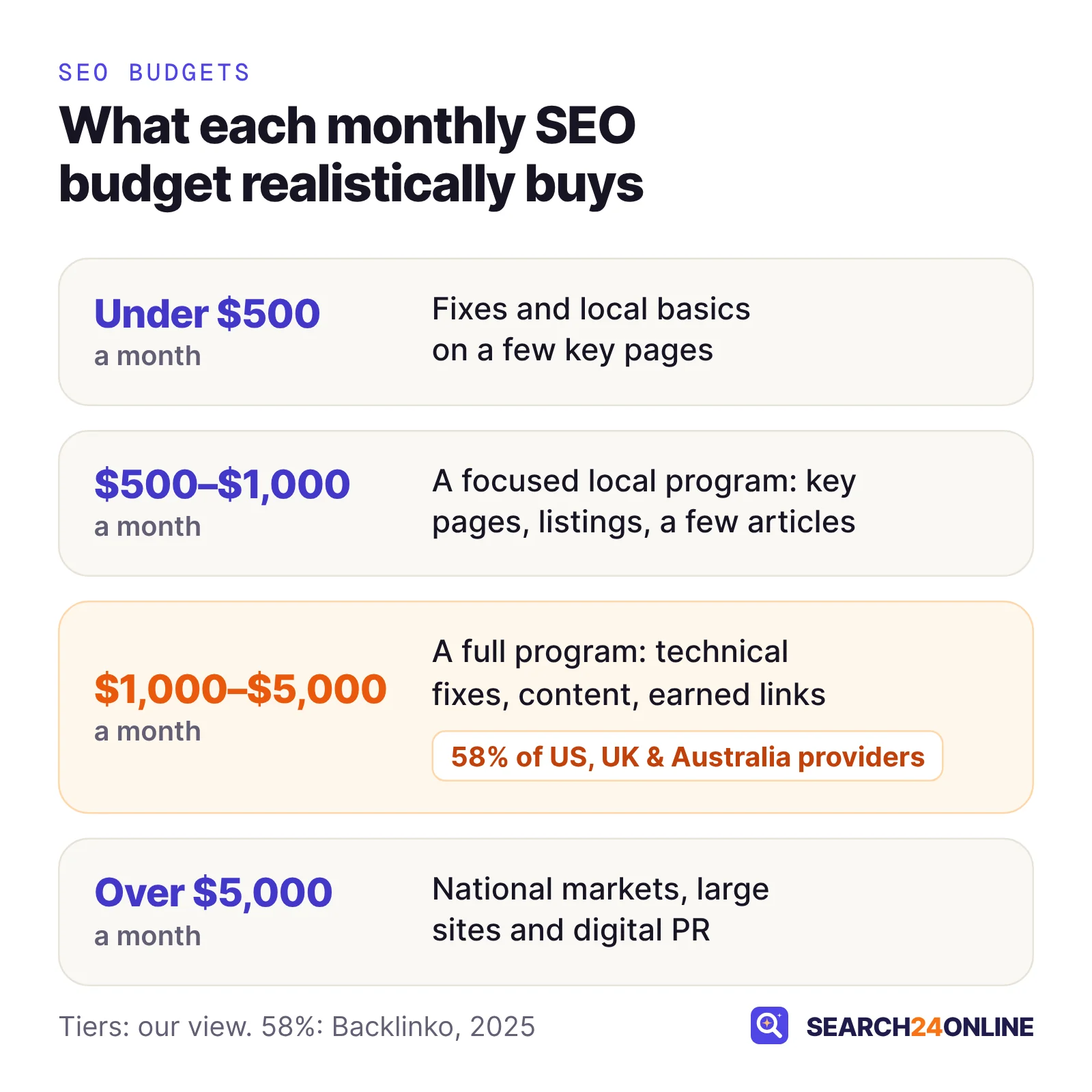
Divide the monthly fee by a realistic hourly rate and you get the honest size of the program. At the $100–$149 an hour Clutch lists for most US agencies, $500 a month buys about 3 to 5 hours of work, $1,000 buys 7 to 10, $2,500 buys 17 to 25, and $5,000 buys 34 to 50. Writing one solid service page, with research and edits, can take several of those hours on its own.
Under $500 a month
Enough for focused basics: fixing a few technical issues, tidying your Google Business Profile and local listings, and improving a handful of key pages. It is rarely enough for regular content and link building at US rates. This tier works best for a small local business in a quiet market, or as expert guidance for an owner who will do some of the work.
$500 to $1,000 a month
A focused local or niche program: steady work on your most important service pages, a couple of useful articles a month, listings and citations kept consistent, and simple tracking. Good for a single-location business whose competitors are not investing heavily.
$1,000 to $5,000 a month
This is where most US providers price, and where you can expect all the parts of a program to move together: technical fixes, regular content, earned links and proper reporting. Backlinko’s regional data puts 58% of providers in the US, UK and Australia in this band (24% at $1,001–$2,500 and 34% at $2,501–$5,000). Competitive local markets, multi-location firms and regional B2B companies usually land here.
Over $5,000 a month
National markets, e-commerce sites with thousands of products, and brands that need digital PR to earn links from major publications. At this level you should expect senior strategists, dedicated writers and developers, and reporting tied to revenue rather than rankings. Whatever the tier, expect months, not weeks, before results show.
Ask any provider: “Roughly how many hours a month will go into my account, and by whom?” If the answer does not fit the fee and the promised deliverables, something is being cut, usually research, writing quality or how links are obtained.
Why does cheap SEO often cost more in the end?
Because the math does not work. At US agency rates, $200 a month buys two hours of work at most, so a package that promises dozens of links and weekly articles at that price has to cut corners somewhere. The usual shortcuts are the ones Google treats as spam.
Google’s spam policies list “Exchanging money for links, or posts that contain links” as link spam. They also name scaled content abuse: many pages generated mainly to manipulate rankings while giving readers little value, which is how cheap AI-written blog packages often end up (see scaled content abuse in our glossary). The consequence, in Google’s words: such sites “may rank lower in results or not appear in results at all.”
Then you pay twice. Cleaning up a weak or unnatural backlink profile, removing or rewriting hundreds of thin pages and rebuilding trust takes skilled hours, usually more than doing it properly would have cost. In audits we regularly see sites whose backlink profile is mostly low-quality directories and paid guest posts, sold as “20 backlinks a month”.
Older survey data points the same way. A 2019 Backlinko and Northstar Research survey of 1,200 US small business decision makers found an average spend of $497 a month on SEO. Those spending more than $500 were 53% more likely to call themselves satisfied, and 65% had already worked with several SEO providers. The data is seven years old and shows correlation, not cause, but the churn tells its own story.
Google’s own advice on hiring an SEO says to “be wary of SEO firms and web consultants or agencies that email you out of the blue.” It also warns against anyone who talks about link schemes or submitting your site to thousands of search engines. More warning signs are in 12 SEO promises that mean you should walk away.
How do you compare SEO proposals line by line?
Put every proposal into the same units: hours, deliverables per month, and the specific problems each one says it will fix. Headline prices are not comparable until you do that. Work through these steps with each quote side by side.
- Translate the fee into hoursAsk for an estimate of monthly hours and who does them. Divide the fee by the hours. A very low implied rate usually means junior staff, offshore resale or automation.
- Check the diagnosis is about your siteA good proposal names your actual issues (pages not indexed, cannibalized keywords, missing structured data). A generic one lists the same services it sends everyone.
- List deliverables in the same unitsPages optimized, articles published, technical fixes shipped, links earned, AI questions tracked. Put them in one column per proposal.
- Ask how links are obtained“Outreach to relevant sites” and “digital PR” are real work. A fixed bulk number of links at a low price usually means paid or directory links.
- Look at reporting and ownershipYou should see progress on leads and traffic, not only rankings, and you should own your content, Google accounts and site access from day one.
- Read the contract termsCheck the notice period, any setup fees, and what happens to the work if you leave.
A worked example
Say a home services company with an older website gets two quotes. Proposal A costs $800 a month: “10 keywords, 4 blog posts, 20 backlinks, monthly ranking report.” Proposal B costs $1,800 a month. It starts with a technical audit and fixes to indexing and internal links, then rewrites eight service pages and adds two in-depth articles a month, outreach for two or three links, AI visibility tracking and a live dashboard.
At $100 an hour, A’s fee covers eight hours. Four decent articles alone could use most of that, which leaves almost nothing for 20 links, so ask exactly where those links come from. B costs more but is built around this site’s problems, and its deliverables can be checked. If the site really has indexing issues, B is likely the better value, even at more than twice the price. If the site were healthy and the market small, a slimmed-down B at a lower fee might be enough. For the full set of questions to ask, see how to choose an SEO agency.
Does AI search visibility (GEO) cost extra?
Partly. Most of what helps you appear in AI answers is the same work that helps you rank, so it should not double your budget. Google says plainly that “There are no additional requirements to appear in AI Overviews or AI Mode, nor other special optimizations necessary,” and that no special schema or AI text files are needed.
What is genuinely extra is measurement and a few specific tasks. GEO (generative engine optimization) work usually adds tracking of how assistants such as ChatGPT, Perplexity and Google’s AI features answer questions in your category, and whether your business is mentioned or cited. It also covers keeping your business details consistent across the web and shaping key pages so they answer questions directly. Those take hours, so they belong in the price, but as part of the program, not a separate premium product.
Our view: be skeptical of standalone “AI SEO” packages that charge a premium for special markup or files that Google says you do not need. Ask what will be tracked, which assistants, how many questions, and how often. For the basics, read what GEO is.
How should you set your own SEO budget?
Start from what a new customer is worth to you and what your competitors are doing, then choose the smallest scope that can realistically move the needle in 6–12 months. A plumber whose average job is worth a few hundred dollars and a law firm whose average case is worth tens of thousands should not budget the same way.
- Work out the value of a leadAverage customer value times your close rate. That tells you what a handful of extra leads a month is worth, and caps what you should spend.
- Size up the competitionSearch your main services and see who ranks and appears in AI answers. Strong, content-rich competitors mean a bigger budget or a narrower focus.
- Get a diagnosis firstFind out whether your site has repair work to do before you buy growth work.
- Commit to a fair testClutch lists 12 months as the typical engagement. Plan for at least six, with monthly reporting so you can judge progress early.
If you are weighing a hire instead, the Bureau of Labor Statistics puts the median salary for market research analysts and marketing specialists at $78,760 (May 2025). That is about $6,563 a month before benefits and tools, for one person who rarely covers technical, content and link work equally well. For tracking the return, see how to measure SEO ROI.
What SEARCH24ONLINE charges
In the interest of transparency, here is how our own plans compare with the ranges above. Starter is $500 a month (5 pages optimized, 15 core keywords, 2 articles a month, Google Business Profile, Bing Places and 10 citations a month, and 25 AI questions tracked across Google AI and ChatGPT). Growth is $1,000 (15 pages, a competitor gap analysis, 4 articles, 3 outreach backlinks a month and 75 AI questions, adding Perplexity, Gemini and Copilot). Authority is $2,000 (30 pages, content pruning, 8 data-backed articles, 6 or more digital PR links a month, 200 AI questions including Claude, and bi-weekly reports). Paying yearly costs 10 times the monthly fee.
That puts us in the lower-middle of the US market, which suits local and regional businesses well. It is not the right fit for everyone: a national e-commerce site with thousands of products needs more than any of these plans. If you want to see what your site actually needs before comparing quotes, our free SEO + GEO report analyzes your website, and you get password-protected dashboard access within 24 hours.
Common questions
Is $500 a month enough for SEO?
It can be, for a local business in a modest market whose website is already in decent shape. At typical US agency rates, $500 buys a few hours of skilled work a month, so expect focused work on a handful of pages and your business listings rather than a full content and link-building program.
Can I pay for SEO only when I get results?
Some providers offer that, but pure pay-for-rankings deals tend to reward easy keywords and risky shortcuts. Google’s advice on hiring an SEO tells you to look elsewhere if someone promises first place. A fixed fee with agreed metrics, reported every month, usually lines up incentives better.
How long should an SEO contract be?
Many engagements run around a year, and Clutch lists 12 months as the typical timeline, but you should not be locked in that long without an exit. Look for a short notice period, monthly deliverables you can check, and written confirmation that you own the content and accounts.
Should I pay for an SEO audit before hiring for ongoing work?
Yes, if a provider cannot tell you what is wrong with your site before quoting. An audit turns a generic package into a scope built around your actual problems. Some agencies, SEARCH24ONLINE included, start with a free initial report, while in-depth paid audits are usually priced as one-off projects.
Do I have to pay for SEO forever?
No, but results tend to fade if you stop entirely while competitors keep publishing and earning links. Many businesses move from an intensive build phase to a lighter maintenance budget once their main pages rank and the technical problems are fixed.
Sources
- Ahrefs: SEO Pricing: How Much Does SEO Cost? 439 People Polled
- Backlinko: SEO Pricing (survey of 300+ SEO professionals, updated December 2025)
- Clutch: SEO Pricing Guide (updated September 2026)
- Upwork: How much does it cost to hire an SEO specialist?
- Backlinko and Northstar Research Partners: 2019 SEO Services Report (press release)
- Google Search Central: Do you need an SEO?
- Google Search Central: Spam policies for Google web search
- Google Search Central: AI features and your website
- U.S. Bureau of Labor Statistics: Market Research Analysts, Occupational Outlook Handbook
Know what your site needs before you pay for SEO.
We’ll analyze your website, create your SEO + GEO report and give you password-protected dashboard access, so you can judge any proposal against your real issues.
Free · No obligation · We only review your public pages.