
SEO Agency vs Freelancer vs In-House: Which Fits Your Business?
Salary data, survey rates and a skills map, turned into a simple test: how much SEO work you have, how many skills it needs, and who should do each part.
Key takeaways
- The right choice depends on how much SEO work you have and how many skills it needs: a freelancer suits a narrow scope, an agency suits a program that needs technical, content and link work at once, and an in-house hire pays off once there is a full-time job’s worth of work.
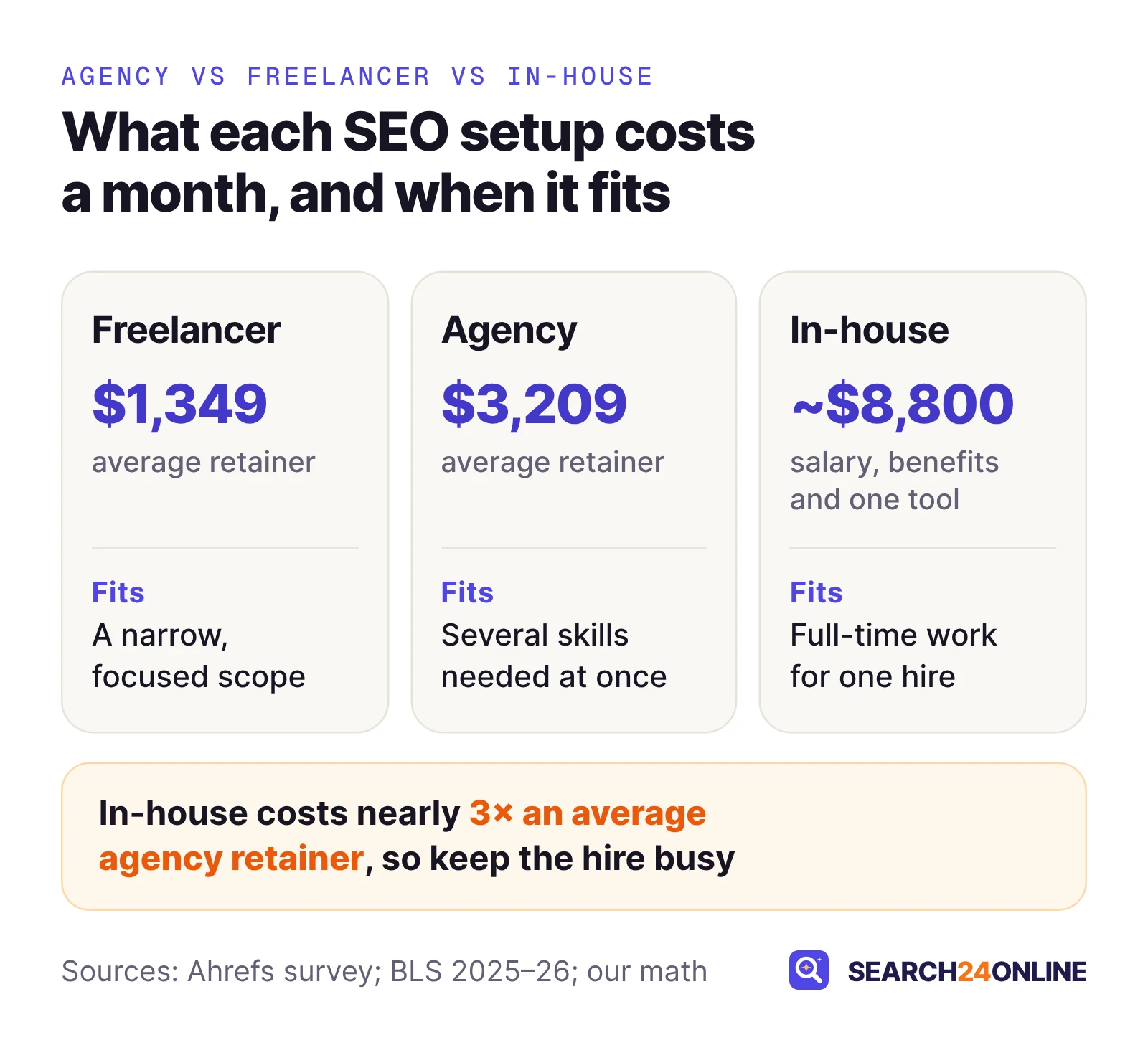
- In-house is the most expensive option per month and the cheapest per hour. With the BLS median of $78,760 (May 2025), employer benefit costs from BLS compensation data, and one mid-tier tool, a single hire costs about $8,800 a month.
- Ahrefs’ survey of 439 SEO providers puts average monthly retainers at $1,348.63 for freelancers and $3,209 for agencies, roughly 19 and 32 hours of work at each group’s average hourly rate.
- Whoever you hire, your business should own the accounts. Google says you are responsible for the actions of any companies you hire, and Search Console lets you give providers user access without giving away ownership.
- Many growing businesses end up with a hybrid: someone inside the company sets priorities, and outside specialists handle the technical, content or link work that one person cannot cover.
On this page
- The short answer
- What skills does a full SEO program need?
- What does an in-house SEO really cost?
- When does an SEO freelancer make sense?
- When is an SEO agency the better fit?
- Side-by-side comparison
- Deciding by stage
- What do hybrid SEO setups look like?
- When should you switch to a different model?
- Common questions
- Sources
Which should you choose: an SEO agency, a freelancer or an in-house hire?
Choose by two things: how much SEO work your business has each month, and how many different skills that work needs. Good and bad providers exist in all three models. What really differs is capacity and how many skill areas one arrangement can cover.
Our rule of thumb, from working with more than 500 brands, looks like this:
- A narrow, well-defined job (local listings, a handful of service pages, a one-off audit or migration): a good freelancer or a small agency plan.
- A program that needs several skills at once (technical fixes, regular content, link earning, reporting): an agency, because one person rarely does all of that equally well.
- Organic search is a main revenue channel and you would otherwise buy a full-time person’s worth of outside work: an in-house lead, usually still with some outside help.
If you mainly want price ranges, our guide to SEO costs covers retainers, projects and what each budget tier buys.
What skills does a full SEO program need?
A complete program needs six kinds of work: technical SEO, content, links, local visibility, analytics, and visibility in AI answers. Before comparing providers, list these and write down who will do each one. Gaps on that list explain most stalled SEO programs we see.
The federal job database O*NET describes Search Marketing Strategists in similar terms: optimizing content for search, analyzing web metrics, working with developers on site architecture, setting up analytics and creating content strategies. Its sample job titles run from SEO Consultant to Social Media Specialist, which shows how far the label “SEO” stretches.
The six skill areas
- Technical SEO. Making sure search engines can crawl and index the pages that matter, with a sensible site structure, internal links, structured data and decent speed. Most fixes need someone with developer access.
- Content and search intent. Mapping keywords to pages, writing new pages, and updating thin or outdated ones so each page matches what searchers actually want.
- Links and digital PR. Earning mentions and links from relevant sites. It is slow, relationship-driven work, and the area where shortcuts do the most damage.
- Local visibility. Google Business Profile, Bing Places, consistent citations and reviews, for any business that serves a geographic area.
- Analytics and reporting. Connecting Search Console and analytics to leads and revenue, so you can see whether the work pays.
- AI search visibility (GEO). Google says “There are no additional requirements to appear in AI Overviews or AI Mode, nor other special optimizations necessary,” so most of this rides on the five areas above. The new part is measurement: tracking how AI assistants mention you across the questions your customers ask.
Who usually covers what
A freelancer tends to go deep in one or two areas, often content or technical audits. An agency spreads the work across specialists, though you should ask who actually does each part. An in-house hire is usually a generalist who owns priorities and reporting and borrows the rest from developers, writers and outside help.
Write the six areas down a page and put a name next to each: a person, a provider, or “nobody”. Every “nobody” is a gap to fill or a part you have consciously chosen to skip. Do this before you read a single proposal.
What does an in-house SEO really cost?
One mid-level in-house SEO costs roughly $106,000 a year, or about $8,800 a month, once you add employer benefit costs and a single mid-tier SEO tool to a median salary. That is before management time, developer time and content production.
Salary
The Bureau of Labor Statistics does not track SEO as its own occupation. SEO roles sit inside “market research analysts and marketing specialists”, and the BLS page for that group links to O*NET’s Search Marketing Strategists profile. The median pay for the group was $78,760 in May 2025, with the lowest 10% earning under $43,390 and the highest 10% over $155,480.
Recruiter data lands in the same place. Robert Half’s 2027 Salary Guide lists a US range of $67,750 to $91,000 for an SEO specialist, with a midpoint of $78,500. If you want someone senior enough to own strategy and manage outside providers, the same guide puts a digital marketing manager at a $103,750 midpoint. Local pay varies, so check your own market.
Benefits and tools
BLS figures for June 2026 show private employers spent an average of $54.00 per hour worked on compensation for full-time workers, of which wages were 68.5% and benefits, including legally required ones, were 31.5%. Paid leave makes up 8.1% of that, and an annual salary already covers it, so the cost on top of salary is the remaining 23.4%. Applied to the $78,760 median, that is about $24,000 in benefit costs, for a total near $102,800. This is an all-industry average, so treat it as a planning figure, not a quote.
Then add tools. Ahrefs lists its Standard plan at $249 a month for one user ($2,988 a year), with extra seats at $60 a month each. Most SEOs also want a site crawler and a rank tracker, and AI-visibility tracking is often sold separately (Ahrefs’ Brand Radar AI add-on starts at $199 a month), so budget for more than one subscription. With just that one plan, the total is about $105,800 a year.
The costs that never show up on the offer letter
- Ramp-up. A new hire spends weeks learning your site, customers and tools.
- Developer time. Technical fixes compete with every other request your developers or web vendor have.
- Content production. One person can plan content, but steady volume usually needs writers or subject experts.
- Management and turnover. Someone has to set goals and judge the work. If the hire leaves, the knowledge leaves too, and the search starts again.
A pattern we see often in audits: a company hires a marketing generalist to “do SEO”, and they publish a blog post every week. A year later, six of those posts compete for the same phrase (cannibalization: your own pages fighting each other in results), while a dozen service pages are not in Google’s index at all. The hire worked hard. Nobody with technical depth was checking the foundations.
When does an SEO freelancer make sense?
A freelancer makes sense when the job is focused, the budget is modest, and you value working directly with the person doing the work. Specialist freelancers can also be the best option for a defined technical project, such as a site migration or an indexing cleanup.
Ahrefs’ survey of 439 SEO providers put freelancers’ average retainer at $1,348.63 a month (about $1,349), and their average hourly rate at $71.59. Ahrefs calculated those averages by assuming each provider charges the top of its price bracket, so they are rough guides. Backlinko’s separate survey of more than 300 SEO professionals found agencies charge about 30% more than freelancers on average.
Where freelancers are strong
- You talk to the expert, not an account manager.
- Lower overhead usually means more hours for the same money.
- Flexible scope: easy to start small, pause or change direction.
- Deep specialists exist for technical SEO, local SEO, e-commerce and content.
Where they struggle
Capacity is the main limit. One person has a fixed number of hours, and holidays, illness or a big new client can stall your program. Breadth is the second: someone excellent at content may be weak at technical diagnosis, and vice versa. The third risk is hidden subcontracting, where the freelancer quietly passes writing or link building to cheaper vendors.
That third risk shows up in audits as a weak or unnatural backlink profile: dozens of links from low-quality directories and paid guest posts, often bought in bulk packages. Google’s own advice on hiring an SEO points out that “you are responsible for the actions of any companies you hire,” and the same logic applies to individuals. Paid links break Google’s spam policies whether an agency or a freelancer bought them.
Agree a written monthly scope with named deliverables, require approval before anyone else works on your site, and give access through your own accounts rather than theirs. Ask how links are obtained, and ask for a list of every link built.
When is an SEO agency the better fit?
An agency is the better fit when your program needs several skills at once and you want continuity that does not depend on one person. You are buying a team: strategists, technical specialists, writers and someone handling links and reporting, plus their tools.
Full disclosure: SEARCH24ONLINE is an agency, so weigh our view accordingly. The survey numbers are independent. Ahrefs found agencies average $3,209 a month on retainer and $98.90 an hour. Clutch’s SEO pricing guide lists an average monthly cost of $3,199.19, a typical engagement of 12 months, and $100–$149 an hour for most US agencies (its guide was updated in September 2026).
Where agencies are strong
- Several specialists cover technical, content, links and analytics in one contract.
- Work continues when someone is on vacation or leaves.
- Tools and processes are included in the fee.
- They see patterns across many sites, which helps when something unusual happens to yours.
Where agencies disappoint
The common complaints: templated work, junior staff after a senior sales pitch, reports full of rankings but empty of leads, and contracts that make leaving painful. Worst of all is an agency that sets up Search Console, analytics or your Business Profile under its own login, so leaving means losing your data.
You can test for most of this before signing. Ask who will work on your account and how many hours a month they will spend on it. Ask to see a sample monthly report, and confirm that you own every account and all content from day one. Our list of questions to ask an SEO agency goes through the rest. If you are weighing a remote or offshore provider, the checks in hiring an SEO agency overseas apply too.
How do the three options compare side by side?
Side by side, the trade-off is capacity versus coverage versus cost per hour. The freelancer is cheapest per month, the agency covers the most skills per dollar, and the in-house hire gives you the most hours, at the highest monthly cost.
| Freelancer | Agency | In-house hire | |
|---|---|---|---|
| Typical monthly cost | $1,348.63 average retainer (Ahrefs) | $3,209 average retainer (Ahrefs); $3,199.19 (Clutch) | About $8,800 with benefits and one tool (BLS median plus Ahrefs list price) |
| Rough hours a month | About 19 at $71.59 an hour | About 32 at $98.90 an hour | Full time, about 173 paid hours |
| Skill coverage | Deep in one or two areas | Broad, across specialists | Usually a generalist who coordinates |
| Continuity | Depends on one person | Team covers absences | Strong until the person leaves |
| Knowledge of your business | Good, if the relationship lasts | Varies with account staffing | Deepest: they sit in your meetings |
| Main risk | Capacity limits, hidden subcontracting | Templated work, junior staff | Skill gaps, cost, turnover |
Look at the hours row. An in-house hire works out to about $51 per paid hour ($105,800 divided by 2,080 hours), well below agency rates. The catch: you pay for every hour whether or not there is valuable SEO work to fill it, and you still buy the skills that person lacks. Treat the hour estimates as rough, since they come from averages built on price-bracket ceilings.
How do you decide for your business stage and budget?
Work through four questions in order; the first two matter most.
- How much work is there each month?Count pages to fix or write, technical issues waiting, locations to manage and links you need. A few hours of steady work is a freelancer job. Something like a full-time week, every week, is a case for a hire.
- How many of the six skill areas are involved?One or two points to a specialist freelancer. Four or more at once points to an agency or a hybrid.
- Who will manage it?An in-house hire needs a manager who can judge SEO work. Outside providers need someone who reads the reports and approves changes. If nobody has that time, choose the option that needs the least supervision.
- How much is organic search worth to you?Multiply the value of a customer by the extra leads you could realistically win. That caps what any option should cost.
Three common situations show how this plays out. These are typical patterns, not client case studies.
A single-location practice in a mid-sized city
A dental practice with a 20-page site, a Google Business Profile and a few local competitors. The work is mostly local visibility, a handful of service pages and reviews. That narrow scope suits a local SEO freelancer or an entry-level agency plan; a full-time hire would soon run out of useful work.
A regional home services company
A common situation: an HVAC company with 40 service pages that all target “HVAC repair” in slightly different words. It serves several towns from two offices, and a cheap provider built its backlinks years ago. That needs technical cleanup, a keyword map, rewritten pages, local work and careful link earning, all at once. An agency usually fits better here, simply because so many skills are involved.
A larger site where search drives revenue
A B2B manufacturer or online store with thousands of pages, a development team and a marketing department. There is easily a full-time job in SEO, and someone needs to sit in product and web meetings to stop new releases from breaking things. This is where an in-house SEO lead pays off, usually with an agency or specialist freelancers for link earning, content volume or a big migration.
If you do not know whether your site’s main problem is technical, content or authority, you cannot know which skills to buy. Get a diagnosis first. An SEO audit tells you which of the six areas need the most work, and that usually decides the model.
What do hybrid SEO setups look like?
A hybrid gives each part of the program to whoever does it best, with one person inside the company setting priorities. In our experience it is the most common setup once a business outgrows the small-business stage.
In-house marketer plus an agency
Your marketer owns goals, brand voice and approvals, and may write some content. The agency handles technical SEO, link earning, AI visibility tracking and reporting. This works well when you have a capable generalist but no technical or outreach depth.
Agency or consultant strategy, your team executes
An outside expert sets the plan, writes briefs and reviews the work, while your writers and developers carry it out. It costs less than full execution, but only works if your team has the time to deliver what the plan calls for.
In-house SEO lead plus freelance specialists
A larger company hires an SEO lead, who brings in freelancers for specific jobs: a technical specialist for a migration, writers for volume, a digital PR specialist for links. The lead needs enough experience to brief and judge each of them.
Whatever the mix, write down who owns each skill area and who has the final say. Hybrids fail when each party assumes the other is handling something, which is how important pages go missing from the index for months.
When should you switch to a different model?
Switch when the work has outgrown the arrangement, or when it has shrunk below it. Results that slow down are not always a reason to switch, but these signals usually are:
- Freelancer to agency: deliverables keep slipping, you need skills your freelancer does not have, or you are adding locations or product lines.
- Agency to in-house: you are spending heavily on outside SEO, you need someone in internal meetings, or the agency spends too much time learning context a staff member would already have.
- In-house to outside help: one person is stretched across too many skill areas, or the program needs depth (technical, links) your hire cannot supply.
- Any model: you cannot see what was done each month, or the reports never connect to leads.
Timing matters too. Google’s guidance says a great time to hire an SEO is when you are considering a site redesign, “the earlier, the better.” Changing providers mid-migration is risky, so switch before the redesign starts.
How to switch without losing ground
- Confirm you own every accountSearch Console, analytics, Google Business Profile, your domain and hosting. In Search Console, make sure someone in your company is a verified owner and that providers are added as full or restricted users.
- Collect the handoverThe keyword map, content calendar, list of links built, technical changes made, and logins for any tools paid for on your behalf.
- Remove old access properlyGoogle’s Search Console help notes that a removed owner whose verification token stays on the site can re-verify and regain access. Delete their unused ownership tokens as well.
- Brief the new provider with a baselineCurrent traffic, leads, indexed pages and AI mentions, so everyone can measure progress from the same starting point.
If you want an outside view of what your site needs before you choose who does the work, our free SEO + GEO report analyzes your website, and you get password-protected dashboard access to it within 24 hours. You can also compare our plans with the numbers above.
Common questions
Is it cheaper to hire an in-house SEO than to pay an agency?
Per hour, usually yes; per month, usually no. One mid-level hire costs roughly $8,800 a month once benefits and a single SEO tool are added, nearly three times the average agency retainer in Ahrefs’ provider survey, but you get a full-time person instead of a few dozen hours.
Can one in-house SEO person handle everything?
Rarely. A single hire can own strategy, on-page work and reporting, but most people are not equally strong at technical fixes, writing at volume and earning links. Plan for developer time and some outside help, or narrow the scope to what one person can do well.
How can I tell if a freelancer is subcontracting my SEO work?
Ask directly and put the answer in the contract. A good freelancer will tell you who writes, who builds links and who touches your site, and will agree that nobody else works on it without your approval. Unexplained jumps in output, or links you cannot trace, are warning signs.
Should a small business just do its own SEO?
It can handle the basics, such as a complete Google Business Profile, clear service pages and asking customers for reviews. Bring in help when you have technical problems you cannot diagnose, when competitors clearly outrank you, or when the owner’s time is worth more spent on the business.
How long should I give a new SEO provider before judging them?
Judge the work shipped in the first 90 days, and the results over six to twelve months. Clutch lists 12 months as the typical SEO engagement. Early on, look for fixed technical issues, improved pages and clear reporting rather than big ranking jumps.
Sources
- U.S. Bureau of Labor Statistics: Market Research Analysts and Marketing Specialists, Occupational Outlook Handbook
- O*NET OnLine: Search Marketing Strategists (13-1161.01)
- U.S. Bureau of Labor Statistics: Employer Costs for Employee Compensation, June 2026 (news release, September 9, 2026)
- Robert Half: SEO Specialist salary (2027 Salary Guide)
- Robert Half: Digital Marketing Manager salary (2027 Salary Guide)
- Ahrefs: SEO Pricing: How Much Does SEO Cost? (survey of 439 SEO providers)
- Backlinko: SEO Pricing (survey of 300+ SEO professionals, updated December 2025)
- Clutch: SEO Pricing Guide (updated September 2026)
- Ahrefs: Plans and pricing
- Google Search Central: Do you need an SEO?
- Google Search Console Help: Managing owners, users, and permissions
- Google Search Central: AI features and your website
Know which skills your site needs before you decide who does the work.
We’ll analyze your website, create your SEO + GEO report and give you password-protected dashboard access, so you can see whether your gaps are technical, content or authority.
Free · No obligation · We only review your public pages.