
SEO Agency Red Flags: 12 Promises That Mean You Should Walk Away
What each warning sign sounds like in a sales pitch, why it puts your website or your business at risk, and the question that separates a careful agency from a risky one.
Key takeaways
- The surest red flags are the ones Google itself warns about: guaranteed rankings, a claimed “special relationship” with Google, secrecy about methods and link schemes. Google’s hiring guidance says no one can guarantee a #1 ranking.
- Bulk link packages, mass-produced AI pages and near-identical city pages fall under Google’s spam policies, and sites that break them “may rank lower in results or not appear in results at all.”
- The risk stays with you. Google says you are responsible for the actions of companies you hire, and the FTC’s fake review rule, in force since October 21, 2024, covers agencies and review brokers too.
- You should own your Google Business Profile, Search Console, analytics, domain and content from day one, with the agency added as a user.
- Not every flag is a dealbreaker: spam tactics and fake reviews are, while rankings-only reports and rigid contracts can often be fixed in negotiation.
On this page
Why do bad SEO promises cost more than the monthly fee?
Because the fee is the smallest part of the bill. When an agency uses tactics that break Google’s rules, the damage lands on your domain, not theirs, and undoing it usually costs more than the original contract. Google’s guidance on hiring an SEO says it plainly: “Ultimately, you are responsible for the actions of any companies you hire.”
The penalty side is spelled out in Google’s spam policies. Sites that violate them “may rank lower in results or not appear in results at all.” Google finds violations through automated systems and, where needed, human review. A human finding becomes a manual action, listed in the Manual actions report in Search Console. To lift one, you fix the problem on every affected page and file a reconsideration request; Google says most reviews take “several days or weeks,” and link-related ones can take longer.
In audits for the 500+ brands our team has served, weak backlink profiles, near-identical location pages and thin articles that compete with each other are recurring findings. Often they are an earlier vendor’s leftovers, such as links from low-quality directories and paid guest posts. None of it was free to create, and all of it takes skilled hours to unwind.
Each flag below covers what it sounds like, why it’s risky and what to ask instead. For the positive version, the full set of questions to put to any agency, see how to choose an SEO agency.
Which promises about rankings and Google should end the conversation?
A promise of a specific ranking, a claim of inside access to Google, or a refusal to explain the work. All three come straight from Google’s own list of things to watch for when you hire an SEO.
1. “We guarantee page one on Google”
What it sounds like: “Top three for your main keywords in 30 days, or your money back.”
Why it’s risky: Google’s hiring guide states that “No one can guarantee a #1 ranking on Google,” and if an SEO promises first place, Google’s advice is to “find someone else.” Rankings depend on Google’s systems, your competitors and what searchers want, none of which an agency controls. In practice a guarantee means one of two things: the keywords are so obscure that nobody searches them, or the agency plans shortcuts that can work briefly and then collapse.
Ask instead: “What results do you expect, over what timeframe, and how will we measure them?” Google suggests asking almost exactly that. A good answer names realistic goals (more calls, form fills, traffic to service pages), explains its assumptions and admits uncertainty. For realistic timeframes, see how long SEO takes to work.
2. “We work directly with Google”
What it sounds like: “Our relationship with Google gets our clients priority.” Or a cold call: “This is your Google listing specialist. Your business will be marked closed unless you verify today.”
Why it’s risky: Google tells you to beware of SEOs that “allege a ‘special relationship’ with Google” and to be wary of firms “that email you out of the blue.” The FTC has taken this pitch to court. In 2018 it sued Pointbreak Media and related companies, alleging robocalls that falsely claimed to represent Google, warned that businesses would be marked “permanently closed,” and promised first-place or first-page placement. Fees allegedly ran from a one-time $300–$700 to $949.99 upfront plus a monthly charge. According to the FTC, the defendants “have no relationship with Google.”
Ask instead: “Which of our accounts will you need, and at what access level?” If a caller says they are from Google, hang up and research the company yourself before paying anyone.
3. “Our methods are proprietary”
What it sounds like: “We can’t share exactly what we do; it’s our secret sauce.” “We’ll submit your site to over a thousand search engines.”
Why it’s risky: Google says to “be careful if a company is secretive or won’t clearly explain what they intend to do,” and to avoid SEOs that talk about link popularity schemes or submitting your site to thousands of search engines. It also says an SEO with access to your server should be willing to explain every change. Secrecy is where risky tactics hide. Good SEO has no secret: the rules are public, and the skill lies in diagnosing your site and doing the work well.
Ask instead: “Can I see a log of every change you make to my site and every link you build?”
Which link and content offers break Google’s spam policies?
In our experience, offers priced by volume (a fixed number of links, articles or city pages for a low monthly fee) are the most common way small businesses end up in breach of Google’s spam policies. The volume is the tell. Real links and useful pages don’t arrive in fixed bulk quantities, and as our breakdown of what SEO costs shows, the hours behind a $300 package can’t produce them honestly.
4. “50 high-authority backlinks a month”
What it sounds like: “DA 50+ guest posts,” “niche edits,” “access to our private blog network.”
Why it’s risky: Google defines link spam as creating links “primarily for the purpose of manipulating search rankings.” Its examples include buying or selling links for ranking purposes, whether with money, goods, services or free products. Others are excessive link exchanges, automated link-building programs, low-quality directory or bookmark links, and keyword-rich anchor text in guest posts or press releases on other sites. “Unnatural links to your site” is one of the manual action types listed in Search Console. Paying for a placement is fine for advertising, but Google expects those links to be marked rel="sponsored" or rel="nofollow", which is exactly what ranking-focused link sellers avoid.
A PBN is a group of websites controlled by one party that exist mainly to link to paying clients, often built on expired domains. Google’s policies don’t use the term, but they cover the parts: buying links, and expired domain abuse, where an old domain is bought and repurposed “primarily to manipulate search rankings.”
Ask instead: “Show me five links you earned for a client in the last six months, and explain how you got each one.” You want real sites relevant to the client’s industry, earned through outreach, useful content or PR. If the agency can’t name the sites, assume they were bought.
5. “We’ll publish 100 articles a month”
What it sounds like: “AI-powered content at scale.” “A page for every keyword in your industry.”
Why it’s risky: Google calls this scaled content abuse: “when many pages are generated for the primary purpose of manipulating search rankings and not helping users.” One example it gives is using generative AI to create many pages without adding value. Its guidance on AI content, updated October 1, 2026, says these tools can help with research and structure, but “It is critical to manually factcheck and review all AI-generated content for accuracy.” AI isn’t the problem; unreviewed volume is. In audits we often see the side effect too: dozens of articles chasing overlapping keywords, so the site’s own pages compete with each other (cannibalization) and none ranks well.
Ask instead: “Who researches, writes and fact-checks each piece, and how do you decide what not to publish?”
6. “A page for every town you serve”
What it sounds like: “We’ll build 200 location pages,” or “We’ll add every city and ZIP code you cover to your footer.”
Why it’s risky: Google’s doorway abuse policy covers pages “created to rank for specific, similar search queries,” and its keyword stuffing examples include “blocks of text that list cities and regions that a web page is trying to rank for.” A common situation: a plumbing company with 60 town pages that are identical except for the town name, plus a footer listing every ZIP code it serves. A location page earns its place with something unique, such as jobs completed nearby, the local team, area-specific services or directions. More on doing this properly in how to rank in cities where you don’t have an office.
Ask instead: “What will be on each location page that isn’t on the others?”
Which review and Business Profile offers put your business at risk?
Buying reviews and handing over control of your Google Business Profile. The first can bring a federal penalty; the second can lock you out of your own listing.
7. “We’ll get you 50 five-star reviews”
What it sounds like: “Reputation packages,” reviews written “on your behalf,” or a system that only sends review requests to customers who said they were happy.
Why it’s risky: Google Maps’ content policy says fake engagement “is not allowed and will be removed,” naming reviews “that have been paid for, directly or in kind” and incentives to post reviews or remove negative ones. It also bars merchants from selectively soliciting positive reviews. Then there’s the law. The FTC’s rule on consumer reviews and testimonials took effect on October 21, 2024. It bans buying or selling fake reviews, including AI-generated ones, and rewards tied to positive or negative sentiment, and it lets the FTC seek civil penalties against knowing violators. The Federal Register notice says advertising agencies, review brokers and reputation management companies count as businesses under the rule. The current maximum civil penalty for this type of violation is $53,088 per violation, according to the FTC’s inflation-adjusted penalty table in the Code of Federal Regulations.
Ask instead: “How will you help us ask every customer for a review, within Google’s rules?” Our guide to getting more Google reviews covers the legitimate methods.
8. “We’ll set up your Business Profile in our account”
What it sounds like: “We manage all our clients’ listings centrally, so you won’t need a login.”
Why it’s risky: Google’s help center explains that a profile “can have multiple owners but only one primary owner,” and that only owners can add or remove other users; managers can’t. If the agency is the primary owner and you aren’t an owner at all, leaving means asking them to hand your own listing back. A common situation: a business changes agencies and only then discovers the old one is the sole owner of its profile, along with years of reviews and photos.
Ask instead: “Please request manager access; we’ll stay primary owner.” Google also recommends that each person uses their own Google account rather than sharing a password.
Which access, reporting and contract terms are warning signs?
Anything that makes the work hard to see or the agency hard to leave. They are less dramatic than paid links, but they decide whether you can check what you pay for.
9. “You don’t need access; we handle the technical side”
What it sounds like: The agency creates Search Console and analytics under its own account, keeps the logins, and sends you a PDF each month.
Why it’s risky: In Search Console, owners have full control and only owners can add or remove users. If the vendor was the only verified owner, a new verified owner has to be set up before anyone can see the data again. Removing someone isn’t enough either: their verification tokens stay on the site, and Google warns they can re-verify unless you delete those tokens. Google’s hiring guide also suggests giving an SEO only read access to Search Console while they audit, not write access. The same logic applies to your analytics, domain registrar, hosting and website admin.
Ask instead: “Will we be the owner of every account, with you added as a user?”
10. “Here’s your monthly rankings report”
What it sounds like: Forty pages of keyword positions, a proprietary “visibility score” and traffic charts, with no mention of leads and no list of work done.
Why it’s risky: Our view: a rankings-only report lets an agency pick the keywords that look good, often long phrases few people search, while saying nothing about whether you gained customers. Without a work log you can’t tell whether anything happened that month. Vague reporting doesn’t prove bad intent, but it removes your ability to judge.
Ask instead: “Can each report show leads from organic search, which pages produced them and what you did this month?” We set out what belongs in one in what a monthly SEO report should include.
11. “Twelve-month minimum, and the content stays with us”
What it sounds like: A long minimum term with automatic renewal, setup fees, and fine print that keeps the copyright to content (or the whole website) with the agency.
Why it’s risky: SEO takes months, so some commitment is reasonable. A contract you can’t exit, though, removes the agency’s reason to keep performing. Watch for two worse versions. One is content that is licensed to you rather than owned, so it has to come down when you leave. The other is links that disappear when you cancel: that usually means they were rented placements, which brings you back to flag 4.
Ask instead: “What happens to the pages, content and links if we cancel?” Our view: look for a short notice period after any initial term and written confirmation that you own every deliverable you paid for.
What should you make of promises about ChatGPT and AI Overviews?
Treat a guaranteed AI mention the same way as a guaranteed ranking. AI answers can change from one question and one day to the next, and no agency controls whether you are named, and Google says no special technique is required for its own AI features.
12. “Our AI markup gets you recommended by ChatGPT”
What it sounds like: “Guaranteed citations in AI Overviews,” “special AI schema,” “an AI file that makes chatbots recommend you.”
Why it’s risky: Google’s documentation is direct: “There are no additional requirements to appear in AI Overviews or AI Mode, nor other special optimizations necessary.” It adds that there is no special schema to add and that “You don’t need to create new machine readable files, AI text files, or markup to appear in these features.” A premium fee for a file or markup Google says you don’t need is money spent on nothing. (We look at one such file in does llms.txt help?)
Real GEO (generative engine optimization) work is more modest and measurable. It tracks how assistants such as ChatGPT, Perplexity and Google’s AI Overviews answer questions in your category. It keeps your business details consistent across the web and makes key pages answer questions clearly. It sits on top of normal SEO, not in place of it.
Ask instead: “Which assistants and which questions will you track, and how will you report changes?”
How serious is each red flag?
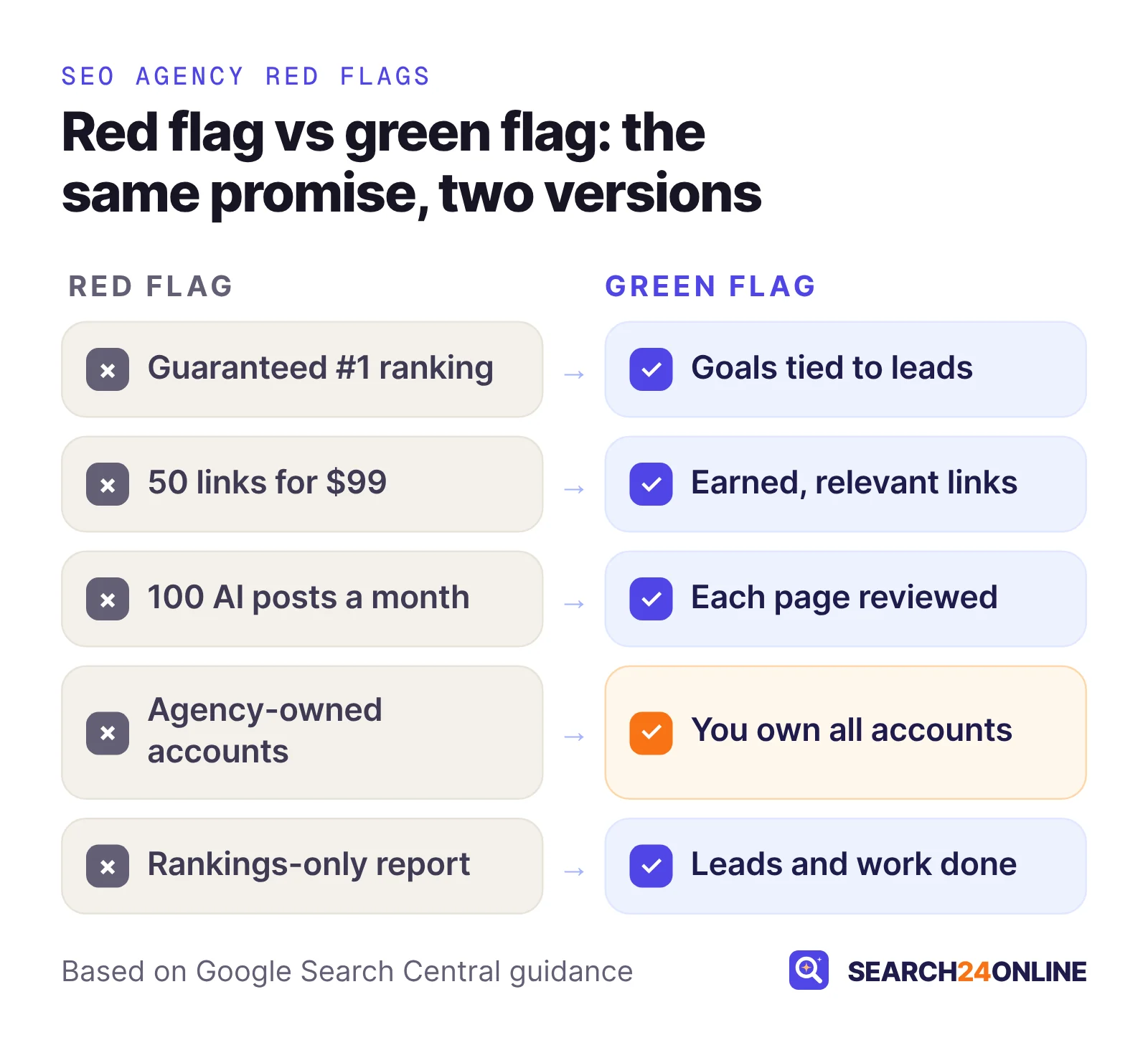
Not equally. Some flags put your domain or your business at legal risk and can’t be fixed with a contract clause; others are often a salesperson’s sloppy wording and disappear when you ask for specifics. Sort what you hear into three groups.
| Group | Flags | Why | Your move |
|---|---|---|---|
| Walk away | 1 guarantees, 2 “from Google,” 4 link packages, 5 mass content, 6 doorway pages, 7 bought reviews | Contradict Google’s guidance or break its spam policies or FTC rules; the risk lands on you | End the conversation. Don’t negotiate scope. |
| Fix in writing | 8 Business Profile ownership, 9 account access, 10 reporting, 11 contract terms | Fixable, and a good agency agrees quickly | Put ownership, access, report contents and exit terms in the contract. |
| Probe further | 3 secret methods, 12 AI promises | Sometimes just vague sales language | Ask for specifics. If answers stay vague, treat it as a walk-away. |
One pattern matters more than any single flag: how an agency reacts when you raise it. A careful agency explains its methods, agrees to your ownership terms and is comfortable saying “we can’t promise that.” An agency that gets defensive or pushes for a signature this week has answered the question for you.
What if your current agency is already doing some of this?
Secure your accounts first, then find out what has been done, then decide. In that order, because an agency you’re about to fire still holds whatever access you gave it.
- Take back ownershipMake sure you are primary owner of your Business Profile and an owner in Search Console, analytics, your domain registrar and hosting. In Search Console, also check the list of unused ownership tokens and remove any that belong to the agency.
- Check for a manual actionOpen the Manual actions report in Search Console. A green check mark means no manual action is in place; anything else lists the issue and the affected pages.
- Ask for a full work logRequest in writing every link built or paid for (with URLs), every page created and every change made to your site. A reluctant answer tells you a lot.
- Stop the risky work in writingPause link buying, bulk content and review campaigns immediately, even before you decide whether to stay.
- Get an independent diagnosisHave someone with no stake in the old work review indexing, content, internal links and backlinks, and rank the problems by impact.
- Clean up in priority orderIf there is a manual action, fix every affected page before you request review. If not, start with what holds the most pages back: thin or duplicate pages to merge or remove, and important pages that aren’t indexed.
Mass-deleting pages or links the week you discover a problem can remove good work along with bad. Get the inventory first, then cut what is actually harmful, ideally with someone who can tell the difference.
If you want that independent look without committing to anything, our free SEO + GEO report analyzes your website and gives you password-protected dashboard access within 24 hours. For background on every policy mentioned here, read Google’s spam policies in plain English.
Common questions
Is it a red flag if an SEO agency contacts me first?
Not automatically, but treat it with extra caution. Google’s own advice on hiring an SEO says to be wary of firms that email you out of the blue, and unsolicited calls claiming to be from Google are a known scam pattern.
Can an SEO agency get my website penalized by Google?
Yes. If an agency builds paid links, mass-produces thin pages or stuffs keywords, your site can rank lower or drop out of results, and Google may apply a manual action. Google says you are ultimately responsible for the actions of any company you hire, so the consequences stay with your domain after the agency is gone.
Is AI-written content against Google’s rules?
No, not by itself. Google’s guidance says generative AI can help with research and structure, but using it to churn out many pages without adding value for readers may count as scaled content abuse. What matters is whether each page is reviewed, accurate and genuinely useful.
Is it illegal for an agency to buy reviews for my business?
Buying fake reviews is prohibited under the FTC’s rule on consumer reviews and testimonials, which took effect on October 21, 2024, and the FTC can seek civil penalties against knowing violators. The rule covers agencies and review brokers as well as the businesses that benefit, and Google removes paid reviews from Maps.
Are cheap SEO packages always a scam?
No. A small budget can buy honest, focused work, such as fixing technical problems and improving a few key pages. The warning sign is a low price paired with big fixed quantities, like dozens of links or articles a month, which skilled people cannot deliver for that money without shortcuts.
Sources
- Google Search Central: Do you need an SEO?
- Google Search Central: Spam policies for Google web search
- Google Search Central: Google Search’s guidance on using generative AI content on your website (updated October 2026)
- Google Search Central: AI features and your website
- Search Console Help: Manual actions report
- Search Console Help: Managing owners, users, and permissions
- Google Business Profile Help: Manage your Business Profile owners and managers
- Google Maps User Contributed Content Policy: Prohibited and restricted content
- FTC: Federal Trade Commission Announces Final Rule Banning Fake Reviews and Testimonials (August 14, 2024)
- Federal Register: Trade Regulation Rule on the Use of Consumer Reviews and Testimonials (August 22, 2024)
- eCFR: 16 CFR 1.98, Adjustment of civil monetary penalty amounts
- FTC: FTC Action Halts Deceptive Robocalls Aimed at Small Business Owners (May 2018)
Worried about what your last agency left behind?
We’ll analyze your website, create your SEO + GEO report and give you password-protected dashboard access, so you can see its real condition before you sign with anyone.
Free · No obligation · We only review your public pages.