
SEO for Real Estate Agents and Brokerages: Winning Beyond the Portals
You are unlikely to outrank Zillow for “homes for sale” in your city, and you do not need to. Here is where agent and brokerage websites can still win on Google and in AI answers, with the buyer data, Google rules and fair-housing limits that shape the work.
Key takeaways
- Real estate SEO for agents is not about outranking Zillow for “homes for sale in [city]”. It is about owning the searches portals answer poorly: neighborhood questions, local market data, your own name and the questions buyers ask once they have found a listing.
- NAR’s 2025 Profile of Home Buyers and Sellers found that 52% of buyers found the home they bought on the internet, yet 88% bought through an agent and 74% interviewed only one agent. The online job is to be the agent they call first.
- IDX listings are the same MLS data shown on many sites, and MLS rules bar changing other brokers’ listing data. Google picks one version of duplicate content to show, so your rankings come from what only you can publish.
- Google names real estate agents as individual practitioners who may have their own Business Profile, if they are public-facing and reachable at the verified location during stated hours.
- Neighborhood content must describe places, not people: the Fair Housing Act bars ads that indicate a preference based on race, color, religion, sex, disability, familial status or national origin.
On this page
Can an agent website still compete with Zillow, Realtor.com and Redfin?
Yes, but not for the searches most agents target first. For a broad search like “homes for sale in Denver,” the portals hold advantages no agent site can match: every listing in the market, years of links and brand searches, and an enormous audience. Zillow alone reported 239 million average monthly unique users and 2.5 billion visits in the second quarter of 2026, and describes itself as the most visited real estate app and website in the United States.
Google is moving in too. With the brokerage HouseCanary, it began testing home listings in search results at the end of 2025 and relaunched the test in May 2026 with listings from three MLSs. On June 11, 2026, The Real Deal reported that the feature was expanding to mobile search results in all 50 states, drawing on participating MLSs. The broad listing search is crowded, and getting more so.
The buyer data shows where the opening is. NAR’s 2025 Profile of Home Buyers and Sellers covers purchases from July 2024 to June 2025. It found that 46% of buyers took their first step by looking online for properties, and 52% found the home they bought on the internet, against 27% through an agent. Yet 88% of purchases went through an agent or broker, 43% of buyers found their agent through a referral from a friend, neighbor or relative, and 74% interviewed only one agent.
Our reading: buyers browse on the portal, then decide whom to call through referrals, your name in search, your reviews and pages that prove you know the area. Since most talk to only one agent, being that one is the whole game.
| Search type | Example | Who usually ranks | Your realistic play |
|---|---|---|---|
| Broad listing searches | “homes for sale in [city]” | Portals and the largest brokerages | Don’t build your plan on it; link curated listing pages from your guides |
| Neighborhood searches | “living in [neighborhood]”, “[area A] vs [area B]” | Templated portal area pages, forums, blogs | Hyperlocal guides built from first-hand detail |
| Local market questions | “[town] housing market” | Local news, portal data pages | A monthly report from your own MLS data |
| Agent and brand searches | “[your name] realtor” | Your profiles, portal agent pages, review sites | Business Profile, reviews and a real about page |
| Process and cost questions | “closing costs in [state]” | National publishers | State- and county-specific answers from your experience |
The “who usually ranks” column is our observation from search results and varies by market. The foundations underneath it all (Business Profile, citations, reviews, a crawlable site) are in our complete local SEO guide; this article covers what is different in real estate.
What makes a hyperlocal neighborhood guide worth ranking?
A neighborhood guide earns its place when it answers what a buyer would ask you on a drive through the area, with detail a portal template cannot supply. Neighborhood matters: in NAR’s 2025 Profile, 59% of buyers named the quality of the neighborhood as a factor in choosing where to buy, ahead of convenience to their job at 31%. Among buyers who used the internet, 81% rated photos as a very useful website feature.
Portal area pages are generated from the same fields for every ZIP code. You know which streets flood, where the newer construction is and how long the 7:45 a.m. drive to the hospital district really takes.
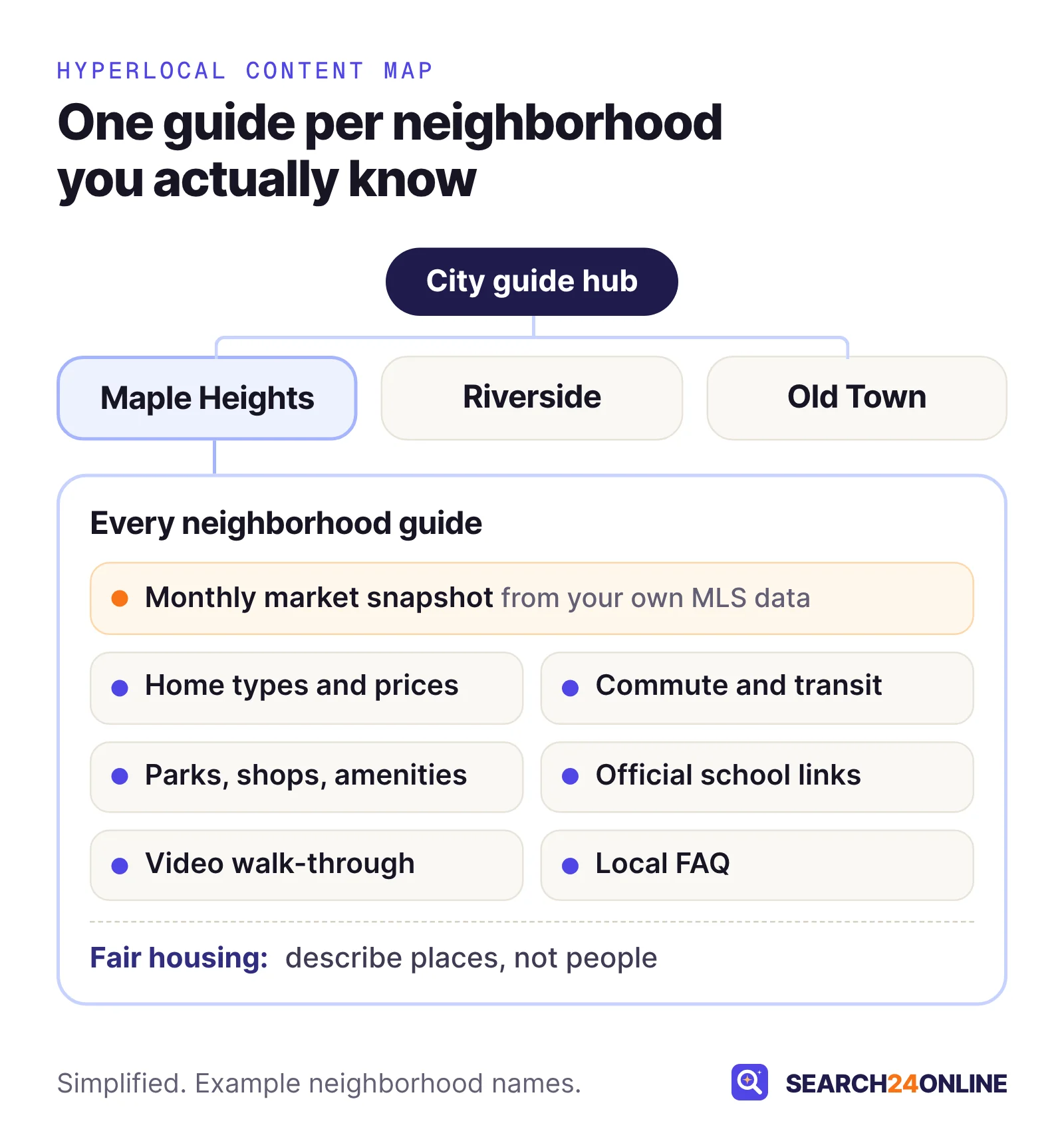
Pick only the neighborhoods you can speak to
Start with the five to ten areas where you have sold, listed or lived, not every subdivision in the county. A common situation in our audits: a brokerage site with 60 neighborhood pages built from one template, the name swapped and the same paragraphs about “charming streets and great amenities” on each. Most are never indexed, and the rest compete with each other. Mass-producing near-identical pages to rank is also risky; our glossary explains scaled content abuse.
Build each guide from first-hand detail
Cover, in plain sentences, the housing stock (ages, styles, lot sizes, condos versus single-family) and typical price bands from your own sales. Add HOA patterns, what is walkable, rush-hour commute times and where to find official information on schools, flood zones and zoning. Then add your own photos and one paragraph of honest trade-offs, such as train noise or older systems in older homes.
Connect guides to listings, data and video
Link each guide to a filtered listing search for the area, its section of your market report and its video walk-through, and link each of those back. Link neighboring guides to each other. That internal linking tells Google and visitors that the guide is the center of everything you publish about the area.
For brokerages: assign neighborhoods
On multi-agent sites we often find five agents who have each written a “Living in Maple Heights” post, all competing with the official neighborhood page. Assign one owner per guide, fold the best agent material into it and feature the agents who know the area. Also link every agent profile page from the team page and its guides: orphaned profile pages are among the most common indexing problems we see on brokerage sites.
How do you keep neighborhood content within fair housing rules?
Describe the property and the place, never the people who live there or who “should” live there. HUD’s advertising page says the Fair Housing Act bars making, printing or publishing ads that indicate a preference, limitation or discrimination based on race, color, religion, sex, disability, familial status or national origin. It applies to anyone placing real estate ads in newspapers or on websites; HUD’s examples include “no children” and “no wheelchairs.” A neighborhood guide on a brokerage site is advertising.
One recent change causes confusion. In a notice published in the Federal Register on April 6, 2026, HUD withdrew eight fair housing guidance documents, effective September 17, 2025, including its April 2024 guidance on advertising through digital platforms. The law did not change: the notice says actions that do not comply with the text of the Fair Housing Act “continue to be subject to enforcement.” Less guidance means more judgment on your side, not more freedom. State and local laws apply too.
Our working rules for neighborhood pages, videos and AI-drafted copy:
- Describe features and distances. “0.4 miles to the river trail” and “20 minutes to downtown at 8 a.m.” are facts about the place.
- Never characterize residents. Skip who lives there: ages, family types, ethnicity, religion or “the kind of neighbors” a buyer will have.
- Replace judgments with sources. Instead of “safe” or “great schools,” link the police department’s crime map, the district’s boundary tool and the state school report card.
- Check photos and video. Show streets, homes, parks and businesses, not curated shots of residents.
- Review every AI draft. Assistants trained on decades of listing copy reproduce coded phrases. Someone with fair housing training should approve each guide.
Fair housing compliance is your broker’s responsibility and yours. Have your brokerage’s compliance contact or counsel approve your neighborhood template once, then follow it for every guide.
Why don’t IDX listing pages rank, and what should you do with them?
IDX pages rarely rank because they show the same listing data as hundreds of other sites, and your copy is usually the least authoritative one. IDX (Internet Data Exchange) is the MLS arrangement that lets brokers display each other’s listings. Take San Diego MLS’s July 2026 rules as one example. Displays must be refreshed at least every 12 hours and name the listing firm. Participants “shall not modify or manipulate” other participants’ listing data, though they may add data from other sources if the source is identified.
When Google finds duplicate content, its documentation says it chooses one canonical URL, the version it considers best to show users, and agent sites usually lose that contest to portals. It is not a penalty, just no reason to show your copy. The same MLS rules say participants are not required to block search engines from indexing IDX listings, so indexing is your choice. In audits we see three recurring problems:
- Listings off your domain. The IDX sits on the vendor’s domain, a subdomain or an embedded frame, so it does little for your site.
- Index bloat. Thirty pages of real content next to tens of thousands of IDX URLs created by every price, bedroom and sort filter, which soak up crawling.
- Dead listings. Sold and expired listings turn into empty pages or errors by the thousand.
- Find out where your IDX livesSearch
site:yourdomain.comand inspect a few listing URLs in Search Console to see where they sit and whether Google indexes them. - Choose what deserves indexingUsually one curated search page per neighborhood or property type, wrapped in your own introduction and linked to its guide.
- Keep filter combinations outHave your vendor block crawling of sort and filter parameters, or point variations to the main page with canonical tags.
- Add what only you can addBeside the listing grid, add an area summary, recent trends from your report and a link to the guide, within your MLS’s rules.
- Handle listings that leave the marketAgree with your vendor where those URLs go, for example to the matching neighborhood page, and check the Page indexing report monthly.
What are Google’s rules for agent and brokerage Business Profiles?
Google allows individual agents their own Business Profile, with conditions. Its guidelines say doctors, dentists, lawyers, financial planners “and insurance or real estate agents are all individual practitioners.” A practitioner qualifies when they are public-facing and can be contacted directly at the verified location during stated hours. Support staff should not create their own profiles.
- Several agents at one office: the brokerage has its own location profile, and each agent’s profile title carries only the agent’s name.
- A solo agent under a brand: one profile in the format “[brand]: [practitioner name]”; Google’s example is “Allstate: Joe Miller.”
- One profile per person: no separate profiles for specializations, such as “luxury” and “relocation”.
- Real names only: the name must reflect the real-world name, and marketing taglines are not permitted. “Jane Ortiz | Top Realtor | Homes for Sale Austin” invites a suspension.
- No virtual offices: a rented mailing address you don’t work from is ineligible, and a service-area business can’t list a virtual office unless it is staffed during business hours.
- A phone you control: the number must be under the business’s direct control and must not redirect to anyone else’s number or landing page.
Two gray areas come up constantly. Agents who work from home and meet clients at properties are, in our reading, closest to Google’s service-area rules (one profile, address hidden); a profile at a brokerage office where you are not reachable during stated hours fails the practitioner test. And the guidelines don’t say what happens when an agent changes brokerages. Our view: agree in writing at onboarding who owns the profile and its login, because the reviews stay with the profile.
For the full setup (categories, services, photos, posts and avoiding suspensions), follow our step-by-step Business Profile guide.
How should agents earn reviews without breaking the rules?
Ask every client, at the same moment in every transaction, through one simple link, and never pay, filter or script. Reviews weigh heavily in real estate because the decision is about trusting a person. In NAR’s 2025 Profile, sellers named the agent’s reputation as the most important factor in choosing an agent (35%). A referred buyer who searches your name and finds 6 reviews, while the agent a coworker mentioned has 80, may make a second call.
Google’s content policy bans offering incentives such as payment, discounts or free services for reviews. Businesses also may not “discourage or prohibit negative reviews, or selectively solicit positive reviews.” Reviews based on a conflict of interest, including current or former employment, are banned. So are merchants “requesting that staff solicit a certain number of reviews,” which means review quotas for agents break the rules, while a consistent asking process does not.
- Time it to a milestone. Closing day, or the day after keys change hands.
- Ask everyone, including the difficult transactions. Selective asking is the most common violation we see, usually without the agent knowing it is one.
- Let clients use their own words. Details like the neighborhood or a tricky inspection come naturally and help other buyers.
- Reply to every review with something specific, without disclosing private details of the deal.
Keep your portal agent profiles current for buyers browsing there, but your Google profile is what appears when someone searches your name. Our guide to getting more Google reviews within the rules covers request templates, the FTC’s fake review rule and negative reviews.
Which video and market reports give an agent site an edge?
Neighborhood walk-through videos and a monthly market report built from your own data, because a portal cannot generate either for your patch. Video is already part of the search: NAR’s 2025 Profile found that 52% of buyers used online video sites during their search, and 70% used a mobile or tablet device.
Video that can be found
Post each walk-through to YouTube for reach, and give it a home on your site. Google’s video guidance recommends a watch page, a page whose main purpose is to show a single video, embedded with standard HTML elements, with a valid thumbnail and metadata such as VideoObject structured data or a video sitemap. In practice: one page per video, a written summary of what it covers and a link from the neighborhood guide.
Market reports with original data
Every month, pull the same figures for each area from your MLS: closed sales, median sale price, median days on market, sale-to-list price ratio and active inventory. Publish them on one stable page per area with a plain-English interpretation, a note on method and an archive of past months. An illustrative opening, with placeholders rather than real figures:
[Neighborhood] housing market, [Month Year]
[N] homes closed in [Neighborhood] in [Month], compared with [N] a year ago.
The median sale price was $[X], and the typical home went under contract
in [N] days. Sellers received a median [X]% of list price.
Source: [MLS name] data for single-family homes, pulled [date].
Fewer than 20 sales: treat month-to-month changes with caution.
That last line earns trust: in a small neighborhood, three unusual sales can swing a median. Check your MLS’s rules on publishing aggregated statistics and crediting the source first, because they vary. To write the interpretation so assistants can lift it, see how to write content AI assistants want to quote.
What do buyers ask AI assistants, and how do you become the answer?
Buyers now ask AI assistants what they used to type into Google or ask an agent, and for listing searches the portals are already inside the assistants. Zillow has experiences in ChatGPT and a rentals-focused experience in Gemini. On October 19, 2026 it launched a Claude connector that searches homes for sale or rent, checks home values, estimates affordability, and lets people request a tour or connect with an agent in the same conversation.
That largely settles who answers “show me 3-bedroom homes under $500,000 in Tempe”. Your opening is every question around the listing. Google says AI Overviews and AI Mode may use query fan-out, “issuing multiple related searches across subtopics,” so one buyer question can draw on a market report, a neighborhood guide and an agent page at once. It also says there are no special requirements: a page must be indexed and eligible to show in Search with a snippet.
Questions like these make a starting list (illustrative; adapt them to your market):
- “What is it like to live in [neighborhood] if I commute to [employment area]?”
- “Is [town] a buyer’s or seller’s market right now?”
- “What are typical closing costs for a buyer in [county, state]?”
- “Should I sell before buying another home in [city]?”
- “Which agents in [area] specialize in condos or first-time buyers?”
If a buyer asks whether an area is “safe,” the fair housing rules above still apply: answer with links to official data, not a verdict. Run your list monthly in ChatGPT, Google AI Mode, Perplexity, Gemini and Claude, record which sites are cited and give each unanswered question a clear section on the right page. Why pages get cited is explained in how AI assistants choose their sources.
How do you track which SEO work produces clients?
Track every lead by source from first contact to closing, because real estate cycles are long and traffic alone tells you nothing. NAR’s 2025 Profile puts the median buyer search at 10 weeks, so a visitor who reads your market report in March may call in June.
- Define the actions that matterShowing requests, valuation requests, contact forms, click-to-call and saved-search sign-ups, each set up as a key event in Google Analytics 4.
- Tag your profile linksAdd UTM parameters to the website link on your Business Profile so those visits show as their own source.
- Record the source in your CRMStore the first-touch source with every lead, include “AI assistant” as an option, and ask “How did you find me?” in the first conversation.
- Connect leads to closingsEach quarter, match closed transactions to their original source and landing page, and invest in the content types that produce clients.
Visits from ChatGPT and other assistants need their own GA4 setup; see seeing AI assistant traffic in GA4. To check the basics first, our free SEO + GEO report analyzes your website, from indexability and structured data to NAP and AI crawler access. You get password-protected dashboard access within 24 hours.
Our team’s over 20 years of digital marketing experience points to one order: fix access first (IDX index bloat, orphaned agent pages), then build three neighborhood guides and one market report. No one can promise rankings; these are the steps you control.
Common questions
Can a real estate agent outrank Zillow on Google?
For broad searches like homes for sale in a city, rarely, because portals carry every listing and years of authority. For neighborhood questions, local market questions and your own name, agent sites can rank, because portal pages there are generic templates.
Should I noindex my IDX listing pages?
Not necessarily all of them. Let a small set of curated area pages with your own written content be indexed, and keep filter and sort combinations out of the crawl. Check your MLS rules first; San Diego MLS, for example, does not require blocking search engines.
Can I have my own Google Business Profile if I work under a brokerage?
Yes, if you are public-facing and can be reached at the verified location during your stated hours; Google names real estate agents as individual practitioners. Where several agents share an office, the brokerage keeps its own profile and yours carries only your name.
Can I mention schools and crime in a neighborhood guide?
You can point buyers to official sources, such as the district boundary tool, state school report cards and police crime maps, and let them judge. Avoid your own labels like safe or good schools, which can read as steering. This is general information, not legal advice.
How often should an agent publish a local market report?
Monthly for areas with enough sales to make the numbers meaningful, quarterly where only a handful of homes sell. A predictable schedule, one stable page per area and a clear note on method matter more than volume.
Sources
- National Association of REALTORS®: 2025 Profile of Home Buyers and Sellers (full report, PDF hosted by Rhode Island REALTORS®)
- Zillow Group, Form 8-K exhibit (August 5, 2026): Second-quarter 2026 results
- Zillow (October 19, 2026): Zillow brings specialized housing intelligence to Claude
- The Real Deal (June 11, 2026): Google, HouseCanary to display home listings in 50 states
- San Diego MLS: IDX Rules and Compliance (July 2026)
- Google Search Central: How to specify a canonical URL with rel="canonical" and other methods
- Google Business Profile Help: Guidelines for representing your business on Google
- Google Maps user-contributed content policy: Prohibited and restricted content
- Google Search Central: Video SEO best practices
- Google Search Central: AI features and your website
- HUD Office of Fair Housing and Equal Opportunity: Advertising and Marketing
- Federal Register (April 6, 2026): HUD notice of withdrawal of fair housing guidance documents
Is your real estate site ready to be found beyond the portals?
We’ll analyze your website, from indexability and structured data to local trust signals and AI readiness, create your SEO + GEO report and give you password-protected dashboard access to view it.
Free · No obligation · We only review your public pages.