
Local Citations: What They Are and Which Still Matter
A citation is any place online that names your business with its address or phone number. Most businesses need a few dozen accurate ones, not hundreds. Here is which ones count in 2026, for Google and for AI assistants, and how to clean up the rest.
Key takeaways
- A local citation is any online mention of your business name with its address or phone number. The ones that still matter are a short list: Google, Bing, Apple, Yelp and Facebook, the main data aggregators, and the leading directories in your industry and town.
- Accuracy beats volume. In Whitespark’s 2026 survey of 47 local search experts, consistency on Google, Bing and Apple Maps ranked 28th of 187 local pack factors, while sheer quantity of structured citations ranked 110th.
- Listings now feed AI answers directly: in BrightLocal’s August 2026 study of nearly 2 million citations, Google Business Profile was the top source for Google’s AI features on local queries, and Yelp appeared in 80% of ChatGPT answers.
- Google says it uses licensed third-party data and user reports to update Business Profiles, so wrong details elsewhere can change your own listing. Fix your website first, then the core platforms, then the aggregators, and merge duplicates rather than deleting them.
On this page
What is a local citation?
A local citation is any online mention of your business that includes its name plus at least one identifying detail, usually the street address or phone number, often with the website. Local SEO shorthand for the core trio is NAP: name, address, phone. Search engines, map apps and AI assistants use these mentions to confirm that a business exists, where it is and how to reach it.
Structured citations
These are listings on platforms built to store business data in fixed fields. Think Google Business Profile, Bing Places, Apple Business (formerly Apple Business Connect), Yelp, Facebook, the Better Business Bureau, industry directories and the aggregators that supply many of them. Because every listing has the same fields, machines can compare them easily, which is exactly why errors in them spread.
Unstructured citations
These are mentions in running text: a local news story about your new location, a roundup of the best bakeries in town, a chamber of commerce member page, a youth league’s sponsor list. They are harder to create and to fake, and many include a link, so the best double as local backlinks.
In local SEO, a citation is a mention of your business details. In AI search, an AI citation is a page an AI answer links as its source. The two now overlap: a Yelp listing is a local citation and, as the data below shows, one of the pages AI assistants cite most for local questions.
Do citations still help you rank in 2026?
Yes, but as a foundation rather than a lever. Accurate listings on the main platforms are part of looking like a real, reachable business; adding more listings beyond that set does little for Google rankings on its own.
Google’s help page on local ranking names three factors: relevance, distance and prominence (its summary line now says “popularity”). Prominence, it says, draws on information such as how many websites link to your business and how many reviews you have. The current page doesn’t mention directories at all, and it states plainly that there is no way to request or pay for a better local ranking.
Google is more explicit about where business data comes from. Its page on sourcing lists crawled web content such as your website, licensed data from third parties, contributions from users and owners, and Google’s own interactions with the business. A separate page explains that Google may update your Business Profile when users or licensed sources report different information. If you don’t respond to a suggested edit within 4 days, Google may publish it when other public information supports it. That is the most concrete reason citations matter: the rest of the web can change your Google listing.
The best ranking evidence available is structured expert opinion. Whitespark’s 2026 Local Search Ranking Factors report, published in November 2025, asked 47 local search specialists to score 187 factors.
Whitespark says citations lost about half a percentage point of weight in its local pack scoring, yet also that “AI SEO is breathing new life into them.” Treat the survey as informed judgment, not measurement. Our view, from audits: once your core listings are accurate, more directories rarely move map rankings. Reviews, your Google Business Profile, your website’s relevance and real local links do. Our complete local SEO guide shows how those pieces fit together.
What does NAP consistency mean in practice?
It means every listing describes the same business: the name on your sign, one address, one main phone number and one website. It doesn’t mean every character must match. In our experience, “Suite 200” versus “Ste 200” is a formatting difference that search engines generally reconcile. Old addresses, old phone numbers, former names and stray tracking numbers are real conflicts, and those are what cause wrong directions, missed calls and suggested edits.
The name
Google’s guidelines say your name should reflect your real-world business name, and that adding unnecessary information to it isn’t permitted. “Smith Plumbing” listed on Google as “Smith Plumbing 24/7 Emergency Plumber Denver” is a guideline violation first and a consistency problem second. Use the name on your signage, invoices and website, everywhere.
The address
Google wants your actual, real-world location and does not accept P.O. boxes or mailboxes at remote locations. Pick one format for your street, suite and ZIP code, write it down in a master record, and copy from that record every time rather than retyping.
The phone number
Google asks for a local number rather than a central call center line where possible, says the number must be under the business’s direct control, and bans numbers that redirect users to landing pages. Its guidelines don’t mention call tracking numbers by name. Our view: put your main local number on every citation. A tracking number copied into 40 directories becomes 40 wrong numbers the day you switch tracking vendors.
The website
Google asks for a website that represents your individual business location. If you have several branches, link each listing to that branch’s location page, not the home page, and keep the NAP on that page identical to the listing.
Picture a dental practice that moved three years ago. Google and the website show the new address, but the old one still sits on Yelp, an insurance directory, two aggregator records and a dental association page. A patient asking a map app or AI assistant for directions could be sent to the old building. A 41st listing fixes nothing; correcting those five does.
In audits we often find that the business’s own website is the inconsistent source: an old address in the footer, a different number on the contact page, or business schema markup that still lists the previous suite. Fix the site first; it is the source Google crawls directly and the only one you fully control.
Which citations still matter?
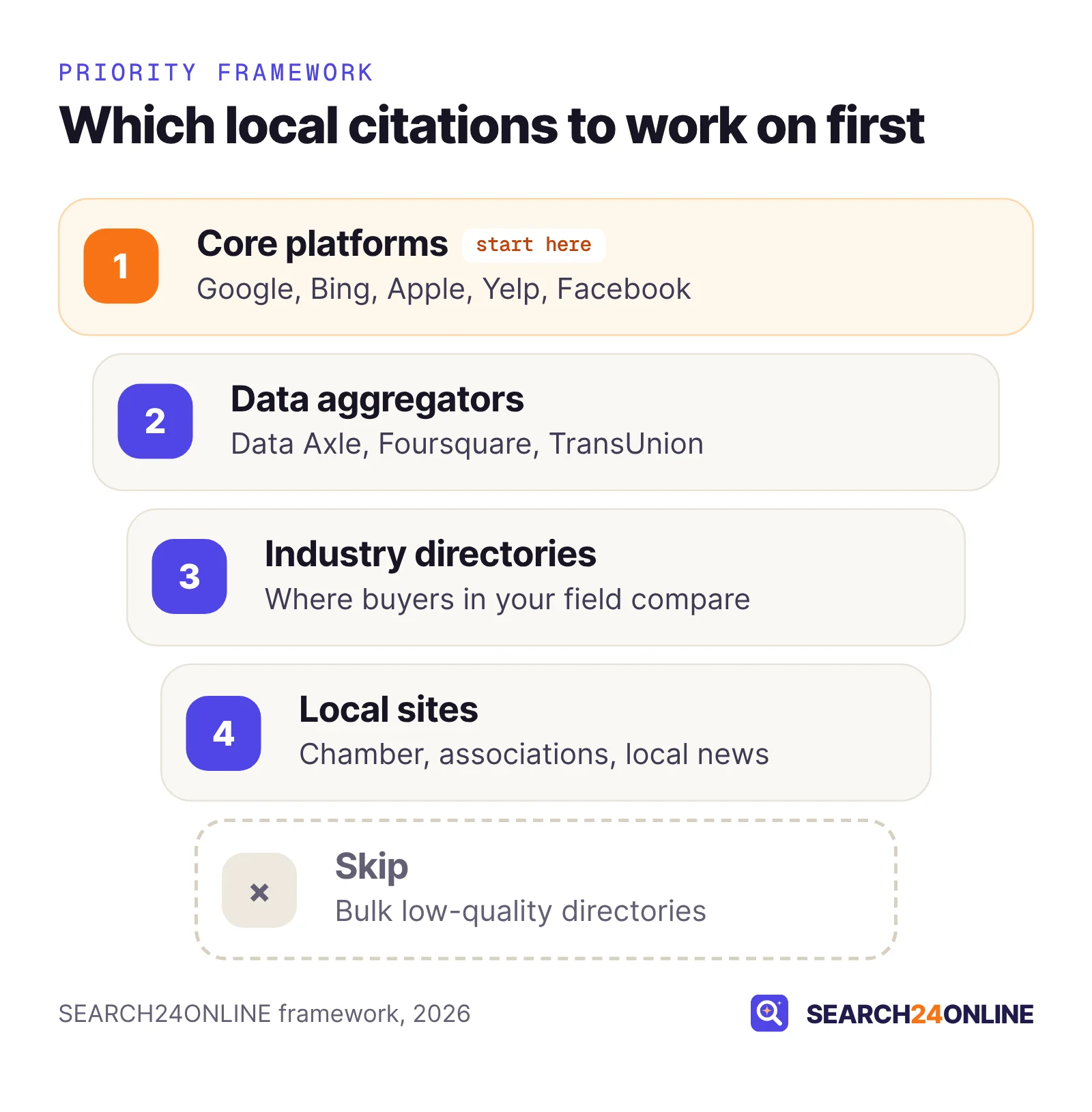
Four tiers, worked in order: core platforms, data aggregators, industry directories and local sites. Everything beyond those is optional at best, and some of it is clutter you will later have to clean up.
Tier 1: the core platforms
Google Business Profile, Bing Places, Apple Business, Yelp and Facebook are where people actually look up businesses, and where map apps, voice assistants and AI answers get much of their local data. In BrightLocal’s 2026 study of local AI answers, Google Business Profile, Yelp and Facebook were the three most cited domains. Claim, verify and complete every one. Our step-by-step guides cover optimizing your Google Business Profile and setting up Bing Places and Apple Business, the two most businesses skip.
Tier 2: the data aggregators
Aggregators collect business records and license them onward, so one correction can reach dozens of sites you will never touch by hand. They get their own section below.
Tier 3: industry directories
These are the sites your customers use to choose within your category. BrightLocal’s data shows the pattern: Tripadvisor and OpenTable for restaurants, Justia for lawyers, Healthy Paws and Scratchpay for pet care. To find yours, search your main service plus your city and note which directories rank on the first page. Whitespark’s Darren Shaw also suggests asking ChatGPT and Gemini which sites they consider important in your industry; treat the answer as a lead to verify, not a list to buy.
Tier 4: local and unstructured
Chamber of commerce and association pages, local news coverage, sponsorships, event listings and supplier “where to buy” pages. In the Whitespark survey, the quality and authority of unstructured citations ranked 37th for local organic results. These take relationships rather than forms, which is why competitors rarely copy them.
What to skip
Bulk packages of hundreds of directories nobody visits, sites that exist only to sell listings, and directories for other countries. They add maintenance, not customers.
Who are the US data aggregators in 2026?
Three names cover the main US networks today: Data Axle, Foursquare and TransUnion, whose listings product is listed as formerly Neustar Localeze. They compile business records and supply them to search engines, map and navigation systems, apps and directories, so a correction there flows to places you will never log in to.
| Aggregator | What it says it reaches | How a business updates it | Cost (as published, Nov 2026) |
|---|---|---|---|
| Data Axle | Top search engines and online directories, in-car and mobile navigation, virtual assistants, and 85% of large public libraries | Find and verify your listing on its platform; bulk upload or API for larger brands | Free for 1 to 10 listings; enterprise plan for more |
| Foursquare | A places dataset of 100M+ points of interest in 200+ countries, used by companies such as Yahoo, Redfin and Nextdoor | Claim the venue through its business listings portal | Not stated on its product page |
| TransUnion Digital Business Profile (formerly Neustar Localeze) | 80+ online publishers, including Google, Apple, Bing, Facebook and YP.com, plus maps and GPS systems | Manage one profile in TransUnion’s portal, which publishes it onward | $99 per year per location |
A few honest caveats. Each row reflects what the company says about itself; none of them publishes a full list of who licenses its data. Google says it uses licensed third-party data but does not name the providers, so no aggregator can promise anything about Google. In the Whitespark survey, consistency on data aggregators ranked 85th of 187 local pack factors. Their value is upstream hygiene: correct the source, and the wrong address stops flowing back into directories you already fixed.
Many citation guides, and even the factor names in Whitespark’s 2026 survey, still list “Localeze” and “Foursquare/Factual”. Before you pay anyone to “submit to the aggregators,” ask which companies they mean and whether the free routes, such as Data Axle’s, already cover you.
How do you find and fix duplicate listings?
Search for every old version of your details, merge or close what you find on the core platforms, then correct the aggregators so duplicates are not recreated. They usually come from a move, a rebrand, a former employee’s listing or a stale aggregator record.
- List every past identityWrite down all phone numbers the business has used (including old tracking numbers), previous addresses, former names and old domains. This list is your search plan.
- Search each detail, not just the nameSearch every phone number and old address on Google, Google Maps, Bing, Apple Maps, Yelp and Facebook. Phone number searches surface duplicates that name searches miss.
- Fix Google firstIf you created a duplicate of your own verified profile, remove it. If two public profiles represent the same business, suggest a merge in Google Maps. If someone else verified a profile for your business, request access through Business Profile.
- Handle the other platformsClaim each duplicate and ask that platform’s support team to merge it into your main listing or mark it closed or moved.
- Correct the aggregatorsUpdate Data Axle, Foursquare and TransUnion with your current details so old records stop feeding directories.
- Recheck after two to three monthsRun the same searches again. Old data that reappears usually points to a source you haven’t found yet.
Google’s help page adds the details. Removing a duplicate you created leaves your verified listing intact but deletes the duplicate’s content and managers. Google reviews every merge request; merged profiles combine reviews, though replies may be lost. When you request access to a profile someone else verified, the owner has 3 days to respond.
An old profile with 60 reviews is an asset with the wrong address, not junk. Ask for a merge so the reviews follow you. And separate businesses at one address, such as two practices in a shared office, are not duplicates: Google allows each its own profile if they have different names, distinct signage and are each eligible.
How do AI assistants use business directories?
For local questions, they lean heavily on the big listings. BrightLocal’s study, published August 26, 2026, analyzed 1,967,762 citations from Google AI Overviews, Google AI Mode and ChatGPT for business locations in the US, UK and Australia, using 60,970 checks.
Share of all citations in local AI answers, by domain
Google AI Overviews, Google AI Mode and ChatGPT combined. Source: BrightLocal, Top sources and directories for local AI search (August 2026), full results table. Its key findings round Google Business Profile to 28.5% and list Yelp at 8.53%.
- Google’s AI features lean on Google Business Profile. It was the top source for both AI Overviews and AI Mode.
- ChatGPT leans on Yelp. Yelp was its top source and appeared in 80% of its answers, followed by Tripadvisor, OpenTable, the BBB and Angi’s list.
- Old directories still show up. BrightLocal found legacy directories such as the BBB, Angi’s list and MapQuest regularly cited.
- Your website is part of the pool. Around 93% of the cited domains were individual business websites. AI Mode drew on 81,817 unique domains, ChatGPT on 6,025.
- Industry sites matter by vertical. For lawyers, Google Business Profile made up 42% of citations, Yelp 7.9% and Justia 3.2%; for dentists, Google Business Profile made up 57%.
Two limits: Gemini, Perplexity and Copilot were not studied, and the study counts which sources appear, not how much weight each carries. The practical reading still holds. Different assistants pull from different listings, so covering all the core platforms beats optimizing for one, and whatever is wrong on them may be repeated to a customer.
Be careful with claims that go further. TransUnion’s product page says AI scans hundreds of directories and fills gaps itself when information conflicts. That is marketing; no AI platform documents how it weighs directory data. Whitespark’s line, “In AI SEO, mentions (citations) are the new link,” is plausible but still opinion. For the wider picture of how assistants recognize a business, see our guides to entity SEO and getting your business mentioned in ChatGPT.
Should you pay for a citation service?
For a single location, usually not on an ongoing basis. Managing the core platforms yourself plus a one-time cleanup and build covers most of the value; subscription sync services earn their keep with many locations or details that change often.
| Do it all yourself | Subscription sync service | Core platforms + one-time cleanup | |
|---|---|---|---|
| Best for | Owners with time and one location | Multi-location brands, frequent hours or menu changes | Most single-location and small multi-location businesses |
| Fixes the upstream source | Only if you update the aggregators too | Not necessarily: it pushes data to its own publisher network | Yes: aggregators are part of the cleanup |
| If you stop | Nothing changes | Listings stay, then drift as publishers rely on other sources | Fixed listings stay fixed; you own the logins |
| Main risk | Missed duplicates, inconsistent typing | Paying for reach on sites customers never visit | Needs a yearly recheck |
The “if you stop” row comes from Yext’s help center. Yext says it never reverts listings after cancellation, but without a provider the data “may change over time” as publishers lean on aggregators and user content. That is the case for fixing the sources rather than renting a layer on top of them.
Whichever route you choose, keep ownership: every listing should be claimed under a login your business controls, not an agency’s personal account. Our own plans build citations at a deliberate pace; Starter includes Google Business Profile, Bing Places and 10 citations a month.
Which citation myths waste money?
The expensive ones all assume that more is better.
- “You need hundreds of citations.” Quantity of structured citations ranked 110th of 187 in Whitespark’s survey. The useful set is the four tiers above, typically a few dozen listings for one location.
- “More citations push you up the map pack.” Google lists links and reviews among its prominence signals and says you cannot pay for a better local ranking. Citations support trust in your data; they are not a ranking dial.
- “Every listing must match to the character.” Fix wrong facts first. Abbreviation differences are the last thing to worry about.
- “Keywords in the listing name help.” On Google they break the naming guidelines, and repeating a stuffed name across directories spreads the problem.
- “Citations are dead.” Their ranking weight has slipped, but BrightLocal’s data shows listings are among the sources AI answers cite most for local questions.
- “Delete the old listing.” Merge it when it holds reviews; deleting throws them away.
What does a citation cleanup look like in practice?
Start from your own website and work outward, in the order the data flows. Our team has served 500+ brands, and businesses with messy citations usually share one root problem: no single master record of their details, so every new listing was typed from memory.
- Write the master recordExact name, address format, main phone, website URL per location, hours, categories and a short description. Every listing is copied from this file.
- Make your website match itHeader, footer, contact page, location pages and business schema markup. Our schema markup guide covers the LocalBusiness type.
- Fix tier 1Claim, verify and complete Google, Bing, Apple, Yelp and Facebook, and turn on notifications so you see suggested edits within Google’s 4-day window.
- Fix the aggregators and duplicatesUpdate Data Axle, Foursquare and TransUnion, then merge or close duplicates.
- Add tiers 3 and 4 graduallyA few relevant industry and local listings a month, each checked against the master record.
For a starting point, our free SEO + GEO report analyzes your website, including its NAP, click-to-call links and business schema, with password-protected dashboard access within 24 hours. It doesn’t audit directory listings; it checks the source you control.
Common questions
How many local citations does a small business need?
There is no magic number; for most single-location businesses, a few dozen accurate listings cover what matters. That means the core platforms, the main data aggregators, the top directories in your industry and a handful of local sites. In Whitespark’s 2026 expert survey, sheer quantity of structured citations ranked 110th of 187 local pack factors.
Are local citations the same as backlinks?
No. A citation is a mention of your business name with your address or phone number, and it counts whether or not it links to your website. Some citations include a link, and a mention in a local news story or association page can be both a citation and a valuable local link.
Will a call tracking number hurt my NAP consistency?
It can, if the tracking number spreads to directories and then changes. Google’s guidelines ask for a local number under the business’s direct control and do not name tracking numbers, so the safest habit is to keep your main local number on every citation and limit tracking numbers to places you control.
Do citations help my business show up in ChatGPT and Google AI answers?
They are among the sources those answers draw on. BrightLocal’s August 2026 study found Google Business Profile was the top source for Google’s AI Overviews and AI Mode on local queries, and Yelp appeared as a source in 80% of ChatGPT answers. Accurate core listings make it more likely that what an assistant repeats about you is correct.
How long does it take for citation fixes to show up?
It varies by platform, from days to months. Google gives owners 4 days to respond to a suggested edit, while aggregators and directories refresh on their own schedules, so we recheck searches for old details two to three months after a cleanup.
Sources
- Google Business Profile Help: Tips to improve your local ranking on Google
- Google Business Profile Help: How Google sources business information
- Google Business Profile Help: Understand Google updates on your Business Profile
- Google Business Profile Help: Guidelines for representing your business on Google
- Google Business Profile Help: Resolve duplicate profiles and ownership issues
- Whitespark (November 2025): 2026 Local Search Ranking Factors
- BrightLocal (August 2026): Top sources and directories for local AI search
- Data Axle: Local listings
- Foursquare Places: product overview
- TransUnion: Digital Business Profiles
- Duda App Store: TransUnion Digital Business Profile (formerly Neustar Localeze)
- Yext Help Center: What happens after opting out of listings in Yext
Does your own website tell the same story as your listings? Check free.
We’ll analyze your website, including the NAP and business schema on it, create your SEO + GEO report and give you password-protected dashboard access to view it.
Free · No obligation · We only review your public pages.