
Does llms.txt Help? What It Does and Does Not Do
llms.txt is a small Markdown file that some sites now publish for AI tools. Here is where it came from, what Google and the AI companies actually say about it, what server-log data shows, and when it is worth your time.
Key takeaways
- llms.txt does not help with Google: Google’s AI optimization guide (updated July 10, 2026) says Google Search ignores llms.txt files, so they “will neither harm nor help” your visibility or rankings, including in AI Overviews and AI Mode.
- No major AI search platform has documented using llms.txt to choose sources. OpenAI and Perplexity publish llms.txt files for their own developer docs, but their crawler documentation points site owners to robots.txt.
- Ahrefs’ June 2026 study of 137,210 domains found that 97% of published llms.txt files received zero requests in May 2026, and AI bots made just 19.5% of the requests the rest received.
- It can make sense for developer documentation that coding agents read, or when your CMS generates it for free. For most business sites, crawler access, indexing and clear pages matter far more.
On this page
Does llms.txt help your SEO or AI visibility?
For Google, no, and Google has said so in writing. For ChatGPT, Perplexity, Claude and Copilot, there is no public evidence that it does, and the best server-log data available says AI crawlers rarely even ask for the file. The one place it has a real job is helping AI coding tools and agents read technical documentation.
That is a narrower answer than many sales pitches give. llms.txt is often pitched as an “AI SEO” quick win: upload one file and the chatbots will cite your business. The proposal’s own author never promised that, and the search platforms have not adopted it. Where a platform has said nothing, we say so rather than guess.
What is llms.txt, and who proposed it?
llms.txt is a proposed convention, not an official standard. Jeremy Howard published it on the Answer.AI blog on September 3, 2024, suggesting that websites put a Markdown file at /llms.txt that gives language models a short, curated guide to the site. The specification lives at llmstxt.org, which lists Howard as the author and shows the page as last modified on August 10, 2026.
The reasoning is about reading cost, not ranking. The spec says HTML wraps information in navigation, ads and JavaScript, and that turning it back into clean text is “difficult and imprecise.” Context windows (the amount of text a model can handle at once) are still too small for most whole websites, so a curated index saves an agent from crawling everything to find three pages.
The proposal has a second half: pages should also offer a clean Markdown copy at the same address with .md added. Answer.AI’s post shows where both ideas came from, its own software documentation for FastHTML and nbdev. The examples were developer docs from the start.
Uptake has come mostly from tools. llmstxt.org lists integrations in documentation platforms such as Mintlify and GitBook, SEO plugins such as Yoast SEO and AIOSEO, and the Wix site builder. It also notes that OpenAI, Anthropic and Google’s Gemini publish llms.txt files for their developer docs. Publishing a file and reading other people’s files are different things.
What does an llms.txt file look like?
It is a short Markdown document with a fixed order. The spec requires only one element, an H1 heading with the name of the site or project; everything else is optional but has a set place.
- H1 titleThe site or project name, on the first line. The only required part.
- Blockquote summaryA one- or two-sentence description that gives the key context a model needs to understand the rest.
- Optional detailsParagraphs or lists with more context, using any Markdown except headings.
- H2 file listsSections of links, one per line, in the form [name](url) followed by an optional colon and a short note.
- An “Optional” sectionLinks the spec says an agent can skip when it needs a shorter context.
Here is a correct example for a fictional heating and cooling contractor. The links point at Markdown copies of each page, as the proposal expects:
# Lakeside Heating & Air

> Family-owned heating and air conditioning contractor serving Columbus, Ohio, and nearby suburbs. Residential repair, replacement and maintenance.

Key facts:

- Service area: Franklin, Delaware and Licking counties
- Emergency repairs available 24/7
- Prices on our pages are typical ranges, not quotes

## Services

- [Furnace repair](https://www.example.com/furnace-repair.md): Common faults, typical repair costs, same-day availability
- [AC replacement](https://www.example.com/ac-replacement.md): System types, sizing, rebates and financing
- [Maintenance plans](https://www.example.com/maintenance-plans.md): What each visit covers and what it costs

## Company

- [About us](https://www.example.com/about.md): Licenses, history and team
- [Contact](https://www.example.com/contact.md): Phone, hours and booking

## Optional

- [Seasonal guides](https://www.example.com/blog.md): Maintenance tips by season
Look at what that file contains: a name, a summary, and links to pages already in the site’s menu and XML sitemap. For a small business, that is the core problem. It restates what a well-built site already exposes, and the .md copies double the pages someone must keep accurate.
Compare a software company with 900 pages of API reference. There, an index that says “start with authentication, then these five endpoints, skip the changelog” tells an agent something the navigation does not. Same format, very different value.
Ahrefs warns that agents are built to trust this file and that potential bad actors are already probing llms.txt for prompt injection (text that tries to give an AI tool instructions). Its advice: plain links and descriptions only, nothing instruction-shaped, and treat the file like code, with version control and limited edit rights.
What does Google say about llms.txt?
Google says Search ignores it. Its AI optimization guide, last updated July 10, 2026, lists llms.txt under “what you don’t need to do.” It says you don’t need “new machine readable files, AI text files, markup, or Markdown to appear in Google Search,” because Search itself does not use them.
The guide is not hostile to the file. It calls it “completely fine” to maintain llms.txt for other services that use it, and says doing so “will neither harm nor help” your visibility or rankings in Google Search. Its closing advice lists “creating unnecessary AI text files (like llms.txt)” among tactics you can skip, next to chunking content and chasing inauthentic mentions.
Google’s page on AI features and your website says the same for AI Overviews and AI Mode. There are “no additional requirements” to appear, and you don’t need “new machine readable files, AI text files, or markup.” Our guide to appearing in AI Overviews and AI Mode covers what Google does require.
Google staff took this line before the guide. In a Bluesky post reported on August 1, 2025, Gary Illyes wrote that it is “very easy to draw a parallel between 1990’s keywords meta tag and this.” Our reading of the comparison: a signal that site owners fully control is easy to game, so a search engine has little reason to trust it.
Why does Chrome’s Lighthouse check for llms.txt, then?
Because that check is about AI agents using a site, not about Search. Chrome’s documentation for the Lighthouse llms.txt audit, updated May 5, 2026, says it flags a server error when the file is requested. A missing file (a 404) is marked “Not Applicable” because providing one is “optional at the moment.” The page says nothing about rankings.
The two positions fit once you separate the products. Search, which decides rankings and AI Overview citations, ignores the file; a tool that measures how easily agents can operate a site treats it as an optional convenience. An audit that marks you down for lacking one is scoring agent readiness, not search visibility.
What have OpenAI, Perplexity, Anthropic and others said?
None of them has publicly documented using llms.txt to decide what to crawl, index or cite. Their help pages for site owners describe robots.txt controls, and that is where their attention is.
OpenAI’s crawler documentation explains its user agents, including OAI-SearchBot for ChatGPT search, GPTBot for training data, and ChatGPT-User for visits a user’s question triggers. It says search results can take about 24 hours to reflect a robots.txt change. The page links to OpenAI’s own llms.txt as “the complete documentation index” for developers, not as something its crawlers look for on your site.
Perplexity’s crawler page follows the same pattern. It opens with a pointer to its own llms.txt documentation index, then explains PerplexityBot, which surfaces and links sites in search results, and Perplexity-User, which fetches pages when a user asks. Nothing on the page mentions reading site owners’ llms.txt files.
We found no public statement from Anthropic, Microsoft or Google’s Gemini team that their assistants use llms.txt to rank or cite sources. Where AI companies publish the file for their own docs, it shows they find it handy for developers. It does not show their search products read yours.
Each assistant has separate bots for training, search and user-triggered visits, and blocking the wrong one can remove you from its answers. Our guide to AI crawlers and whether to block them lists them and the robots.txt rules for each.
Do AI crawlers actually request llms.txt?
Rarely. The largest log-based study we found, published by Ahrefs on June 15, 2026, checked 137,210 domains with traffic in May 2026. About 28% of them (roughly 38,000) published an llms.txt file, and 97% of those files received zero requests during the month.
Ahrefs is open about the limits. Its analytics customers skew technical and SEO-aware, so it calls the 28% adoption figure an upper bound, and it measured fetches of the index file only. A fetch does not prove that anything was read, used or cited.
Who requested llms.txt files in May 2026 (share of all requests)
Requests to llms.txt files across 137,210 domains; selected categories, smaller ones not shown. The bots that fetch pages for AI search answers made the fewest requests. Source: Ahrefs, June 2026.
The breakdown is telling. Bots made 96% of requests and AI bots of all kinds 19.5%; SEO audit tools out-requested every AI category. GPTBot, OpenAI’s training crawler, was the most active single AI bot at 4.51% of requests, while OAI-SearchBot, the crawler behind ChatGPT search, made 0.74% and ClaudeBot 0.8%. Slackbot fetched the files more often than PerplexityBot.
Googlebot fetched llms.txt files about 900 times, which Ahrefs reads as routine crawling of any URL it discovers. AI bots made zero requests for llms.txt paths that returned a 404. Ahrefs concludes that agents fetch the file when a link, an index or a user instruction points to it, not speculatively.
A second study agrees. SE Ranking analyzed roughly 300,000 domains, found llms.txt on 10.13%, and found no measurable relationship between having the file and how often a domain was cited in LLM answers, as Search Engine Journal reported in November 2025. Our reading: the evidence does not prove the file is useless, but gives no reason to expect citation gains.
llms.txt vs robots.txt vs XML sitemap: what does each file do?
They sound like siblings but do very different jobs. robots.txt controls which crawlers may fetch which URLs, an XML sitemap lists the pages you want search engines to find, and llms.txt is a curated reading list that only some AI tools fetch, usually when told to.
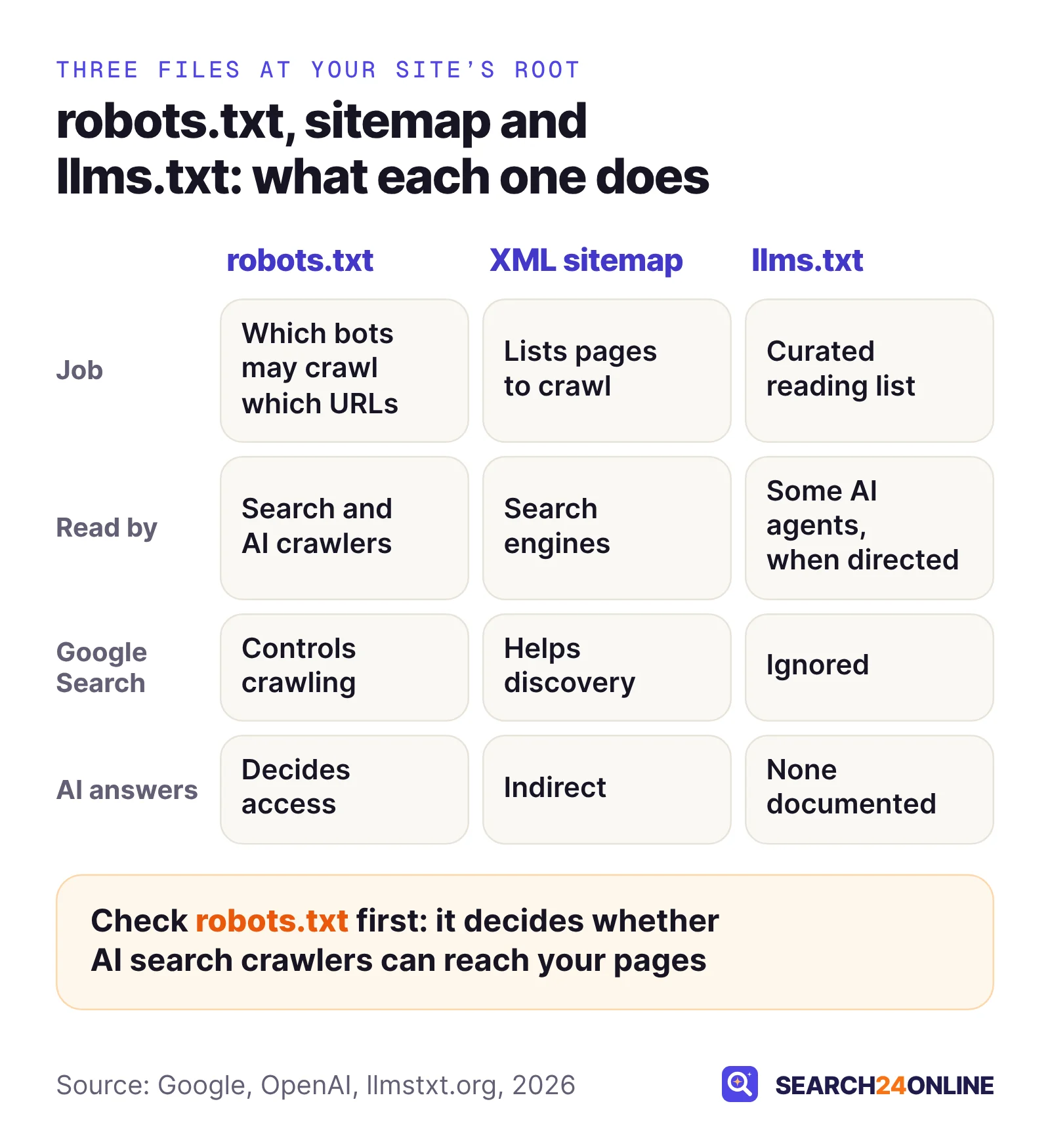
| robots.txt | XML sitemap | llms.txt | |
|---|---|---|---|
| What it does | Tells crawlers which URLs they can access | Lists the pages and files you consider important, with details such as last update | Gives AI tools a summary and a curated list of key pages |
| Who reads it | Search crawlers and AI crawlers, including OAI-SearchBot and PerplexityBot | Search engines such as Google, to crawl more efficiently | Some AI agents and coding tools, mostly when pointed to it |
| Effect on Google Search | Controls crawling, but Google says it is not a way to keep a page out of Google | Helps discovery; Google says inclusion does not guarantee crawling or indexing | None: Google says Search ignores it |
| Effect on AI search answers | Decisive: blocking a search crawler such as OAI-SearchBot keeps you out of that assistant’s search answers | Indirect, through better crawling and indexing | None documented by any AI search platform |
| Who needs one | Any site that wants to set rules for crawlers, including AI bots | Most sites; Google says sites of about 500 pages or fewer may not need one | Optional; most useful for developer documentation |
The practical consequence: a site with a polished llms.txt and a robots.txt that accidentally blocks OAI-SearchBot stays out of ChatGPT search answers, because OpenAI says opted-out sites “will not be shown” there. A site with no llms.txt and clean crawler access gives up nothing any platform has documented.
What does llms.txt cost, and what can it get you?
The direct cost is small; the hidden costs are where businesses lose. A basic file takes minutes, and several plugins and site builders generate one. The risks are maintenance drift, security, distraction and paying for something free.
The costs
- Maintenance. A hand-written file goes stale the first time you rename a service page, and one that sends an agent to old prices is worse than none.
- Security. The file is a prompt injection target, so restrict who can change it and review auto-generated versions.
- Search clutter. Google’s guide notes it may crawl and index many kinds of files besides HTML, so a raw text file can turn up in results.
- Opportunity cost. Every hour on llms.txt is an hour not spent on indexing problems, thin pages or blocked crawlers, which do affect visibility.
- Overpaying. Some vendors sell llms.txt as a premium “AI readiness” service. Paying for a file Google ignores is a warning sign about the rest of the vendor’s pitch.
The possible benefits
- Agents that are told to use it. Coding assistants can follow a link to llms.txt and get a cleaner map of your content. Ahrefs calls coding agents the closest thing to an intended audience in its data.
- A minor Lighthouse item. Lighthouse’s audit explains how to add the file, though a missing one is marked Not Applicable rather than failed.
- Little downside when generated well. If your platform keeps it in sync and you review it once, the cost is close to zero.
Our view: for a typical lead-generation business, the expected value is close to zero. It turns positive only for sites whose readers point AI tools at their documentation.
When is llms.txt worth adding?
It is worth adding when software agents are a real part of your audience, or when it costs you nothing. Four questions settle it for most businesses.
- Do developers use AI tools to read your docs?If you publish API references, SDK guides or product documentation, yes is likely. This is the use case the proposal was built for.
- Are your docs too big to navigate quickly?A curated index earns its keep on hundreds of reference pages, not on a 20-page brochure site whose menu already does the job.
- Can your platform generate and update it?If Yoast, AIOSEO, Wix or your documentation platform keeps it in sync, enabling it is low-risk. A hand-maintained file needs an owner.
- Are the basics already done?If key pages are not indexed or AI crawlers are blocked, fix that first. llms.txt cannot rescue a page that crawlers cannot reach.
Three common situations
A SaaS company with public API docs. Worth doing, ideally through the documentation platform, with a link to the file from the docs. Since agents fetch it when directed, telling developers it exists is part of the job.
A local service business. A plumber, dental practice or law firm gains little. Its customers ask ChatGPT or Google AI Mode for a recommendation, and in our experience those answers draw on search results, reviews and listings, not on llms.txt. If the website plugin offers it for free, turning it on is harmless; paying for it is not sensible.
An online store. Prices and stock change daily, which a static file cannot keep up with. Accurate product pages and structured data that matches them do far more.
If you do publish one, keep it short and factual, link only to canonical pages, give one person the job of updating it, and let your logs tell you whether anything reads it.
What should you do instead to show up in AI answers?
The work that earns AI citations is the work that earns rankings: crawler access, indexing, clear pages and a reputation beyond your own site. Google calls optimizing for generative AI search “still SEO,” and nothing the other platforms publish contradicts that.
Our team brings over 20 years of digital marketing experience, and in audits we often find sites with an llms.txt, sometimes generated by a plugin nobody remembers enabling, while the problems that actually block visibility go unnoticed. These are the ones to check first.
1. Make sure the right crawlers can reach you
Check yoursite.com/robots.txt for rules that block search crawlers such as OAI-SearchBot or PerplexityBot, and ask your host or CDN whether bot protection blocks them anyway. Decide separately about training crawlers like GPTBot. Our AI crawler guide has the rules for each bot.
2. Fix indexing before anything else
A common situation: a regional contractor whose most profitable service pages were never indexed because of a stray noindex tag or a sitemap full of redirected URLs. Check the Page indexing report and URL Inspection in Search Console, keep the sitemap to live, canonical pages, and link to important pages from related ones. Our technical SEO checklist walks through the rest.
3. Write pages that answer the questions buyers ask
Put the key facts in crawlable text near the top of each page: what you do, for whom, where, at what typical price. Google’s guide asks for non-commodity content, meaning unique expert or experienced takes beyond common knowledge. Thin, outdated or overlapping pages that compete for the same keyword (cannibalization) are the usual obstacles. See how to write content AI assistants want to quote.
4. Use structured data that matches the page
Google’s guide says structured data “isn’t required for generative AI search,” but recommends keeping it in your SEO strategy because it helps pages qualify for rich results. Make sure it matches what the page visibly says. Our schema markup guide covers which types matter.
5. Measure what you can
Search Console data, AI referral traffic in analytics and a monthly check of the questions your customers ask give you a baseline; our guide to tracking brand visibility in AI answers shows how. The broader discipline is generative engine optimization (GEO).
If you would like this checked for you, our free SEO + GEO report analyzes your website and gives you password-protected dashboard access within 24 hours. No one can promise an AI citation; what you can control is whether your pages are reachable, indexed and worth quoting.
Common questions
Will adding llms.txt improve my Google rankings?
No. Google’s AI optimization guide says Google Search ignores llms.txt files, so publishing one will neither help nor harm your visibility or rankings in Google Search, including AI Overviews and AI Mode.
Does ChatGPT read llms.txt?
OpenAI has not said that ChatGPT search uses llms.txt. Its crawler documentation describes robots.txt controls and links to an llms.txt only as the index of its own developer docs. GPTBot does fetch some llms.txt files, but a fetch does not show the content was used.
Can llms.txt block AI companies from training on my content?
No. llms.txt is a curated reading list, not a permission file. Blocking or allowing crawlers is done in robots.txt, user agent by user agent, and the AI companies’ own documentation points site owners to robots.txt for that.
What are llms-full.txt and llms-ctx.txt?
llms-ctx.txt and llms-ctx-full.txt are expanded companions to llms.txt that put the linked content itself into one file; Answer.AI’s 2024 post describes FastHTML generating both from its llms.txt. llms-full.txt is a similar name you may see, but the llmstxt.org specification does not define it. All of them suit developer documentation far more than business websites.
Should I pay an agency to create an llms.txt file?
Not as a separate service. A basic file takes minutes to write, several SEO plugins and site builders can generate one, and no platform has documented a ranking or citation benefit. Spend the budget on indexing, crawler access and clearer pages.
Sources
- llmstxt.org: The /llms.txt file (proposal and specification)
- Answer.AI (September 3, 2024): /llms.txt, a proposal to provide information to help LLMs use websites
- Google Search Central: Optimizing for generative AI search (AI optimization guide)
- Google Search Central: AI features and your website
- Chrome for Developers: Lighthouse llms.txt audit
- Ahrefs (June 15, 2026): We analyzed 137K sites: 97% of llms.txt files never get read
- Search Engine Journal (November 20, 2025): llms.txt shows no clear effect on AI citations, based on 300K domains
- Search Engine Roundtable (August 1, 2025): Google’s Gary Illyes compares llms.txt to the keywords meta tag
- OpenAI: Overview of OpenAI crawlers
- Perplexity docs: Perplexity crawlers
- Google Search Central: Introduction to robots.txt
- Google Search Central: What is a sitemap?
Skip the AI file tricks. See what is really blocking you.
We’ll analyze your website, create your SEO + GEO report and give you password-protected dashboard access to view it.
Free · No obligation · We only review your public pages.