
SEO for Law Firms: How Clients Find Attorneys Online
A practical guide for US law firms: how to build practice-area and city pages that rank, show real attorney expertise, stay inside bar advertising rules and trace each search back to a signed case.
Key takeaways
- Clients find attorneys through Google’s map results, practice-area searches, question searches, legal directories and AI assistants, so law firm SEO means one strong page per practice area, an accurate Google Business Profile for each real office, and attorney bios that prove who is behind the advice.
- In our view, legal topics fall under what Google calls “Your Money or Your Life” content, where trust weighs most, so named attorney authors, current facts and clear jurisdiction matter more here than in most industries.
- ABA Model Rules 7.1–7.3 ban false or misleading communications, restrict paying for recommendations and specialist claims, and limit live solicitation, but each state adopts its own version: check your state bar’s rules, not just the model.
- Ranking is only half the job: in Clio’s 2024 secret shopper study of 500 law firms, only 33% replied to emails and 48% could not be reached by phone, so intake and lead tracking decide whether SEO turns into signed cases.
On this page
How do people find a lawyer online?
Through five main routes: the map results for “lawyer near me” searches, practice-area searches (“Tampa DUI attorney”), question searches (“can I sue my landlord for mold”), legal directories and AI assistants. A sixth is easy to forget. A client referred by a friend still searches the attorney’s name before calling, and the bio page decides whether they call.
Each route needs a different asset: an accurate Google Business Profile for the map, dedicated practice-area pages, jurisdiction-specific answers, claimed directory profiles and bios that read like a credential check. Our complete local SEO guide covers how local ranking works in general; this article covers what is different for attorneys.
What is different is the stakes. Someone searching for a divorce or criminal defense lawyer is often stressed, facing a deadline and choosing whom to trust with their money or freedom. That raises the bar for content and adds a layer of professional rules a plumber’s website never faces.
This guide summarizes ABA Model Rules and a few state examples so you know where to look. It is not legal or ethics advice. Lawyer advertising rules vary by state and change; your state bar’s rules and ethics opinions, or your own ethics counsel, have the final word.
How should you structure practice-area pages?
Give every practice area you want clients for its own page, and split it into separate pages only when the searcher’s situation is genuinely different. “Car accident lawyer” and “truck accident lawyer” usually deserve separate pages because the facts, defendants and evidence differ. “Car accident attorney” and “auto accident lawyer” do not: they are the same search in different words.
The most common structure problem in our audits is a single “Practice Areas” page covering twelve areas in a paragraph each, which gives Google nothing substantial to rank. The second is cannibalization: a practice page, three blog posts and a city page all targeting “personal injury lawyer [city]”, competing so that none of them wins. Decide which page owns each search, then point the others at it with internal links.
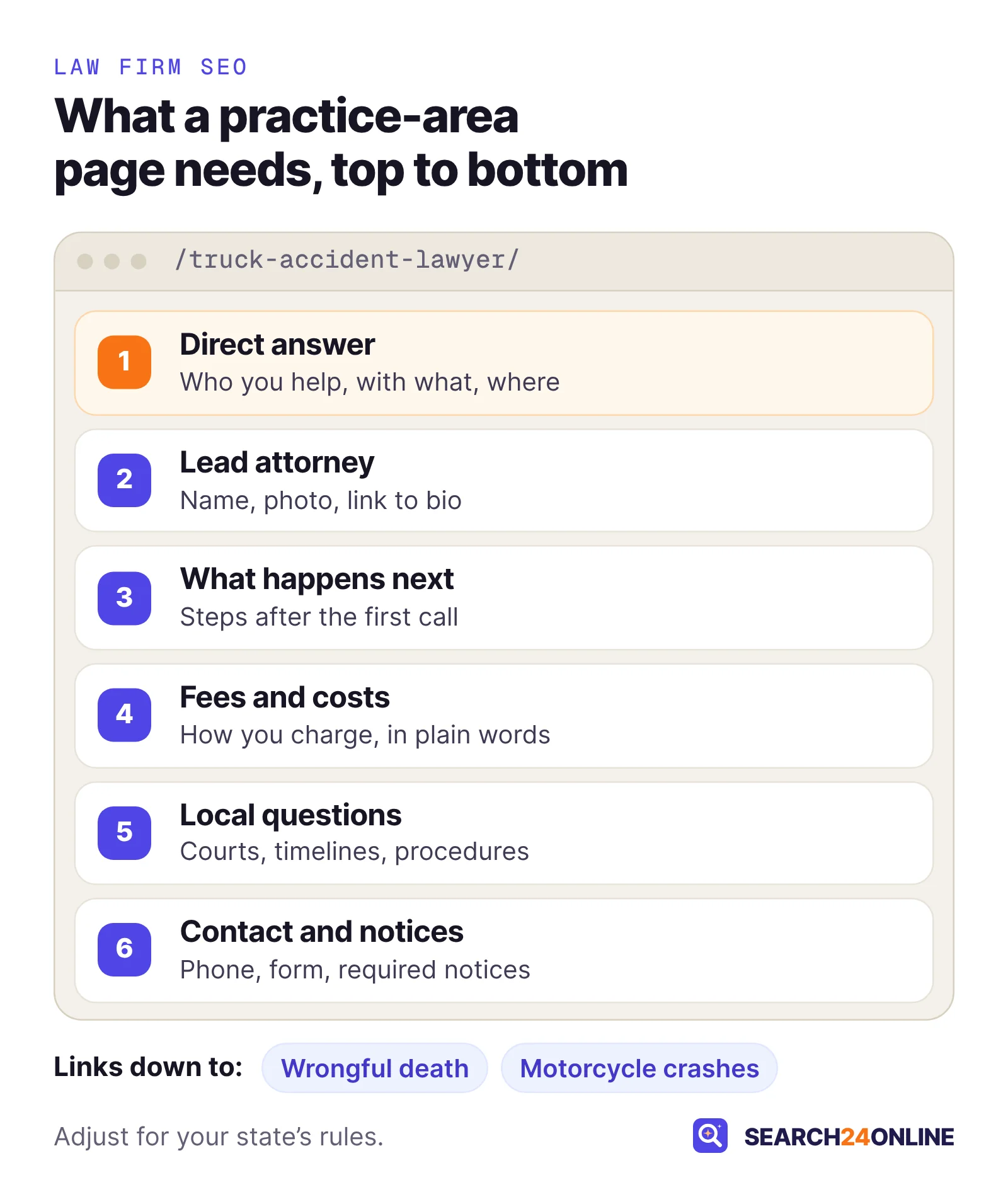
What goes on the page
Open with two or three sentences saying who you help, with what, and where. For example, that you represent people injured in truck crashes in Hillsborough and Pinellas counties. Then answer the client’s questions in the order they have them. Who will handle my case? What happens after I call? How do fees work? How long does this take here?
Name the lead attorney and link to their bio. Explain fees plainly, including how a contingency fee works if you use one, because fee anxiety stops calls. End with a contact path and the notices your state requires.
How the pages link together
Treat each practice area as a hub. The main page links down to sub-matter pages (wrongful death, motorcycle accidents) and to your best articles in that area, and they link back up. Blog posts that never link to a practice page are among the cheapest fixes in legal SEO: the article earns the visit, and the link sends that reader to the page that converts.
How do you target cities without creating doorway pages?
Target the cities where you have a real office through Google Business Profile and a location page per office, and target other cities only with pages that carry genuinely local substance. Pages that swap the city name into the same text are what Google’s spam policies call doorway abuse.
Google’s spam policies, updated in August 2026, list “multiple domain names or pages targeted at specific regions or cities that funnel users to one page” as an example of doorway abuse. We meet this often in law firm audits: forty “[City] Personal Injury Lawyer” pages, identical apart from the town name.
What Google Business Profile allows for law firms
Google’s Business Profile guidelines treat lawyers as individual practitioners. A lawyer can have a separate profile if they work in a public-facing role and can be contacted at the verified location during stated hours, but should not create several profiles for different specialties. If a lawyer is the only public-facing practitioner at a branded firm, Google says it is best to share one profile, named “[brand]: [practitioner name]”.
The address rules catch many firms. A virtual office, meaning a rented address you don’t operate from, is not eligible. A co-working space qualifies only with clear signage, clients received during business hours and your own staff present. The business name must match the real-world name, so “Smith Law – Best Car Accident Lawyer Miami” breaks the rules.
What makes a city page legitimate
A page for a city without an office can still help if it says something only that city’s page could. Think of which courthouse handles these cases, whether you meet clients there, local procedures, or matters you have handled there (where your state rules allow). If you can’t write that, skip the page. Our guides to multi-location SEO and ranking in cities without an office cover the site architecture.
What makes an attorney bio show real expertise?
A strong bio lets a stranger verify the lawyer in under a minute: where they are licensed, since when, what they focus on, and evidence of experience. Google’s guidance on people-first content calls this E-E-A-T, short for experience, expertise, authoritativeness and trustworthiness, and says trust is the most important of the four.
Google says its systems give extra weight to these signals on topics that could affect “the health, financial stability, or safety of people”, which it calls Your Money or Your Life topics. Legal problems touch all three: custody, criminal charges, injury claims, immigration status. Our view is that legal pages are judged against this higher bar.
Google also says its search quality raters have no control over rankings. So E-E-A-T is not a score you raise with a plugin. It describes what a careful reader trusts, and Google’s systems try to reward pages that meet it.
What to include in each bio
- Bar admissions and years: each state and federal court admission, with a link to the state bar’s public lookup so clients can check standing.
- Practice focus: what the attorney does most of the time, in plain words, linked to the matching practice pages.
- Evidence of experience: publications, bar committee roles, teaching, speaking, notable matters where your state’s rules allow.
- A real photo and direct contact: people hire people, and a stock image undermines everything else.
- Consistency: name, firm and office should match the Business Profile, bar listing and directory profiles exactly.
Link the bio from every article the attorney wrote or reviewed, with a byline and a “last reviewed” date; Google asks site owners to make clear who created content. Person markup on bios and LegalService markup on office pages help machines connect the pieces, as our schema markup guide explains.
Which bar advertising rules affect your website?
Your website, Business Profile, directory listings and social posts are all communications about your services, so your state’s advertising rules apply to every one of them. The ABA Model Rules are the template most states start from, and three of them matter most for SEO.
The three model rules in brief
Rule 7.1 says a lawyer shall not make a false or misleading communication about the lawyer or the lawyer’s services. A statement is misleading if it contains a material misrepresentation of fact or law, or omits a fact needed to keep the overall message from being materially misleading. That omission clause is the one marketing copy trips over.
Rule 7.2 lets lawyers communicate through any media but bars giving anything of value for recommending their services. Exceptions include the reasonable cost of permitted ads, the usual charges of legal service plans and qualified lawyer referral services, disclosed non-exclusive reciprocal referral deals, and nominal thank-you gifts. Rule 7.2(c) bars implying specialist certification unless an approved or ABA-accredited body certified the lawyer and is named. Rule 7.2(d) requires the name and contact details of at least one responsible lawyer or firm.
Rule 7.3 defines solicitation as a communication directed to a specific person the lawyer knows, or should know, needs legal services in a particular matter. It bars live person-to-person solicitation when a significant motive is pecuniary gain, with exceptions such as other lawyers and close personal or prior professional relationships. The rule’s comments say a website, or a reply to someone who asked for information, is not solicitation, and that text messages are not live contact. The risk is unrequested live calls.
How states differ
States adopt, modify and update these rules on their own schedules. The Florida Bar requires most television, radio, print and internet ads to be filed for review at least 20 days before first use, at $250 per ad ($750 if late), unless they carry only safe-harbor information. Law firm websites are exempt from filing but must still follow the rules. New York adopted amendments effective June 1, 2026 that largely take on the ABA’s 2018 advertising rules, according to the New York State Bar Association.
So a page that is fine in one state may need changes in the next. If you practice in several states, write to the stricter rules and have each state’s requirements reviewed.
Where SEO habits collide with the rules
| Common SEO habit | Rule question it raises | Safer approach |
|---|---|---|
| “Best”, “top” or “#1” in titles and headings | Comparisons that can’t be backed up may be misleading under Rule 7.1 and state versions | Describe the work: “Truck accident lawyers in Tampa, 20 years in practice” |
| “Expert” or “specialist” in page copy | Rule 7.2(c) limits implying certification as a specialist | Use “focuses on” unless properly certified, and then name the certifying body |
| Verdict and settlement lists | Results without context can mislead; some states require disclaimers | Check your state’s rule on past results first; add context where required |
| Paying sites or people for “recommendations” or links | Rule 7.2(b) bars giving anything of value for a recommendation, beyond the listed exceptions | Pay for clearly labeled advertising; earn mentions with useful content and real relationships |
| Calling people who never contacted you | Live calls to a specific person known to need help are solicitation under Rule 7.3; state rules vary | Respond to the inquiry the person made; have intake scripts reviewed |
How should a law firm handle reviews ethically?
Ask every client at the end of the matter, the same way, and never reveal client information when you reply. Request mechanics and Google’s review policies are in our guide to getting more Google reviews within the rules. Lawyers carry two extra constraints.
Replies must protect confidentiality
In January 2021 the ABA issued Formal Opinion 496 on responding to online criticism. As summarized in ABA Litigation News, it found that Model Rule 1.6 generally bars disclosing client information in a reply without consent, and that an online review does not trigger the exception for defending against a claim.
The acceptable options: ask the site to remove a post (without disclosing confidential information), don’t respond, or invite the reviewer to talk offline. If the reviewer is a current or former client, a public reply should say no more than something like “Professional obligations do not allow me to respond as I would wish”. Even saying a poster was never a client can reveal something if they are tied to a real matter, such as opposing counsel.
Agree on two or three approved reply templates, decide who may post them, and route anything mentioning case facts to a partner first. An angry reply written at 11 p.m. is how firms end up in ethics trouble.
Rewards for reviews
Rule 7.2(b)’s ban on giving anything of value for a recommendation is worded broadly, and a review is a public recommendation. Our view: offer nothing in exchange for reviews, on any platform. Testimonials on your own site are communications about your services too, and some states add specific rules for them, so check yours before adding a reviews widget to practice pages.
Which legal directories are worth your time?
Claim and complete your free profiles on the major legal directories and bar listings, keep every detail consistent, and pay for upgrades only once you can measure what they bring in. In our experience, directory pages often appear in results for practice-area searches, and AI assistants can draw on them when describing a lawyer, so a wrong profile can cost you twice.
Each directory works differently, so read the fine print. Avvo’s help center says its rating runs from 1 (“Extreme Caution”) to 10 (“Superb”) and comes from a model combining profile details with public records from state bars and licensing bodies, covering experience, achievements and disciplinary sanctions. Avvo says attorneys can’t pay to improve it, client reviews don’t affect it, and attorneys who claim their profile and add information tend to rate higher.
| Directory type | Examples | What to do |
|---|---|---|
| Consumer lawyer directories | Avvo, Justia, FindLaw, Lawyers.com | Claim, complete every field, match your Business Profile, link to the right practice page |
| Peer-review ratings and lists | Martindale-Hubbell, Super Lawyers, Best Lawyers | Read each selection method; check your state’s rules before citing an award |
| Bar listings and referral services | State and local bar directories, lawyer referral services | Keep current; Rule 7.2(b) allows paying the usual charges of qualified referral services |
| General business listings | Google Business Profile, Bing Places, Yelp | Same name, address and phone everywhere |
A pattern we see: a firm pays for premium placement on two directories but never claimed a third, which still lists an old address and a former partner. Fix accuracy first, then give each directory its own tracking number or tagged link to see which ones produce consultations. Our local citations guide covers cleanup.
How do you write legal content that is accurate and worth citing?
Answer one real client question per page, for one jurisdiction, with the attorney’s name and a review date on it. “How long do I have to file a personal injury claim in Georgia?” deserves the actual Georgia answer, the main exceptions, what starts the clock and when to call, checked by a Georgia-licensed attorney.
Generic national articles (“What is a statute of limitations?”) compete with law schools, government sites and big publishers, and rarely bring in clients. Jurisdiction-specific answers are more useful, more winnable, and closer to how people phrase legal questions to AI assistants.
Accuracy rules worth adopting
- Name the jurisdiction up frontSo a reader in another state knows to look elsewhere.
- Have a licensed attorney review every pageShow the reviewer’s name and review date, linked to their bio.
- Cite the statute or court ruleLink the official source so readers, and AI systems, can verify it.
- Re-check deadlines and figures yearlyA stale deadline is the most harmful error a legal page can carry.
- Separate information from adviceSay the page is general information and when to speak to a lawyer.
Be careful with AI-generated legal pages. Google’s spam policies name “using generative AI tools or other similar tools to generate many pages without adding value for users” as scaled content abuse. Fifty AI-written “what to do after an accident in [town]” pages fit that description. AI can help an attorney draft; it can’t replace their review. For shaping answers so assistants can quote them, see our guide to writing content AI assistants want to quote.
How do you track which searches turn into signed cases?
Track every inquiry from first contact to signed engagement, tagged with its source, and review the pipeline monthly. Rankings tell you whether people find you; only intake data tells you whether SEO pays. Intake is also where many firms quietly lose the clients search sent them.
Those figures come from the secret shopper study in Clio’s 2024 Legal Trends Report. A firm with responsiveness like that which doubles its search traffic mostly doubles the people it fails to call back. Fixing the phones is often the highest-return “SEO” work available.
A tracking setup that works for most firms
- Count calls and forms as conversionsUse call tracking numbers by source (website, Business Profile, each directory) and record form submissions in analytics.
- Log every inquiry in one placeYour practice management software or CRM records source, practice area and date.
- Track the stagesInquiry, qualified, consultation booked, retained, and the fee once known.
- Review monthly by practice areaWhich pages and sources produce retained clients, not just calls.
Keep confidential details out of marketing tools: names, phone numbers and case facts belong in your practice management system, not in analytics events, URLs or ad platforms. The contact form needs care too. Under Model Rule 1.18, someone who consults a lawyer about possibly forming a relationship is a prospective client, and the lawyer generally may not use or reveal what they shared even if no engagement follows. The rule’s comment says a person responding to advertising that merely describes the lawyer is not a prospective client, so have ethics counsel review your form’s wording and notice.
Turning this pipeline into a return figure, including how to value a signed case, is covered in our guide to measuring SEO ROI. For the website side, our free SEO + GEO report checks indexability, on-page basics, structured data, page speed, AI crawler access and local trust signals such as click-to-call and business schema, with every issue ranked from critical to low.
Our team has served 500+ brands. For professional practices, the order that usually pays off fastest is: fix how inquiries are answered, fix Business Profile and indexing problems, merge competing practice pages, then build content. Firms that start with content while calls go unanswered spend the most for the least.
Common questions
How long does SEO take for a law firm?
There is no fixed timeline, and nobody can honestly promise one. In our experience, fixing indexing and Business Profile problems can show effects within weeks, while competitive practice-area searches in large cities usually take many months of steady work. Treat any promise of a ranking by a set date as a red flag.
Should each attorney at a firm have their own Google Business Profile?
Only if they meet Google’s practitioner rules: a public-facing role and being reachable at the verified location during stated hours. A lawyer who is the only practitioner at a branded firm should usually share the firm’s profile, and no lawyer should create separate profiles for different specialties.
Can a law firm call its attorneys experts or specialists on its website?
Be careful with both words. ABA Model Rule 7.2(c) bars stating or implying specialist certification unless an approved or ABA-accredited organization certified the lawyer and is named, and states have their own versions. Describing what the attorney actually does, and for how long, is safer and more useful.
Is it worth paying for an enhanced Avvo, Justia or FindLaw listing?
Sometimes, but claim and complete the free profile first. Track calls and form leads from each directory for a few months, then judge any paid upgrade by signed cases, not profile views.
Can a law firm use AI to write its legal content?
It can help with drafts, but an attorney licensed in the relevant state should review every page before it goes live. Google’s spam policies treat mass-produced AI pages that add no value as scaled content abuse, and a wrong deadline on a legal page can hurt a reader.
Sources
- ABA Model Rules of Professional Conduct: Rule 7.1, Communications Concerning a Lawyer’s Services
- ABA Model Rules of Professional Conduct: Rule 7.2, Communications Concerning a Lawyer’s Services: Specific Rules
- ABA Model Rules of Professional Conduct: Rule 7.3, Solicitation of Clients
- ABA Model Rules of Professional Conduct: Comment on Rule 7.3
- ABA Litigation News: How to Ethically Respond to Negative Online Reviews (Formal Opinion 496), 2021
- ABA Business Law Today: Conflicts and Imputation from ‘The Client That Never Was’ (Rule 1.18), June 2024
- New York State Bar Association: Amendments Adopted to Advertising Rules, September 2026
- The Florida Bar: Lawyer Advertising Filing Requirements
- Google Search Central: Creating helpful, reliable, people-first content
- Google Search Central: Spam policies for Google web search
- Google Business Profile Help: Guidelines for representing your business on Google
- Avvo Support: What is the Avvo Rating?
- Clio: Client intake findings from the 2024 Legal Trends Report (secret shopper study)
See how your law firm’s website measures up — free.
We’ll analyze your firm’s website, from indexing and practice-page basics to structured data and local trust signals, create your SEO + GEO report and give you password-protected dashboard access to view it.
Free · No obligation · We only review your public pages.