
Is SEO Dead Because of AI? What Is Really Changing in Search
Google says searches are growing faster than in years, while independent studies show far fewer clicks per search. Here is what Pew, Ahrefs, Seer, SparkToro, academic researchers and Google itself actually report, where they disagree, and where that leaves your SEO budget.
Key takeaways
- SEO is not dead, but the model of ranking general-information pages to collect clicks is shrinking: Google reported its fastest query growth in five years in October 2026, while a smaller share of those searches sends anyone to a website.
- SparkToro estimated that 68.01% of US Google searches ended without a click from January to April 2026, up from 60.45% in its 2024 study, which used a different data panel.
- Every independent study we reviewed finds fewer clicks when an AI Overview appears: Ahrefs measured a 58% lower click-through rate for the top result, and a randomized experiment found 39.8% fewer organic clicks. Google says total organic clicks have been relatively stable.
- The foundations have not changed. Google says a page must be indexed and eligible for a snippet to appear in AI Overviews or AI Mode, and that optimizing for its AI search features is “still SEO.”
- What to do now: find out how much of your traffic comes from general questions, fix indexing and structure, publish what only you can write, and measure leads and AI visibility instead of sessions alone.
On this page
Is SEO dead? The short answer
No. People search more than ever, and Google says its AI features draw on the same index, and reward the same SEO basics, as its regular results. What is in serious trouble is one particular business model: publishing pages that answer general questions and counting on the click that used to follow. When Google writes the answer at the top of the page, far fewer people need to visit yours.
So both camps are half right. “SEO is dead” mistakes a drop in clicks per search for a drop in search. “Nothing has changed” ignores several independent datasets that point the same way. The useful question is narrower: which of your searches still turn into customers, and what does it take to be the business that gets chosen, by a person or by an AI answer?
Even SparkToro’s Rand Fishkin, who publishes some of the starkest zero-click data, wrote in June 2026 that “your SEO still matters as much or more than ever before, it just won’t earn you traffic the way it once did.” That is a fair summary of everything below.
Are people still searching on Google?
Yes, and by Google’s account more than before. On its October 28, 2026 earnings call, Alphabet chief executive Sundar Pichai said “our year-over-year query growth rate is the highest it’s been in the last five years,” and credited Google’s AI investments with driving query growth, including commercial queries. He added that searches in AI Mode, Google’s chat-style search, are on average three times longer than traditional searches.
Google’s own usage figures are large. In a post published in June and updated on August 31, 2026, it said AI Overviews have over 2.5 billion monthly active users and AI Mode has passed one billion monthly users. These are company claims without published methodology, and Google has an obvious interest in them, but no independent data we found contradicts the basic point that Google search volume is not collapsing.
AI tools are growing, from a small base
Pew Research Center’s February 2026 survey found that 44% of US adults say they have used ChatGPT, up from 18% in 2023. Pew notes that the 2026 question also asked about other chatbots, so the trend is approximate. SparkToro reports that more than 20% of Americans now use an AI tool ten or more times a month.
Usage is not the same as traffic. SparkToro describes AI tools as sending “less than 1% of all traffic out” to websites. And in its clickstream data for January to April 2026, only 0.34% of Google searches made their way to AI Mode, a number that sits awkwardly next to Google’s billion monthly users. Both can be true: many people trying a feature occasionally is different from it carrying a large share of searches.
Our reading: search is spreading across more places rather than disappearing. For most US businesses, Google still sends most search-driven customers; the AI share is worth tracking because it is growing, not because it has replaced anything yet.
How much do AI Overviews reduce clicks?
A lot, on the searches where they appear. Independent estimates range from roughly 35% to 60% fewer clicks on the regular results, depending on the method, the date and which results are counted. No independent study we reviewed found that AI Overviews increase clicks to the sites listed below them.
The studies use very different methods, which is why they deserve to be read side by side rather than quoted one at a time.
| Study | How it measured | Main finding | Main limitation |
|---|---|---|---|
| Pew Research Center (March 2025 data) | Real browsing of 900 US adults who agreed to share it | A regular result was clicked on 8% of visits with an AI summary, 15% without | Early snapshot; one month |
| Ahrefs (published February 2026) | Aggregated Search Console data for 300,000 keywords, December 2023 vs December 2025 | Top-result click-through rate about 58% below forecast when an AI Overview appeared | Desktop only; a forecast-based correlation |
| Seer Interactive (published April 2026) | 53 brands’ accounts, 2.43 billion organic impressions, January 2025 to February 2026 | Organic click-through rate 2.36% with an AI Overview vs 3.82% without (February 2026) | One agency’s client accounts; correlation, not causation |
| Agarwal and Sen (2026 working paper) | Over 1,000 users randomly assigned to see or not see AI Overviews for two weeks | 39.8% fewer organic clicks; zero-click searches up 34.5% | Chrome-extension volunteers; two weeks |
| SparkToro (published June 2026) | Similarweb clickstream panel of US desktop and mobile browsers | 68.01% of searches ended without a click | Excludes the Google app; panels change between years |
What the details add
Pew found that people clicked a link inside the AI summary itself on only 1% of visits, and ended their browsing session on 26% of pages with a summary versus 16% without. AI summaries appeared on 18% of the searches in its sample, far more often on long or question-style searches than on short ones.
Ahrefs’ earlier version of its study, published in April 2025, put the drop at 34.5%; the 2026 rerun found 58%. The effect also shrinks further down the page, to about 19% at position 10. Seer’s data shows the size of the gap moving month to month: organic click-through rate on queries with an AI Overview fell to 1.31% in December 2025, then recovered to 2.36% by February 2026, still well below queries without one.
The Agarwal and Sen experiment matters because it is the only one here built to show cause, not just correlation. Their browser extension removed AI Overviews in real time for a random group of users. Beyond the 39.8% drop, they found no change in ad clicks or in how often people searched, and their follow-up survey showed no measurable improvement in how users rated their search experience.
Every figure above is an average across many keywords. A plumber whose leads come from “emergency plumber near me” and a software company whose blog lives on “what is” searches face completely different numbers. Check your own Search Console data before you cut or double a budget.
Why do Google and the independent studies disagree?
Mostly because they measure different things. The studies above measure clicks per search on queries that show an AI Overview. Google talks about total clicks across all of Search, and about the quality of those clicks.
What Google says
In August 2025, Google’s head of Search, Liz Reid, wrote that “total organic click volume from Google Search to websites has been relatively stable year-over-year.” She added that Google was sending “slightly more quality clicks” than a year earlier, meaning clicks where people do not quickly return to the results. She said third-party reports claiming dramatic traffic declines were “often based on flawed methodologies.” Google’s developer documentation adds that clicks from AI Overviews are “higher quality,” with visitors more likely to spend more time on the site.
How both can be true
Simple arithmetic reconciles part of it. If searches grow quickly and the share that ends in a click falls, total clicks can stay roughly flat. A business does not live on Google’s total, though. If new searches are long, conversational questions that rarely produce a click, while the informational searches you used to win now end on the results page, your traffic can fall even while Google’s total holds steady. The clicks move to different sites and different kinds of queries.
The quality claim is harder to settle. Google has not published the data behind it. The one randomized study found no difference in bounce rates or time on site between people who saw AI Overviews and people who did not, which does not support the claim, at least for that sample. Meanwhile, every independent dataset has gaps: desktop-only, browser-only, one agency’s client accounts, or a single month.
Treat Google’s totals and the independent click studies as answers to different questions. Google’s figures tell you search is not shrinking. The studies tell you an informational page earns far fewer visits per search than it did in 2023. Plan around both, and let your own Search Console data decide which applies to you.
What has actually changed in search?
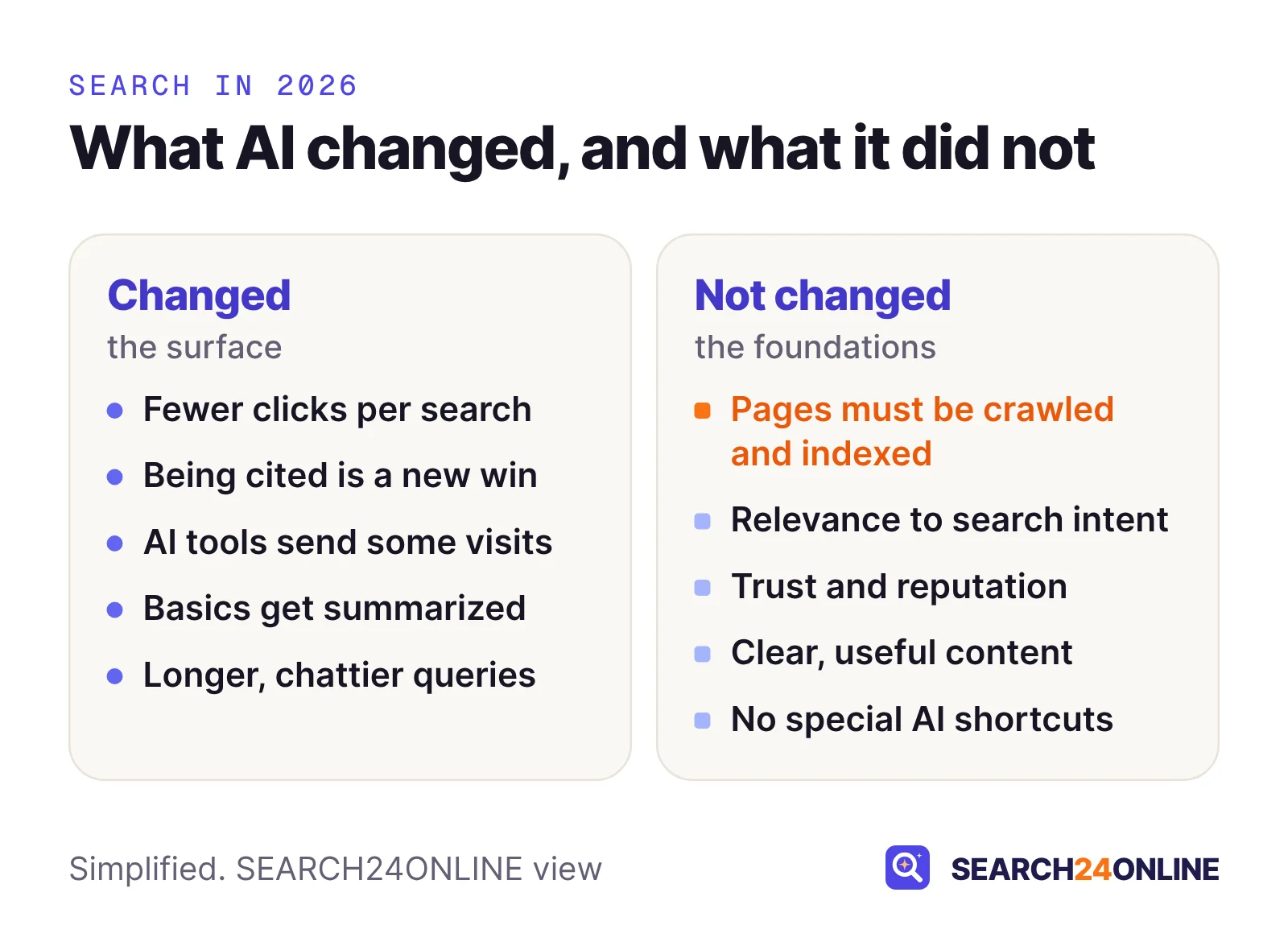
Five things, and none of them is the end of search. Together they change what a good result looks like and how you should measure it.
1. Fewer clicks per search
The loss is concentrated on informational searches, the ones that start with “what,” “how” or “why.” Our guide to zero-click search covers how to win customers on searches that end on the results page, including Business Profile calls and direction requests.
2. Being cited is a new kind of win
Inside an AI Overview, a link to your page is now a result in its own right. Seer’s 2025 data on informational queries gives a sense of its value. Per million impressions, brands earned about 33,500 organic clicks on queries without an AI Overview, about 20,700 when they were cited in the AI Overview and about 9,400 when an AI Overview appeared without citing them. Seer cautions that stronger brands are more likely to be cited, so not all of that gap is caused by the citation. Still, being cited beats being skipped by a wide margin. Visibility in AI answers is what people call GEO, or generative engine optimization.
3. AI assistants are a small but real channel
ChatGPT, Perplexity, Gemini and Copilot send far fewer visits than Google, and in our experience those visitors are often further along in their research. You can see them separately in analytics; our guide to AI traffic in GA4 shows where.
4. The bar for content is higher
A page that restates common knowledge is exactly what an AI summary can replace. Google’s AI optimization guide, last updated in July 2026, asks for non-commodity content that “provides unique expert or experienced takes that go beyond common knowledge and the ordinary.” In practice: your prices, your process, your cases, your data, your judgment.
5. Queries are longer, and measurement is messier
Longer queries in AI Mode mean more specific questions, which reward pages that cover a topic thoroughly. Measurement has not caught up. Search Console’s Generative AI performance report, available to all sites since August 31, 2026, counts how often your links appear in AI Overviews and AI Mode, but it reports impressions only. The clicks are mixed into the regular Performance report under the Web search type.
What has not changed?
The requirements underneath. Google says that to appear as a supporting link in AI Overviews or AI Mode, “a page must be indexed and eligible to be shown in Google Search with a snippet,” and that there are “no additional requirements” or special optimizations. Its AI optimization guide goes further: optimizing for generative AI search “is optimizing for the search experience, and thus still SEO.”
The same guide says you do not need new machine-readable files, AI text files or special schema markup, and that there is no requirement to break content into tiny pieces. It also warns that seeking “inauthentic ‘mentions’” across the web is not as helpful as it might seem. Anyone selling an AI shortcut is selling something Google says does not exist.
Crawling, indexing, relevance to what the searcher wants and a trustworthy reputation still decide who gets shown, in the classic results and in AI answers. The overlap and the differences are laid out in SEO vs GEO; the short version is that most of the work is shared.
Why good businesses still go missing
Our team brings over 20 years of digital marketing experience and has served 500+ brands. The problems that keep a business out of AI answers are the ones that kept it off page one before AI arrived:
- Important pages not indexed. A service page with an accidental noindex tag or no internal links cannot rank or be cited. Check the Page indexing report and URL Inspection in Search Console.
- Pages competing with each other. A common situation: a regional HVAC company with 40 service pages that all target “HVAC repair” with only the city swapped. None stands out, and none answers the follow-up questions about cost, brands or emergency hours.
- Thin or outdated content. A pricing page untouched for three years gives neither a searcher nor an AI system anything specific to use.
- Weak site structure and missing structured data. When the important pages are buried four clicks deep, search engines treat them as unimportant too.
- A thin reputation off the site. Few relevant links, reviews or mentions means little outside evidence that you are who you say you are.
In audits we often find two or three of these on sites whose owners believed AI had taken their traffic. Some of the decline was AI. Some of it had been building for years.
Which businesses are most exposed?
Businesses whose search traffic comes from general questions are the most exposed; businesses found through short, ready-to-buy or local searches are the least. The pattern is consistent across the data.
Share of queries showing an AI Overview, by search intent
Source: Seer Interactive, AIO impact on Google CTR, 2026 update (53 accounts, 49,358 tracked queries, February 2026).
Pew’s browsing data shows the same split by query length: AI summaries appeared on 8% of one- or two-word searches, 53% of searches of ten words or more and 60% of searches starting with a question word. Three typical situations:
Local service businesses: least exposed
A dental practice or roofing company wins most customers on searches like “dentist near me” or “roof repair Columbus,” where, judging by the intent and query-length data above, AI Overviews appear less often and the map results do much of the work. The bigger risks are the usual ones: an incomplete Business Profile, thin service pages, few reviews. Their general blog posts will lose clicks, but in our experience those rarely produced many customers anyway.
B2B and software companies with large blogs: most exposed
Picture a software company whose traffic grew on glossary-style posts such as “what is inventory turnover.” Those are exactly the searches AI summaries answer, and that traffic may already be down sharply. The fix is not more posts. It is fewer, deeper pages tied to buying decisions (comparisons, pricing, implementation, original data) and a reputation that gets the company named when buyers ask AI tools for a shortlist.
Online stores and professional firms: mixed
Our expectation, based on the intent data above: product and category searches are mostly commercial, so stores should lose less than publishers, while their buying guides lose more. Law, accounting and medical practices sit in between: their “what should I do if” content is exposed, their “lawyer in [city]” searches much less so.
What should you do now?
Start with your own data, fix the foundations, then shift effort toward content and reputation that earn both clicks and citations. In our experience this order holds for almost every business, because each step depends on the one before it.
- Split your traffic by intentIn Search Console, compare clicks and impressions for the last three months with the same months a year earlier. Group pages into informational, commercial and local. Falling clicks with steady impressions on informational pages is the AI Overview pattern.
- Count leads, not sessionsFind out which pages produced calls, forms and sales last year. If the informational pages that lost traffic never produced leads, the loss matters less than it looks.
- Fix indexing and structureMake sure every important page is indexed, linked from relevant pages and not competing with a near-duplicate. This serves classic rankings and AI citations at once.
- Rebuild the pages that make moneyService, product, pricing and comparison pages deserve your best work: specific facts, clear answers near the top, and the follow-up questions buyers actually ask.
- Publish what only you canReplace generic posts with your own data, real examples, prices and expert judgment. Merge or remove thin posts that compete with stronger ones.
- Strengthen your reputation off the siteReviews, a complete Business Profile, relevant links and mentions in places your buyers read give both Google and AI assistants outside evidence to trust you.
- Measure the new surfacesWatch the Generative AI performance report in Search Console, AI assistant referrals in analytics and how often you appear for a fixed set of buyer questions. Our guide to tracking brand visibility in AI answers explains how.
Read the first paragraph and ask whether an AI summary could replace the whole page. If yes, either add something only your business knows, merge the post into a stronger page, or accept that it will drive awareness rather than visits.
If you would rather start with an outside view, our free SEO + GEO report analyzes your website, and you get password-protected dashboard access within 24 hours. For ongoing work, our SEO + GEO services treat search and AI visibility as one program. No one can guarantee rankings, citations or traffic. What you can control is whether your site deserves to be found and can be found.
Common questions
Will AI chatbots replace Google search?
Not on current evidence. Use of AI tools is growing fast, but Google reported its fastest query growth in five years in October 2026, and SparkToro puts AI tools at less than 1% of all traffic sent to websites. Most businesses should plan for both, with Google still the larger source of customers.
Should I stop publishing blog posts because of AI Overviews?
No, but stop publishing generic ones. Short answers to common questions are the content AI summaries replace most easily. Posts built on your own data, cases, prices and expert judgment still earn clicks and citations, and Google’s own AI guidance asks for exactly that kind of non-commodity content.
Is it still worth paying for SEO in 2026?
It is worth paying for SEO that is tied to leads and revenue rather than traffic alone. Pages that are indexed, relevant and trusted are what both Google rankings and AI answers draw on. Be wary of any provider that promises rankings or traffic figures, because no one can guarantee them.
How can I tell whether AI Overviews are hurting my traffic?
Compare impressions and clicks for your informational pages in Search Console with the same months a year earlier. Rising or steady impressions with falling clicks on question-style queries is the typical pattern. The Generative AI performance report shows how often your links appear in AI Overviews and AI Mode, but it reports impressions only.
Do I need a separate GEO agency as well as SEO?
Usually not. Google says optimizing for its AI features is still SEO, and most of the work that earns AI citations, such as indexing, clear structure and a trusted reputation, is shared. The extra work for AI visibility is best treated as a layer on top of one program.
Sources
- Google blog (October 28, 2026): Q3 2026 earnings call, remarks from our CEO
- Google blog (June 3, 2026, updated August 31, 2026): New controls for website owners
- Google blog (August 6, 2025): AI in Search is driving more queries and higher quality clicks
- Google Search Central: AI features and your website
- Google Search Central: Optimizing for generative AI search (AI optimization guide)
- Search Console Help: Generative AI performance report (Search)
- Pew Research Center (July 22, 2025): Google users are less likely to click on links when an AI summary appears in the results
- Pew Research Center (June 17, 2026): Majorities of adults under 50 now use ChatGPT
- SparkToro (June 2026): In 2026, less than one third of Google searches still send a click
- Ahrefs (February 4, 2026): Update: AI Overviews reduce clicks by 58%
- Seer Interactive (April 24, 2026): AIO impact on Google CTR, 2026 update
- Agarwal and Sen, ProMarket (August 17, 2026): How to preserve the online information ecosystem in the presence of Google AI Overviews
Is AI really behind your traffic change? Find out free.
We’ll analyze your website, create your SEO + GEO report and give you password-protected dashboard access to view it.
Free · No obligation · We only review your public pages.