
How to Choose an SEO Agency: 15 Questions to Ask Before You Sign
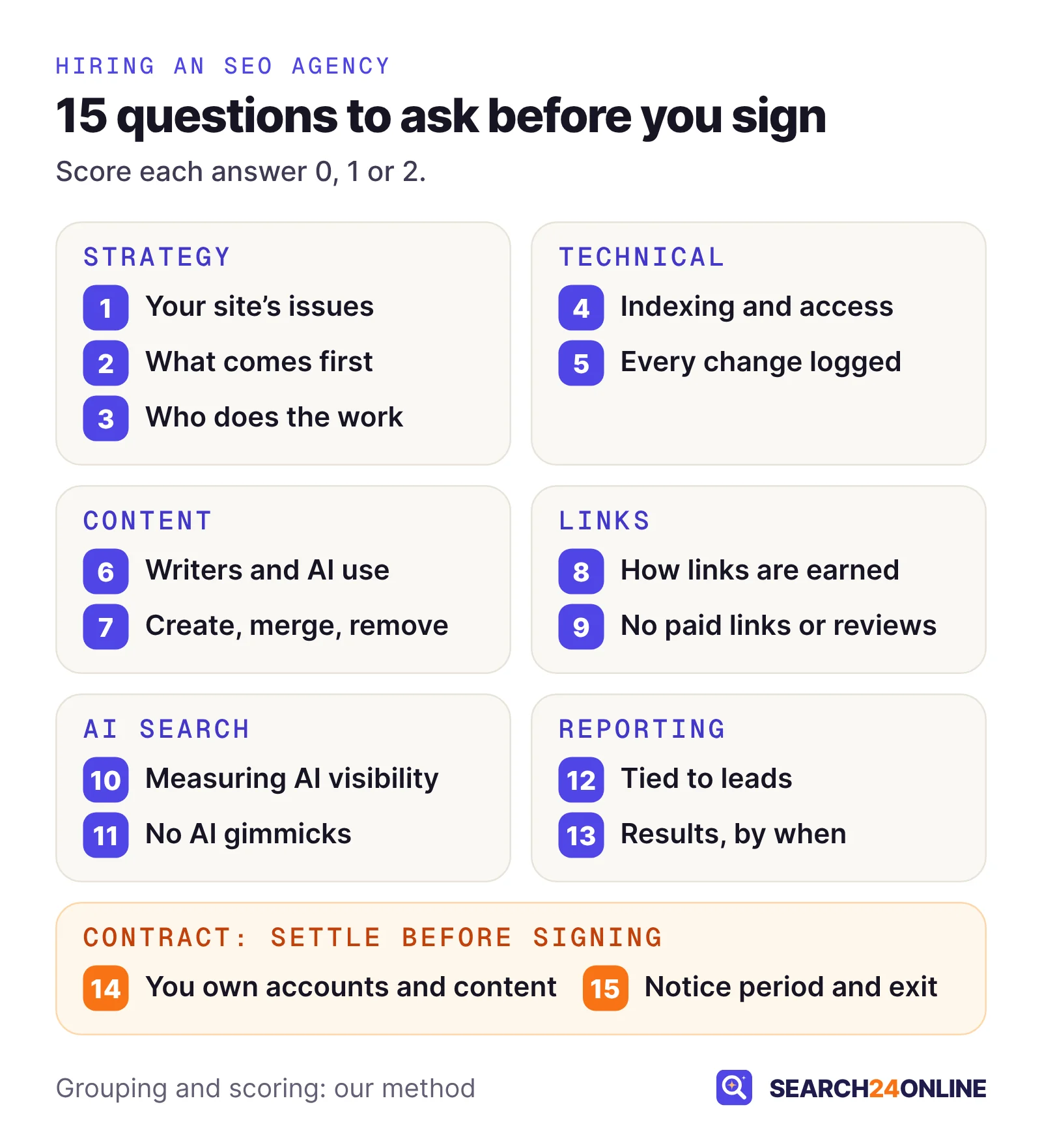
Fifteen questions grouped into strategy, technical work, content, links, AI search, reporting and the contract, with what a strong answer sounds like and what should end the conversation.
Key takeaways
- Choose an SEO agency by testing how it thinks about your website, not by its pitch: ask for a diagnosis of your site, a prioritized plan, named people, and written answers on links, AI search, reporting and ownership.
- Switching agencies is common. In vcita’s April 2025 survey of 500 US small businesses, 40% of those that outsource marketing had dropped or switched agencies, and 56% of that churn came within 6–12 months.
- An agency that promises rankings fails the first test. Google’s own hiring advice says “No one can guarantee a #1 ranking on Google.”
- Keep control: be a verified owner in Search Console, the primary owner of your Google Business Profile and an Administrator in Google Analytics, and get a contract clause that assigns you copyright in the content you pay for.
- Google says AI Overviews and AI Mode have no special requirements, so a good agency measures AI visibility with real data instead of selling special files or markup.
On this page
How should you use these 15 questions?
Send the questions in writing before the first call, then use the call to dig into the answers. Written answers are easy to compare, and they show who has actually looked at your website and who is pasting from a sales deck.
Score each answer 0, 1 or 2. A zero is vague or evasive, a one is sensible but general, and a two is specific to your site and says who does the work. Fifteen questions give a maximum of 30. The zeros matter more than the total: a zero on links, ownership or guarantees ends the conversation.
Being this careful pays off because breakups are common. vcita, a business software company, surveyed 500 US small and medium-sized businesses in April 2025.
Those figures cover marketing agencies in general, not only SEO, and come from a vendor’s press release, so read them as a signal. Our team has more than 20 years of digital marketing experience. When a business comes to us after a bad agency year, the cause is usually one these questions expose: a plan not built around the site, reports nobody could tie to leads, or a painful contract.
Google’s own page on hiring an SEO is a useful baseline: it suggests asking for examples of previous work, whether the agency follows Google Search Essentials, what results to expect and when, and how you will communicate. The questions below add what it leaves out, such as AI search, ownership and contract terms.
Strategy questions: has the agency looked at your business?
The strategy questions tell you whether you would be buying a plan built for your website or a package built for everyone. Ask them first, because the answers shape everything else.
1. What did you find when you looked at our website?
An agency that quotes before looking is selling a package. Even a short review should turn up something concrete.
A strong answer names issues with URLs: “Your emergency repair page is not indexed, and three service pages compete for ‘water heater installation’ in your city.”
Walk away if you get a generic list (on-page optimization, link building, content) that would fit any business, or a proposal that jumps straight to “four blog posts a month”.
In audits we often find the real problem is not the one the owner asked about. They want more blog posts, but their best service pages are missing from Google’s index or buried four clicks deep.
2. What will you work on first, and why?
Priorities reveal judgment. Fixing indexing and structure usually comes before new content, because new pages on a hard-to-crawl site earn little.
A strong answer is a short ranked list tied to likely impact on the pages that bring in customers. Walk away if the plan starts with whatever is cheapest to deliver, such as directory submissions, or promises everything at once.
3. Who will do the work, and what do they know about our market?
Google suggests asking about experience in your industry and in your country or city. Go one step further and ask who, by name, will handle strategy, writing and technical fixes, and whether any of it is subcontracted.
A strong answer introduces the actual team and how they will learn your customers and competitors. Walk away if nobody can tell you who delivers the work. Remote teams can do excellent work with the same transparency; see hiring an SEO agency overseas.
Technical questions: can they find what blocks Google?
Technical problems are a common reason good businesses stay invisible, and an easy place to hide behind jargon.
4. How will you check that our important pages are indexed, and what access do you need?
Pages that are not indexed cannot rank anywhere, in classic results or AI answers. Indexing gaps are among our most frequent audit findings, usually caused by stray noindex tags, redirect chains, duplicate templates or pages nothing links to.
A strong answer describes comparing a crawl of your site with Search Console’s indexing data and explaining why each important page is excluded.
On access, Google’s advice for the audit stage is to “only grant read access to Search Console (at this stage, don’t grant them write access).” Walk away if they ask for ownership before you have signed, or offer to “submit your site to Google”. Google specifically warns about SEOs that advertise a “priority submit”.
A common situation: a clinic group with a dozen location pages built from one template, most of which Google treats as duplicates. A good agency spots that in the first audit.
5. Will you tell us about every change you make to our site?
This one comes almost word for word from Google’s list: “Will you share with me all the changes you make to my site,” along with the reasoning behind each recommendation. An SEO with server access, Google adds, “should be willing to explain all the changes they are making to your site.”
A strong answer is a dated change log with URLs, risky edits such as redirects tested first, and structured data validated before launch. Walk away if you hear about “proprietary methods” they cannot explain. Google’s wording is plain: be careful if a company “is secretive or won’t clearly explain what they intend to do.”
Content questions: will it help customers or fill a quota?
Content is where you can most easily pay for volume instead of value.
6. Who writes our content, and how do you use AI?
Google’s guidance on generative AI, updated on October 1, 2026, says AI can help with research and structure.
But using it “to generate many pages without adding value for users may violate Google’s spam policy on scaled content abuse.” It also calls it “critical to manually factcheck and review all AI-generated content” before publishing (see scaled content abuse in our glossary).
A strong answer names the writers and editors, explains how they will capture your expertise (usually by interviewing you), and describes the fact-checking step. AI is not the problem; skipping human judgment is. Walk away if the offer is dozens of cheap articles a month with no interview and no review.
7. How do you decide which pages to create, update, merge or remove?
Good content strategy starts from search intent (what the searcher actually wants) and full coverage of your topics, not a keyword list. Often the right move is fewer, stronger pages.
A common situation: a regional HVAC company with 40 service pages that all target “HVAC repair”. The pages compete with each other, a problem called keyword cannibalization, and Google may rank none of them well. Merging overlaps and giving each remaining page a distinct job usually does more than writing page 41.
A strong answer describes mapping each important search to one page, refreshing thin or outdated pages, and consolidating duplicates. Walk away if the only plan is new posts, measured by how many get published.
Link questions: how will they earn links safely?
Links are where cheap SEO most often turns into risk. Google’s spam policies define link spam as “the practice of creating links to or from a site primarily for the purpose of manipulating search rankings,” and list buying links for ranking purposes as an example. Paid placements are allowed only when they carry a rel="sponsored" or rel="nofollow" attribute. Sites that break the policies, Google says, “may rank lower in results or not appear in results at all.”
8. How will you earn links, and can you show links you earned for similar clients?
A strong answer lists tactics that fit your business, such as local partnerships, industry associations, supplier pages or expert commentary for journalists, then shows live examples on relevant sites. Walk away if the proposal promises a fixed number of cheap links a month, mentions private networks, or cannot show one example.
Weak or unnatural backlink profiles are a recurring finding in our audits, often left over from an earlier provider’s link package. A good agency tells you whether any need cleaning up first.
9. Will you ever buy links or reviews on our behalf?
The answer should be a plain no, in writing. Reviews carry legal risk as well as search risk. The FTC’s Consumer Reviews and Testimonials Rule, in effect since October 21, 2024, bans buying and selling fake reviews. The FTC’s guidance says agencies and reputation firms can be liable, and so can a business that bought reviews it knew or should have known were fake.
Some contracts require an “SEO by” link to the agency on every page of your site. Google’s hiring advice is direct: “You should never have to link to an SEO.” Strike the clause.
AI search questions: what about ChatGPT and AI Overviews?
A good agency treats visibility in AI answers as part of SEO, not a separate magic product. Google lists “Optimizing for generative AI” among the services an SEO may offer, yet its documentation also says: “There are no additional requirements to appear in AI Overviews or AI Mode, nor other special optimizations necessary.”
10. How will you measure whether we show up in AI answers?
A strong answer uses first-party data. Search Console’s Generative AI performance report shows how often links to your site appeared in AI Overviews and AI Mode, by page, country, date and device; Google says it reached all websites worldwide by August 31, 2026. It reports impressions; clicks from AI features stay in the regular Performance report under the Web search type.
Bing Webmaster Tools added an AI Performance report in public preview in February 2026. It counts citations of your pages across Microsoft Copilot, AI summaries in Bing and some partner integrations, and lists grounding queries: the phrases the AI used to retrieve your content. For assistants such as ChatGPT, Perplexity and Claude, a careful agency also tracks a fixed set of customer questions on a schedule and reports mentions and citations as trends.
Walk away if the proof is one chatbot screenshot, or someone promises you a guaranteed spot in ChatGPT. AI answers can change from one day to the next, which is why trends matter.
11. What will you change for AI search, and what won’t you sell us?
A strong answer sounds like good SEO with sharper edges: pages that answer real questions directly, business details consistent across the web, and a joint decision about which AI crawlers may access the site. It is also honest about limits. Google says there is “no special schema.org structured data that you need to add,” and that you don’t need “new machine readable files, AI text files, or markup” to appear in its AI features.
Walk away if the centerpiece is a premium “AI package” built around special files or markup. Our view on one popular example is in does llms.txt help?
Reporting questions: how will you know it is working?
You should be able to tell within minutes of opening a report whether the work is moving the business.
12. What will our monthly report show, and how does it connect to leads?
A strong answer leads with outcomes: calls, form fills, bookings or sales from organic search. Then come traffic to the pages that produce them, indexing health, work done against plan, AI visibility and a plain-English summary, ideally with a live dashboard. Walk away if the sample report is pages of rankings for phrases nobody searches, third-party scores, and traffic totals padded with visitors who will never buy. For the full breakdown, see what a monthly SEO report should include.
13. What results do you expect, by when, and what happens if we fall behind?
Google suggests asking the first half of this question. Honest agencies answer with ranges and assumptions, not promises. Expect leading signals first (fixes shipped, pages indexed, impressions on target pages), with leads following on a timeline set by your competition and starting point. We look at realistic timelines in how long SEO takes to work.
A strong answer also sets a checkpoint: if agreed indicators have not moved by a set date, you review the plan together. Walk away if you hear a guaranteed position by a date. Google’s advice: “If they guarantee you that their changes will give you first place in search results, find someone else.”
Contract questions: what protects you if it does not work out?
These two questions matter most when the relationship ends, which is when it is too late to negotiate them.
14. Who owns the accounts, content and data?
You should, with the agency added as a user. Each platform has its own rules:
- Search Console: verify ownership yourself and add the agency as a user. A removed owner can re-verify if their verification token stays on your site, so delete it when you part ways.
- Google Business Profile: stay primary owner and make the agency a manager. Managers can do nearly everything except add or remove users or delete the profile. A newly added owner must wait 7 days before transferring primary ownership or removing users.
- Google Analytics: keep the Administrator role, the only one that can manage users, and give the agency Editor or Marketer access.
- Domain and hosting: registered in your business’s name, on an account you control.
Content needs a contract clause. The Copyright Office’s Circular 30 (revised August 2024) explains that a commissioned work is a “work made for hire” only if it fits one of nine categories and a signed written agreement says so. Otherwise, the person who created it generally owns the copyright. So ask for a clause that assigns you copyright in all content, images and code you pay for. This is not legal advice; have your attorney review the wording.
15. What is the minimum term, the notice period, and what happens when we leave?
A strong answer is a short notice period, no buried automatic renewals, and a written handover: report exports, the change log, content files, links earned and an access-removal checklist. Walk away if links or content “go away” when you cancel, which means you were renting them, or if a long lock-in has no exit for non-performance.
| Contract term | Risky version | Fair version |
|---|---|---|
| Length and notice | 12 months, auto-renewing, no early exit | Monthly or a short initial term, then 30 days’ notice |
| Content | Agency keeps copyright or a license that ends when you leave | Copyright assigned to you on payment |
| Google accounts | Created and owned by the agency | Owned by you; agency added as user or manager |
| Links | Placements removed if you cancel | Earned links on third-party sites, listed in reports |
| Exit | Fees to cancel; data stays in the agency’s tools | Handover pack and access removal within the notice period |
The 30-day notice is our view of fair, not an industry standard. A short initial term to cover audit and setup work is reasonable if its deliverables are written down.
How do you check references and past work?
Ask for two or three clients similar to you, then call them yourself. Case studies are marketing; a 15-minute call with a client is evidence.
- Ask for matching referencesSame kind of business and market, ideally one current and one former client. How the agency handled a client who left tells you a lot.
- Ask references specific questionsWhat happened in the first 90 days? Did reports connect to leads? How did they handle a bad month? Do you own your accounts? Would you hire them again?
- Check the live workSearch for the services named in a case study: are those pages still visible? Open a few links the agency says it earned: are they relevant, and still live?
- Read the agency’s own site criticallyIs its content specific and useful? Does it promise rankings anywhere? An agency that ignores its own advice will ignore it on your site too.
- Read reviews for detail, not starsLook for reviews that describe the work and the people. Repeated vague praise deserves suspicion.
Some clients do not want their agency named, which is fair. Ask instead for a redacted audit and monthly report from a real client. They show the quality of thinking better than any case study.
How do you compare agencies and make the final call?
Rule out any agency with a zero on a deal-breaker, compare the rest on fit and specificity, and only then on price. That order stops a low quote from pulling you toward a risky provider.
A worked example
Say a family-run landscaping company gets answers from three agencies. Agency A is cheapest and scores 14 out of 30, with a zero on question 9 because it sells a monthly link bundle. It is out. Agency B scores 24 with a polished pitch, but gets a zero on question 14: it wants to own the Google Business Profile, and its contract runs 12 months with no exit. Agency C scores 22: its team is smaller, but its diagnosis named four specific problems on the site and its terms are fair.
The sensible move is to choose C, unless B puts fair ownership and exit terms in writing. B’s higher score does not outweigh losing control of the listing that brings in most local calls. Price decides only when two agencies are close on substance, and even then compare deliverables and hours, not headline fees. Our guide to how much SEO costs shows how to put proposals into the same units, and 12 SEO promises that mean you should walk away covers the warning signs in more depth.
Put us through the same test
We would rather be judged on these questions than on a pitch. Our approach starts with your actual website, industry and competitors and prioritizes by likely impact, and our plans list the deliverables for each month. If you want a diagnosis to hold every proposal against, including ours, our free SEO + GEO report analyzes your website, and you get password-protected dashboard access to view it within 24 hours.
Common questions
How many SEO agencies should I talk to before choosing one?
Three is usually enough to see the range, four at most. Fewer gives you nothing to compare; more and the answers blur together. Send each the same questions.
Do I need an SEO agency in my own city?
No. What matters is that the people doing the work understand your market, customers and competitors. Google suggests asking about experience in your industry and your country or city, which you can test remotely.
Is it normal for an agency to ask for access to my site before I sign?
Read-only access for an audit is normal; ownership or admin rights are not. Google advises granting only read access to Search Console at that stage. Add the agency as a user rather than sharing your password.
How soon can I tell whether a new SEO agency is working?
In our experience, you can judge the work within about three months, but outcomes take longer. Early on, look for shipped fixes, indexed pages and rising impressions on target pages. Leads tend to follow later, depending on competition and your site’s starting point.
Do I keep my content if I stop working with an SEO agency?
Only if your contract says so. Under US copyright law, commissioned work usually belongs to its creator unless a signed agreement says otherwise, so ask for a clause assigning you copyright. Have your attorney check it.
Sources
- Google Search Central: Do you need an SEO? (updated June 2026)
- Google Search Central: Spam policies for Google web search
- Google Search Central: Guidance on using generative AI content (updated October 2026)
- Google Search Central: AI features and your website
- Search Console Help: Generative AI performance report (Search)
- Search Console Help: Managing owners, users, and permissions
- Google Business Profile Help: Manage your Business Profile owners and managers
- Google Analytics Help: Access and data-restriction management
- Bing Webmaster Blog: Introducing AI Performance in Bing Webmaster Tools Public Preview (February 2026)
- U.S. Copyright Office: Circular 30, Works Made for Hire (revised August 2024)
- FTC: The Consumer Reviews and Testimonials Rule, Questions and Answers
- vcita: 2025 SMB Marketing Report survey of 500 US small businesses (press release, July 2025)
Get a diagnosis of your site before agencies pitch you.
We’ll analyze your website, create your SEO + GEO report and give you password-protected dashboard access, so you can check whether each agency’s plan matches your real issues.
Free · No obligation · We only review your public pages.