
How Long Does SEO Take to Work? Realistic Timelines by Situation
Why “it depends” is the honest answer, what it actually depends on, and how to tell month by month whether your SEO is moving in the right direction long before the leads arrive.
Key takeaways
- SEO usually takes months, not weeks: early signals such as indexed pages and rising impressions can appear within weeks, while in our experience steady leads from competitive searches commonly take six to twelve months or more.
- The often-quoted “four months to a year” comes from a 2017 Google video. Google’s current guidance gives no single number and tells you to ask any SEO what results to expect, and in what timeframe.
- In Ahrefs’ study of 2 million pages, only 5.7% reached Google’s top 10 for any keyword within a year of being first seen, and just 0.3% did so for a high-volume keyword.
- Your starting point sets the pace: fixing indexing problems on an established site can show results fastest, while a new domain in a national market or a recovery from a core update can take several months to over a year.
- Judge progress in order: pages indexed, then impressions, then the number of queries, then clicks, then leads. Each tends to move weeks or months before the next.
On this page
So how long does SEO take?
For most businesses, the honest range is several months to a year before SEO produces a steady flow of leads, with the first measurable signs showing up much sooner. Where you land depends on your site’s condition today, how hard your competitors are working, and how much actually changes each month.
The figure quoted most often does come from Google, just not from its current documentation. In a February 2017 video on hiring an SEO, Maile Ohye, then at Google, said SEOs in most cases need four months to a year to implement improvements and then see potential benefit, as Search Engine Roundtable reported. Google’s current page on the subject, Do you need an SEO? (last updated June 2026), gives no number. It suggests asking any SEO you might hire: “What kind of results do you expect to see, and in what timeframe?”
Our view: leaving out a single range makes sense, because any one range hides both ends. A local business that fixes one indexing problem can see movement within weeks, while a new site chasing a valuable national term may need well over a year. The sections below help you place your own business on that range.
What does Google itself say about timing?
Google does not publish a timeline for SEO as a whole, but it does give time frames for the individual steps, and together they explain why results take months. Here they are in one place, each taken from Google’s own documentation.
| Step | What Google says | Google page |
|---|---|---|
| Crawling a page you submit | “Anywhere from a few days to a few weeks.” Requesting the same URL again won’t speed it up. | Ask Google to recrawl your URLs |
| Any change to your site | Some changes take effect in a few hours, others could take several months. Wait a few weeks before judging the effect. | SEO Starter Guide |
| Moving to new URLs or a new domain | A small to medium site can take a few weeks for most pages to move; larger sites take longer. Rankings may fluctuate meanwhile. | Site moves with URL changes |
| Recovering after a core update | It could take several months for Google’s systems to learn and confirm a site’s improvements, sometimes until the next core update. | Core updates and your website |
| Recovering from spam problems | Automated systems learn “over a period of months” that a site now complies. | Spam updates and your site |
| Manual action review | Most reconsideration reviews take several days or weeks; link-related ones may take longer. | Manual actions report |
| Business Profile verification | Reviews take up to 5 business days; postcard codes usually arrive within 14 days. | Verify your business on Google |
Almost nothing on the list is measured in hours, and every step after crawling involves Google re-evaluating something over time. Improvements are not held back for announced updates, though. Google’s core updates page says you “don’t necessarily have to wait for a major core update to see the effect of your improvements.”
Indexed means Google has stored a page and can show it in results. An unindexed page cannot rank, or appear in Google’s AI answers. Google says a page must be “indexed and eligible to be shown in Google Search with a snippet” to be a supporting link in AI Overviews or AI Mode.
Why does SEO take months rather than weeks?
Because every result sits at the end of a chain of slower steps, each with its own delay. Google has to find a page, crawl it, decide whether to index it, work out which searches it answers, and weigh it against every competing page. Only then can visitors arrive, and only some of them will call or buy.
The chain, and where it usually stalls
Discovery happens through links and your XML sitemap. Crawling takes days to weeks. Indexing is a decision, not a formality: Google can crawl a page and still not store it, typically when it looks thin or duplicates another page. Ranking is relative, so a decent page can sit on page three because ten stronger ones exist. Clicks depend on position; leads depend on the page.
In audits we often find the chain broken at the crawl or index step, long before rankings are the real question. Important service pages are not indexed, or are reachable only through a search box crawlers handle poorly. Fixing those breaks is usually the fastest progress available, because it removes a block rather than trying to outcompete anyone.
Google judges your site over time
Quality reassessment is gradual. Google’s core updates guidance says it “could take several months” for its systems to learn and confirm that a site is producing helpful content. Rewrite thin service pages in March and they get recrawled within weeks, but the broader judgment about the site builds over months.
Your competitors are not standing still
The pages you want to outrank have often been accumulating links and history for years. Ahrefs tested this at scale. In a sample of 2 million random keywords, the average top-10 page was more than two years old and the average #1 page almost three. Ahrefs then tracked 2 million pages its crawler had first seen a year earlier.
Read these with care. Ahrefs itself warns against treating “2–6 months” as an average, since it describes only the pages that made it, and its page does not say when the data was collected. The shape is still clear: low-competition searches can be won quickly, popular ones rarely are, and pages on stronger sites did much better.
How long does SEO take in your situation?
Your starting point matters more than any other factor. These are the five situations we meet most often. The ranges come from our experience, not a formula, and they are not promises: they assume steady monthly work and a business that acts on recommendations without long delays.
A brand-new website or domain
A new site starts with nothing indexed, no links and no track record. The first job is getting every important page crawled and indexed: submit a sitemap in Search Console, link the site from your business profiles, and make each page reachable through ordinary links. In our experience, impressions for your brand name and long, specific searches usually appear within the first couple of months.
Competitive phrases are another matter: expect a year or more where established sites dominate, consistent with the Ahrefs data. Target narrow questions first (“how long does a water heater install take” rather than “plumber”), build coverage around them, and earn a few relevant links from partners, suppliers and associations.
An established site held back by technical problems
This is often the fastest situation to improve, because the site has history and links it is not using. A common situation: a multi-location dental group whose location pages are reachable only through a store-finder widget, so Google rarely finds them. Meanwhile two old blog posts and the homepage all compete for “dentist” plus the city. That is cannibalization: your own pages chase the same search, and Google may rank none of them well.
Once pages are linked properly, duplicates merged and blocked pages opened up, change can follow as soon as Google recrawls them, often within weeks. If pages are missing from Google entirely, start with our list of reasons a website is not showing up on Google.
A local business
Local visibility usually moves faster than national, because you compete with a few dozen nearby businesses. Google says local results are based mainly on relevance, distance and prominence, and that more reviews and positive ratings can help. You cannot change distance; the other two you can.
Verification alone takes time: Google says reviews take up to 5 business days, and postcard codes usually arrive within 14 days. In a modest market, we typically see map visibility for core services improve over the first few months once the profile, service pages and listings agree. Dense metros take longer, and Google is explicit that “There’s no way to request or pay for a better local ranking on Google.”
A competitive national market
National head terms are the slowest category, and Ahrefs’ 0.3% figure is a fair warning. Winning them takes deep topical coverage, a structure that makes it obvious, and links from respected sites in your field. Plan for 12 months or more before the hardest terms move, and treat that as a hope, not a date. Meanwhile, the long tail keeps the program worthwhile: a B2B software company won’t rank for its category name in six months, but comparison and how-to searches can bring qualified visitors much sooner.
Recovering from a core update, a penalty or a migration
Recovery runs on Google’s clock more than yours. After a core update, Google recommends waiting at least a full week after the rollout completes before analyzing your data. It says recovery could take several months, sometimes until the next core update, and that changes may not produce a noticeable improvement at all.
Spam problems are slower: Google’s systems learn over months that a site complies, and benefit from discounted bought links “cannot be regained.” A manual action review usually takes days or weeks, and link-related ones can take longer. For a migration, Google says most pages of a small to medium site move within a few weeks. Our guide to traffic drops after a core update covers the diagnosis.
What happens month by month in a realistic SEO program?
A well-run program moves through four overlapping phases: diagnose, repair, build, then compete. Below is how we typically sequence the work for an established small or mid-sized business site. A new domain spends longer in the early phases; a healthy site moves faster.
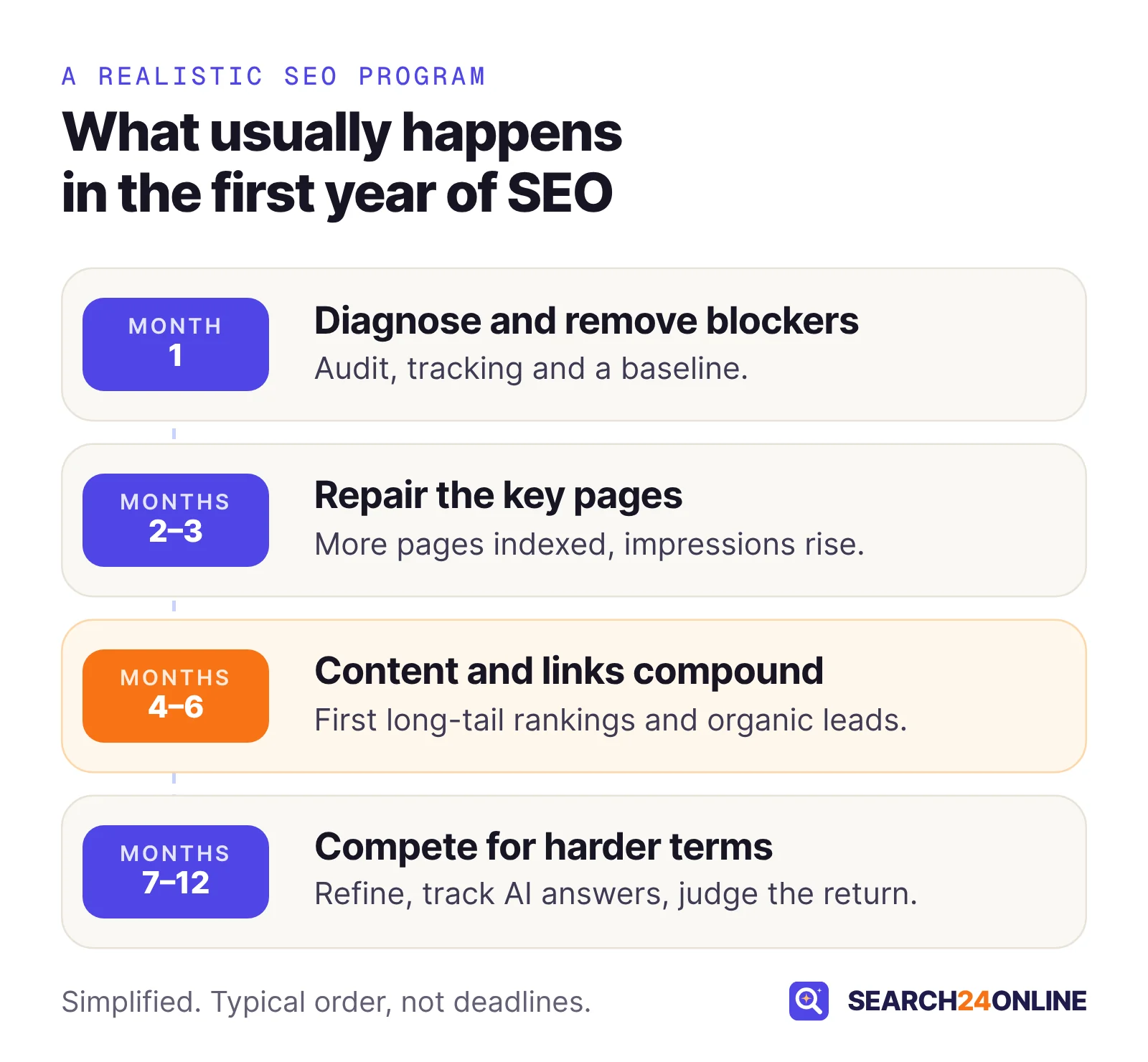
Month 1: diagnose and remove blockers
The first month is about knowing where you stand: an audit of indexing, internal links, competing pages, speed and structured data, plus a look at who ranks for your services today. Just as important is measurement: Search Console, calls and form fills tracked as conversions, and a baseline of how AI assistants answer questions in your category. Without a baseline, nobody can say in month six whether anything worked. Our own sequence is on how it works.
Months 2–3: repair the pages that earn money
Next come the highest-impact fixes. Unblock and consolidate pages, rewrite thin service pages around what searchers want, and pull key pages closer to the homepage with internal links. Complete your Business Profile. Expect technical signals here, not commercial ones: more important pages indexed and impressions starting to rise.
Months 4–6: content and links start to compound
With the foundation sound, new content fills gaps your competitors cover and you do not, and outreach starts earning relevant links. Long, specific searches usually begin ranking on page one, and the first clearly organic leads appear. In our experience, this is also when impatient owners are most tempted to quit, just before the earlier work pays.
Months 7–12: compete for harder terms and judge the return
Now the program goes after more competitive phrases, refreshes pages that slipped, prunes content that drags the site down, and tracks mentions in AI answers. Google says there are no special optimizations needed for AI Overviews or AI Mode, so that visibility grows from the same work. By month twelve you should have enough data to judge the return, using our guide to measuring SEO ROI.
Which early signals show SEO is working before rankings move?
Watch the chain in order: indexing, impressions, the number of searches you appear for, position on specific pages, clicks, then leads. Each tends to move weeks or months before the next, so flat leads in month three are normal if earlier signals are rising. Most are free in Google Search Console.
- Check that key pages are indexedUse the Page indexing report and the URL Inspection tool. Every page you want customers to find should be indexed; an unexplained gap here outranks every other priority.
- Watch impressions riseIn the Performance report, impressions count how many times your site appeared in results. They climb before clicks, because pages first surface in low positions few people scroll to.
- Count the queries you appear forThe Queries tab lists the searches that showed your site. A growing list means Google understands more of what you offer, even before any single phrase ranks highly.
- Track position by page, not sitewideAverage position across the whole site mixes branded and unbranded searches. Filter to a target page and look at its trend over a few months.
- Look for clicks to the pages that sellClicks to service and product pages matter more than total traffic from readers outside your market.
- Tie it to leadsCalls, form fills, bookings and Business Profile actions are what counts. Track them as conversions from day one.
Compare the last 28 days with the previous 28, or with the same period last year if your business is seasonal. Look at trends over several months rather than week-to-week wobbles. Traffic from Google’s AI features is included in the same report, under the “Web” search type.
A good monthly report walks you through these signals in this order and explains what was done to move them. If yours shows only a list of rankings, read what a monthly SEO report should include and ask for more.
What genuinely speeds SEO up, and what only looks faster?
The legitimate accelerators all do the same thing: they put effort where Google already sees potential, instead of starting from zero. The fake ones borrow speed now and charge for it later.
Things that genuinely shorten the timeline
- Remove indexing blockers first. A stray noindex tag, a robots.txt rule or a broken canonical can hide pages that would otherwise rank. Nothing else you do matters for those pages until they are fixed.
- Improve pages already on page two. Pages sitting around positions 8 to 20 are ones Google already considers relevant. Better answers, clearer structure and stronger internal links often move them sooner than new pages would rank.
- Merge pages that compete with each other. Consolidating three weak pages into one strong one, with redirects, gives Google a single clear choice.
- Pick winnable searches first. Specific, lower-competition questions build traffic and topical coverage while harder terms mature.
- Get local basics right. A verified, complete Business Profile and consistent listings are among the quickest wins for a local business.
- Implement quickly. In our experience, the most common reason a timeline slips is not Google. It is recommended fixes waiting weeks for a developer or a sign-off.
Buying links: Google can discount them, and any benefit they produced cannot be regained. Publishing hundreds of thin AI-written pages: that pattern can fall under scaled content abuse. Requesting indexing for the same page again and again: Google says it won’t get crawled any faster. Each of these trades a few weeks of apparent progress for months of cleanup.
Budget affects speed only up to a point. More hours mean more pages fixed and content shipped, so a tiny retainer moves slowly in a competitive market, but no budget makes Google crawl or reassess faster. Our breakdown of what SEO costs shows what each budget level realistically buys in hours and deliverables.
How do you know if your SEO timeline is on track?
Set checkpoints at the start and judge each one against the right signal for that stage. Rankings in month two are the wrong test; indexing and impressions are the right one. These are the checkpoints we use, and you can hold any provider to the same ones.
- By day 30: a written diagnosis of your site’s specific problems, tracking in place, and a prioritized plan. No results yet, and that is fine.
- By day 90: the main technical fixes shipped, key pages indexed, and impressions and the number of queries trending up compared with the baseline.
- By month six: first-page positions for some specific searches, more clicks to pages that sell, and the first leads you can trace to organic search.
- By month twelve: enough lead and revenue data to judge whether the program pays for itself, and a view of whether harder terms are within reach.
Outside a core update recovery, we treat no improvement in indexing or impressions by day 90 as a sign the diagnosis or execution is off; ask why before spending another quarter. Rising impressions but few clicks by month six usually points to titles, page quality or the wrong target searches, all fixable.
Questions to ask before you sign
Start with Google’s own question about results and timeframe. Then ask what the provider will examine in month one, which signals they will report before rankings move, and what happens if those stay flat. Be wary of anyone who names a date for a specific position. Google’s guidance is direct: “No one can guarantee a #1 ranking on Google.” A timeline is a forecast built on your site’s condition and your market, and an honest provider will explain the assumptions behind theirs.
Our team has worked with more than 500 brands, and our view is simple: the most useful thing to know before you start is which of the five situations above you are in. If you want that starting point, our free SEO + GEO report analyzes your website, and you get password-protected dashboard access to view it within 24 hours.
Common questions
Can SEO show results in 30 days?
Sometimes, but only for narrow fixes. If an important page was blocked from Google and you unblock it, it can come back once Google recrawls it, which Google says takes anywhere from a few days to a few weeks. New rankings for competitive searches almost never appear in the first month.
Why did my rankings drop right after SEO changes were made?
Short-term movement after big changes is common while Google recrawls and re-evaluates pages. Google warns of temporary fluctuations during site moves, and its SEO Starter Guide suggests waiting a few weeks before judging whether a change helped. A drop that persists for more than a month deserves a closer look.
Is local SEO faster than national SEO?
Usually, because you compete with a few dozen nearby businesses rather than every site in the country. Google ranks local results on relevance, distance and prominence, so a complete, verified profile, strong service pages and steady reviews can move faster than a national content and link program.
How long does it take a new page to rank on Google?
It varies far more by keyword than by page. In Ahrefs’ study of 2 million pages, only 5.7% reached the top 10 for any keyword within a year, and most of those took roughly 61 to 182 days. Pages targeting specific, low-competition questions tend to rank much sooner than pages chasing popular terms.
Does showing up in AI answers take longer than ranking on Google?
For Google’s AI features it runs on the same clock, because a page has to be indexed and eligible for a snippet before it can be a supporting link in AI Overviews or AI Mode. Other assistants differ, but none offers a faster shortcut than being a clear, well-linked, trusted source.
Sources
- Google Search Central: Do you need an SEO? (last updated June 2026)
- Search Engine Roundtable: Google: Give SEOs 4-12 Months To See Positive Ranking Benefits (February 2017)
- Google Search Central: SEO Starter Guide
- Google Search Central: Ask Google to recrawl your URLs
- Google Search Central: Google Search’s core updates and your website
- Google Search Central: Google Search spam updates and your site
- Search Console Help: Manual actions report
- Google Search Central: Site moves with URL changes
- Ahrefs: How Long Does It Take to Rank in Google? And How Old Are Top Ranking Pages?
- Google Business Profile Help: Verify your business on Google
- Google Business Profile Help: How to improve your local ranking on Google
- Google Search Central: AI features and your website
Find out which timeline your site is on — free.
We’ll analyze your website, create your SEO + GEO report and give you password-protected dashboard access, so you can see what is holding it back before you plan the months ahead.
Free · No obligation · We only review your public pages.