
How AI Assistants Choose the Sources They Cite
Every AI answer that links to websites comes out of the same basic process: search, retrieve, rank passages, write, cite. Here is how each step works in ChatGPT, Perplexity, Google, Copilot, Gemini and Claude, based on their own documentation, and what it means for your website.
Key takeaways
- AI assistants cite what they retrieve: when they search, they rewrite your question into one or more searches, pull candidate pages from a search index, rank individual passages and link the passages their answer relies on.
- Access comes first. Google only links pages that are indexed and eligible for a snippet, and OpenAI says sites that opt out of its OAI-SearchBot crawler will not be shown in ChatGPT search answers.
- Ranking for your main keyword is no longer enough: an Ahrefs study published in March 2026 found that only 37.9% of AI Overview citations ranked in Google’s top 10 for the original query.
- The signals the platforms document are relevance to the follow-up questions, clear self-contained passages, evidence, authority and freshness. No platform documents a special file, tag or payment that buys one.
On this page
How do AI assistants decide which sources to cite?
They cite what they retrieved, and they retrieve through a search index. When ChatGPT, Perplexity, Google’s AI Overviews, Microsoft Copilot, Gemini or Claude answer with links, they have usually run searches behind the scenes, pulled pages from an index and picked the passages that best support each part of the answer. The citation is a by-product of that retrieval, not a prize handed out afterward.
The technical name is retrieval-augmented generation, usually shortened to RAG or called grounding. In plain English: instead of answering only from what the model memorized in training, the assistant looks things up first, writes from what it found and shows where it found it. Picture a sharp research assistant with a library card and twenty minutes. They search the catalog, skim the most promising books, photocopy the useful pages and cite them in the memo.
You cannot edit a model’s memory. You can make sure your pages are in the catalog, easy to skim and worth photocopying. Everything below uses what the platforms themselves publish; where they publish nothing, we say so.
An AI citation is a link to your page shown as a source. A brand mention is your name in the answer, with or without a link, and can also come from training. This article is about citations.
What happens between a question and a cited answer?
Five steps, in roughly the same order, across every assistant covered here. The vendors use different names and keep the internals private, but the shape is consistent.
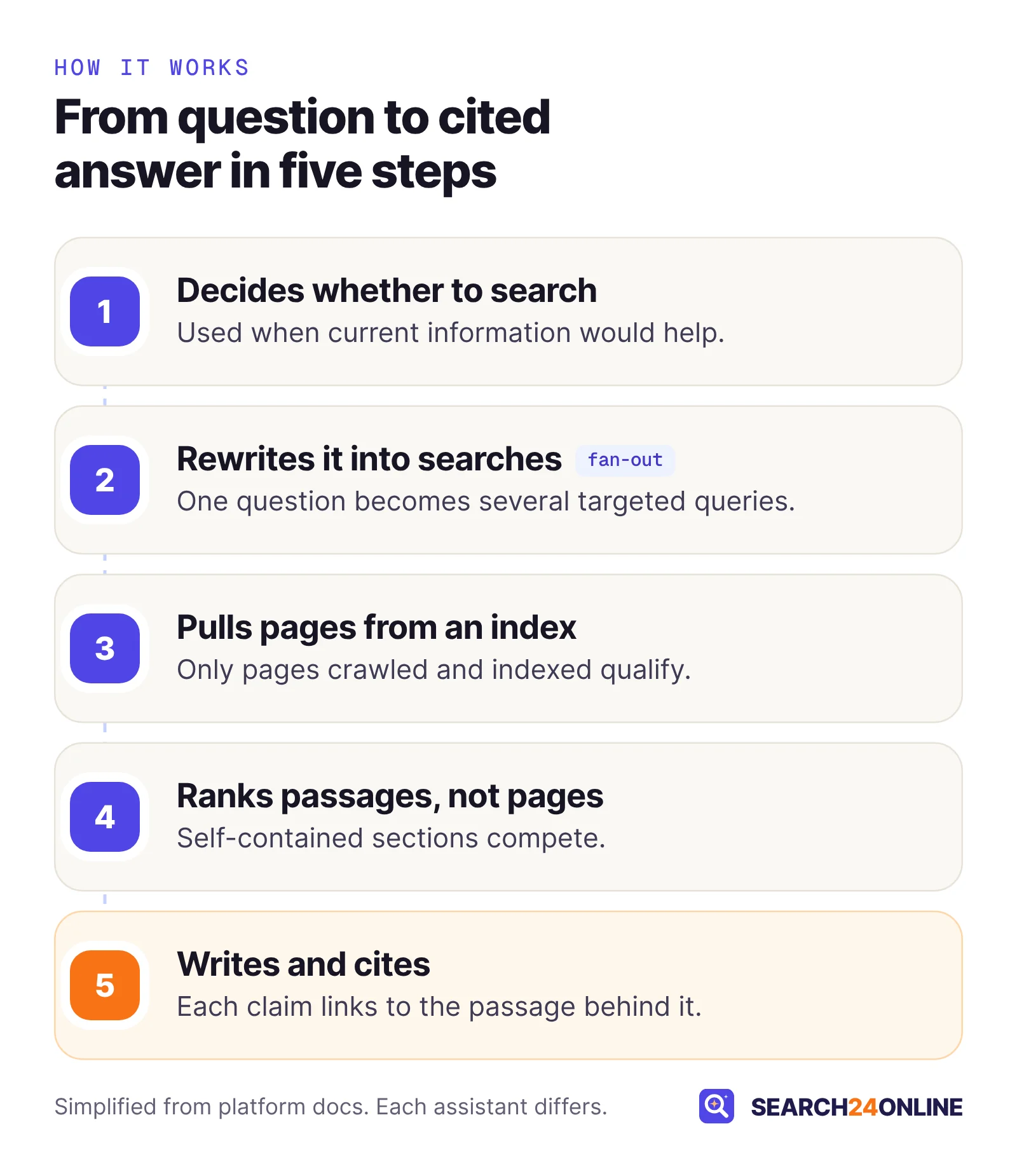
Step 1: The assistant decides whether to search
Not every answer involves a search. OpenAI says ChatGPT “may search the web automatically when your question would benefit from current information.” Anthropic’s help center says Claude invokes a search tool when a topic benefits from current information. Google’s developer documentation for grounding Gemini models with Google Search describes the same choice: the model decides whether search can improve its response, and answers that skip search carry no source data.
Our reading: local, commercial, comparative and time-sensitive questions (“best”, “near me”, “cost”, “vs”) are the most likely to trigger retrieval, so that is where citations are up for grabs. A textbook question may be answered from training alone, with no links.
Step 2: It rewrites the question into searches
Assistants rarely search for the exact words a person typed. OpenAI says ChatGPT search “typically rewrites your query into one or more targeted queries,” and may use saved memories and general location when it does. Google calls its version query fan-out: its documentation says AI Overviews and AI Mode may issue “multiple related searches across subtopics and data sources.”
Bing Webmaster Tools now shows site owners samples of these behind-the-scenes searches, called grounding queries: the key phrases the AI used when retrieving content it later cited.
An illustration, since no assistant publishes its sub-queries for a given prompt. A facilities manager asks who should replace the flat roof on a Columbus warehouse. A fan-out could search “commercial flat roof replacement Columbus”, “TPO vs EPDM for warehouses”, “commercial roof replacement cost per square foot” and “how to vet a roofing contractor”. A roofer with one generic commercial page competes in one of those searches; a competitor with a cost guide and a materials comparison competes in three.
Step 3: It pulls candidates from a search index
Assistants do not browse the open web from scratch for each question; they query an index that a crawler has already built. Google says a page must be indexed and eligible to appear in Google Search with a snippet before it can be a supporting link in AI Overviews or AI Mode. OpenAI says ChatGPT search sometimes partners with other search providers, and that a site becomes eligible by allowing its OAI-SearchBot crawler.
Perplexity runs its own index. Its September 2025 engineering write-up says the index tracks over 200 billion unique URLs. A machine-learning model decides which pages to index and when to refresh them, based on each URL’s importance and likely update frequency. Anthropic lists a dedicated crawler, Claude-SearchBot, which indexes content to improve Claude’s search results.
This is where most businesses quietly lose: if a page is not in the index, its writing never comes into play.
Step 4: It ranks passages, not whole pages
Once the candidates are in, the systems work at the level of sections and sentences. Perplexity says it splits documents into “self-contained spans, each of which can be individually retrieved and ranked,” combines keyword-based (lexical) and meaning-based (semantic) retrieval, and narrows the field through several ranking stages that end with more precise rerankers. Microsoft’s Krishna Madhavan, a principal product manager on Bing, wrote in October 2025 that assistants like Copilot break content into “smaller, structured pieces” and evaluate those pieces for authority and relevance.
So a strong page can lose the citation to a weaker one that has a single paragraph answering one sub-question cleanly. The unit of competition is the passage.
Step 5: It writes the answer and attaches citations
Finally the model writes, and each citation is tied to the part of the answer it supports. Google’s grounding documentation shows the mechanism plainly: the response data links each text segment, by its start and end position, to one or more of the web sources that were retrieved. Microsoft notes that AI can “lift a single line or combine multiple snippets from across sites into one answer.”
OpenAI says ChatGPT “ranks search results using multiple factors intended to help users find relevant, reliable information,” and adds that placement is not guaranteed. In every case, the link you hope for is attached to a specific claim, which is why specific claims matter.
What makes a page more likely to be cited?
Five qualities are documented by the platforms or supported by published research: access, relevance, extractability, credibility and freshness. They are what makes a page useful to a person, seen through a system that reads in fragments.
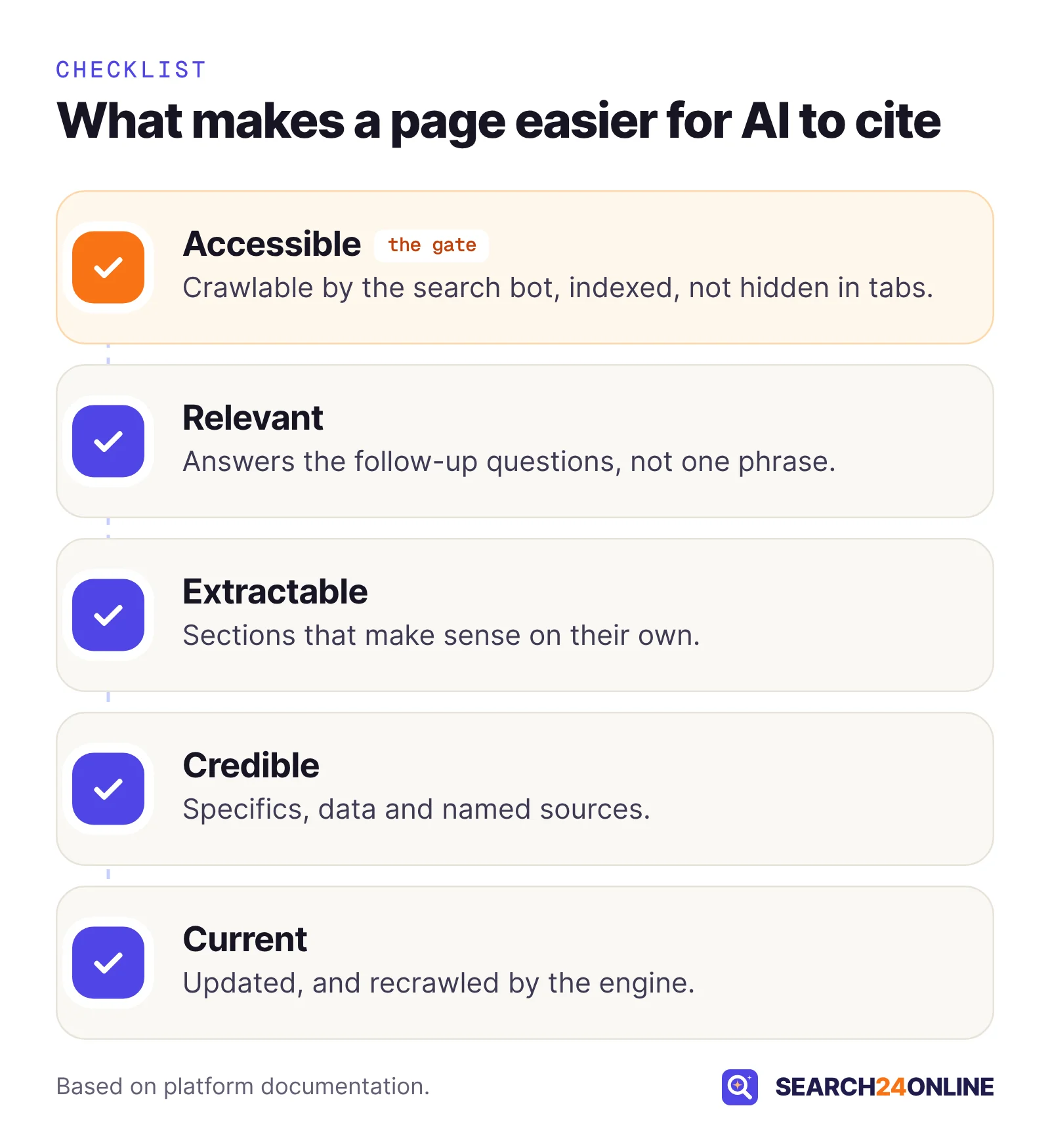
Access: can the assistant’s engine reach and index the page?
Access is a gate, not a score. Google requires indexing and snippet eligibility, and since August 31, 2026, Search Console has a Search generative AI setting that can exclude a site from AI Overviews and AI Mode (inclusion is the default). OpenAI says sites that opt out of OAI-SearchBot “will not be shown in ChatGPT search answers,” though they can still appear as navigational links. Anthropic says blocking Claude-SearchBot may reduce your visibility and accuracy in Claude’s search results, and Perplexity says its crawler follows the limits set in robots.txt.
Microsoft adds a subtler access problem. Its guidance warns that AI systems may not render hidden content, such as text in tabs, and that details shown only in images need alt text or an HTML version.
Relevance: does the page answer the follow-up questions?
Because of fan-out, relevance is judged against the searches the assistant runs, not just the words the customer typed. Ahrefs analyzed 863,000 keyword result pages and about 4 million AI Overview URLs for a study published in March 2026. It found that 37.9% of cited URLs ranked in Google’s top 10 for the original query, 31.2% ranked in positions 11 to 100, and 31.0% ranked beyond the top 100.
Ahrefs’ July 2025 study had put the top-10 share at about 76%. Ahrefs links the drop to query fan-out and possibly to AI Overviews moving to Gemini 3 in January 2026, but it also changed its parsing method between studies, so treat the size of the change with caution. Our view: ranking for the main phrase still helps, but pages that win citations also answer the next questions a buyer would ask.
Extractability: can a passage stand on its own?
Since systems rank passages, a section that makes sense out of context is more useful to them. Microsoft’s guidance is unusually specific. Clear headings act “like chapter titles,” one- to two-sentence direct answers are easy to lift, question-and-answer pairs can often be lifted word for word, and lists and tables suit how-to and comparison questions. It also warns that long walls of text “blur ideas together.”
A quick test we use: paste any single section of a page into a blank document. If it no longer says what you do, for whom and where, it will make a weak citation. Our guide to writing content AI assistants want to quote covers the rewriting in detail.
Credibility: does the page show evidence and expertise?
Bing’s February 2026 guidance asks site owners to back up claims with examples, data and cited sources. Perplexity says its index prioritizes documents from authoritative domains, and Microsoft’s October 2025 post notes that vague terms such as “innovative” or “eco” mean little without specifics.
Research points the same way. In the GEO paper by Aggarwal and colleagues (KDD 2024), adding quotations, statistics and source citations improved pages’ visibility in generative engine answers by roughly 30 to 40% on the main measure. Keyword stuffing gave little or no improvement. Gains were largest for lower-placed pages: citing sources lifted fifth-position pages by 115%. It was a lab benchmark, so take the direction, not the exact percentages, as the lesson.
Freshness: is the page current, and does the engine know?
Bing advises updating content regularly so AI systems reference the current version, and using IndexNow, a protocol for notifying participating search engines when pages are added, updated or removed. Perplexity says its indexing model accounts for how often each URL is likely to be updated. In our experience, visible dates and current figures help readers and machines alike; changing the date without changing the content helps neither.
How do ChatGPT, Perplexity, Google, Copilot, Gemini and Claude differ?
They share the five steps but draw on different indexes, crawlers and controls, so one question can produce different sources in each. Google says even its AI Overviews and AI Mode may use different models and techniques, so their links vary.
| Assistant | Where sources come from | Crawler or control that matters | What you can measure |
|---|---|---|---|
| ChatGPT search | Rewritten queries sent to search partners, plus pages OpenAI’s search crawler can reach | OAI-SearchBot (search). GPTBot is for model training only | Referral visits in your analytics |
| Perplexity | Its own index of over 200 billion URLs, ranked passage by passage | PerplexityBot, which follows robots.txt limits | Referral visits |
| Google AI Overviews and AI Mode | Google’s Search index, with query fan-out | Googlebot, snippet controls (nosnippet, data-nosnippet, max-snippet, noindex) and Search Console’s Search generative AI setting (Include is the default) | Search Console’s Generative AI performance report (impressions); clicks are in the Performance report under the Web search type |
| Microsoft Copilot and Bing AI summaries | Bing’s search systems, queried with grounding queries | robots.txt preferences; IndexNow to report updates | Bing Webmaster Tools AI Performance report: citations, cited pages, sample grounding queries |
| Gemini app | Internals unpublished; Google’s developer docs describe Gemini grounding with Google Search, where the model writes its own queries | Google-Extended, which Google says governs training and grounding in some of its other AI systems | Referral visits |
| Claude | A web search tool Claude uses when current information helps; images powered by Bing | Claude-SearchBot (search indexing) and Claude-User (fetches for a user’s question). ClaudeBot is for training | Referral visits |
Two points matter most. First, training crawlers and search crawlers are separate bots: blocking GPTBot or ClaudeBot opts you out of training, not out of search answers. Our guide to AI crawlers and whether to block them covers each one.
Second, measurement is uneven. Bing’s AI Performance report, in public preview since February 2026, counts how often your pages are cited across Copilot, Bing’s AI summaries and some partner integrations, though not where in the answer. Google’s Generative AI performance report in Search Console, rolled out to all sites by August 31, 2026, shows impressions in AI Overviews and AI Mode. Elsewhere you mostly rely on referral traffic and asking the questions yourself; see how to track brand visibility in AI answers.
For platform-specific detail, see what Google says about AI Overviews and AI Mode and how to get cited by Perplexity.
What does not earn AI citations?
Shortcuts don’t, because none is documented. Google says there are “no additional requirements to appear in AI Overviews or AI Mode, nor other special optimizations necessary,” and that you do not need new machine-readable files, AI text files or special schema markup. Microsoft’s Madhavan wrote that “there’s no secret sauce that guarantees selection in AI answers.”
- Keyword repetition. In the GEO paper, keyword stuffing did no better than the unmodified pages.
- Schema as a magic switch. Microsoft says structured data helps machines interpret text; Google says no special schema is required. Both fit: markup is a clarity aid that should match the visible page, not a ticket in.
- Blocking every AI bot “to be safe”. Blocking a search crawler removes you from that assistant’s candidate pool. Decide bot by bot.
OpenAI tells site owners to confirm that their host or content delivery network allows traffic from OpenAI’s published search bot IP addresses. In audits we often find bot protection blocking AI crawlers that robots.txt welcomes.
Why do some good businesses never get cited?
Usually because of ordinary SEO debt, not anything specific to AI. Our team brings over 20 years of digital marketing experience and has served 500+ brands, and the businesses missing from AI answers show the same problems that keep sites off page one.
Important pages are not indexed
This fails at step 3. In audits we often find service pages or guides that were never indexed because of an accidental noindex tag, a wrong canonical tag or no internal links. Spot it with the Page indexing report and URL Inspection in Search Console, and Bing Webmaster Tools. Fix the tag, link to the page from relevant pages and resubmit your sitemap.
Forty pages chasing one phrase
A common situation: a regional HVAC company with 40 service pages that all target “HVAC repair” with only the city name swapped. The pages compete with each other (keyword cannibalization), and none of them answers the follow-up questions a fan-out would search for, such as costs, brands serviced, emergency hours or financing. Consolidate into fewer, stronger pages and give each remaining page a distinct job and distinct answers.
The answers live in tabs, PDFs and images
Picture a manufacturer whose tolerances and certifications sit in PDF brochures and image-based spec tables. Microsoft warns that AI systems may skip hidden content and may not reliably understand details shown only in images. Move the key specifications into HTML tables, with a one-sentence summary above each.
Thin, stale or vague content
A pricing page last touched three years ago, or a service page full of “industry-leading” and “quality solutions,” gives an assistant nothing specific to cite. Replace adjectives with facts: price ranges, service areas, standards met, turnaround times, named sources for any figure, and a real “last updated” date when you change the content.
A weak footprint beyond your own site
Assistants pull from far more than business websites. Ahrefs found that YouTube URLs made up 18.2% of cited URLs that did not rank in Google’s top 100, and 5.6% of all cited URLs in its sample. Perplexity says its index prioritizes authoritative domains. Relevant mentions and links, video where your buyers watch and consistent listings (Bing points local businesses to Bing Places) widen the pool of pages that can vouch for you. That broader discipline is what we mean by GEO, or generative engine optimization.
How can you make your site easier for AI assistants to cite?
Work through the steps in order, starting with access, because everything else depends on it. In our experience, for a typical small business site this takes about a month, then the last step repeats monthly.
- Confirm crawler accessCheck yoursite.com/robots.txt does not block Googlebot, Bing’s crawler, OAI-SearchBot, PerplexityBot or Claude-SearchBot, and ask your host or CDN whether bot protection does.
- Confirm indexing in Google and BingCheck your 20 to 30 most important URLs in Google Search Console and Bing Webmaster Tools, submit sitemaps to both, and turn on IndexNow if your platform supports it.
- List the questions buyers askPull 20 to 30 real questions from sales calls, emails and reviews, including cost and comparison questions.
- Ask the assistants and record the sourcesRun each question in ChatGPT, Perplexity, Google AI Mode, Copilot, Gemini and Claude and note which domains are cited. Answers vary between runs, so look for patterns.
- Map follow-up questions to pagesList the sub-questions a fan-out would likely search and give each a clear home, a section or a page. Merge pages that compete for the same answer.
- Rewrite key sections answer-firstUnder a descriptive heading, answer in one or two sentences, then add specifics and sourced numbers. Move anything important out of tabs, PDFs and images.
- Measure monthlyReview Bing’s AI Performance report, Search Console’s Generative AI performance report and AI referral traffic, rerun your questions and adjust the pages that are close.
To allow search crawlers while opting out of model training, the robots.txt entries look like this (Allow lines only matter if another rule would block these bots):
# Search crawlers: allowed, so pages can be cited
User-agent: OAI-SearchBot
Allow: /

User-agent: PerplexityBot
Allow: /

User-agent: Claude-SearchBot
Allow: /

# Training crawlers: blocked (optional, your choice)
User-agent: GPTBot
Disallow: /

User-agent: ClaudeBot
Disallow: /OpenAI says ChatGPT search takes about 24 hours to adjust after a robots.txt change, and content changes count only once each engine recrawls the page. Wait a few weeks before judging a rewrite.
To have this checked for you, our free SEO + GEO report analyzes your website, and you get password-protected dashboard access within 24 hours. Our SEO + GEO services include ongoing tracking: the plans cover 25 AI questions on Starter (Google AI and ChatGPT), 75 on Growth (adding Perplexity, Gemini and Copilot) and 200 on Authority (adding Claude). No one can promise a citation; you can control whether your pages deserve one and can be found.
Common questions
Does ChatGPT use Google or Bing to find its sources?
OpenAI’s current help article does not name a single engine: it says ChatGPT rewrites your prompt into targeted queries and sometimes partners with other search providers. To be eligible, your site must allow OpenAI’s OAI-SearchBot crawler.
Why does an AI assistant cite my competitor when I rank higher on Google?
Because assistants rank passages for the several searches they run behind the scenes, not just for the words the customer typed. A competitor with a clear section answering one of those follow-up searches can win the citation even when you rank higher for the main phrase.
Can I pay to be cited by ChatGPT, Perplexity or Google AI Overviews?
None of the platform documentation we reviewed describes a way to pay for an organic citation. OpenAI says ChatGPT ranks results using multiple factors and that placement is not guaranteed.
If I block GPTBot or ClaudeBot, will my site disappear from AI answers?
No, not from search-based answers, because GPTBot and ClaudeBot are training crawlers. Search visibility depends on OAI-SearchBot for ChatGPT and Claude-SearchBot for Claude, so you can opt out of training and stay eligible for citations.
How quickly do AI assistants pick up changes to my pages?
There is no fixed timeline; it depends on when each engine recrawls the page. Perplexity says its indexing accounts for how often a page is likely to be updated, and Bing recommends IndexNow to tell it when content is added or updated.
Sources
- Google Search Central: AI features and your website
- Search Console Help: Generative AI performance report (Search)
- Search Console Help: Search generative AI control
- Google Firebase AI Logic docs: Grounding with Google Search
- OpenAI Help Center: Searching the web with ChatGPT
- OpenAI: Overview of OpenAI crawlers
- Perplexity Research (September 25, 2025): Architecting and evaluating an AI-first search API
- Bing Webmaster Blog (February 10, 2026): Introducing AI Performance in Bing Webmaster Tools Public Preview
- Microsoft Advertising Blog (October 2025): Optimizing your content for inclusion in AI search answers
- Claude Help Center: Does Anthropic crawl data from the web, and how can site owners block the crawler?
- Claude Help Center: Enable and use web search
- Ahrefs (March 2026): How many AI Overview citations come from top-10 rankings
- Aggarwal et al., GEO: Generative Engine Optimization (KDD 2024), arXiv
Can AI assistants find and cite your site? Find out free.
We’ll analyze your website, including AI crawler access, create your SEO + GEO report and give you password-protected dashboard access to view it.
Free · No obligation · We only review your public pages.