
Hiring an SEO Agency Overseas: What to Check Before You Sign
Lower rates and overnight turnaround are real, and so are the risks. Here is how a US business can vet a remote SEO team on access, proof of work, communication, contracts, payment and data before any real money changes hands.
Key takeaways
- Hiring an SEO agency overseas can work well for a US business if you vet how the agency works, not where it is based: account ownership, a paid pilot, US-market knowledge, communication, contract and payment.
- The savings are real. Backlinko’s survey, updated December 2025, found US-based SEO services cost 3–5x more than providers in emerging markets, and 42% of providers in India and Latin America charge under $500 a month, against 7% in the US, UK and Australia.
- The main risks come from distance: spam tactics you can’t see, hidden subcontracting, slow feedback and weak recourse.
- Keep every account in your name and grant the least access the work needs. Google advises read-only Search Console access while an SEO audits your site.
- Pay in arrears or by milestone with a method you can dispute. The FTC notes that credit cards “offer more protections and give you the option to dispute charges.”
On this page
- Should you hire overseas?
- What are the real advantages of an overseas SEO agency?
- What are the real risks of outsourcing SEO overseas?
- The six vetting checks
- Accounts, access and data
- Testing quality and market knowledge
- Communication across time zones
- Contract and payment terms
- A worked example
- Common questions
- Sources
Should a US business hire an SEO agency overseas?
It can be a sound decision, as long as you judge the agency on how it works rather than where it sits. Location doesn’t decide quality. It changes which risks you have to manage: slower feedback across time zones, less familiarity with US customers and rules, and a harder time recovering money or enforcing a contract if the relationship goes wrong.
A disclosure before going further: SEARCH24ONLINE works with US clients remotely, so we have a stake in this question. What follows is the version we would want if we were on your side of the table, including the situations where a local provider is the better choice.
Good and bad remote agencies look much the same on a sales call. The difference shows up in details you can check: whose name is on your accounts, what real work on your site looks like, how links are earned, and what the contract says about leaving.
Still deciding between an agency, a freelancer and an in-house hire? Start with SEO agency vs freelancer vs in-house. Comparing agencies in general? The 15 questions to ask any SEO agency apply wherever the provider is based. This article covers what changes when the team is in another country.
What are the real advantages of an overseas SEO agency?
Three advantages hold up: lower rates, work that moves while you sleep, and a wider pool of specialists. Each comes with a catch.
Lower rates for the same hours
The price gap is large and well documented. Backlinko surveyed more than 300 SEO professionals (its page was last updated in December 2025) and found that US-based SEO services cost 3–5x more than providers in emerging markets. In its regional breakdown, 42% of providers in India and Latin America charge under $500 a month, compared with 7% in the US, UK and Australia.
The catch: a lower rate only saves money if the hours produce work you can use, and you will spend time reviewing drafts and correcting misunderstandings, especially early on. Our view: a good overseas agency gives you more skilled hours for the same fee, not the same thin package for less. Our guide to what SEO costs shows how to turn any fee into hours and deliverables you can compare.
Work that moves overnight
A team several time zones ahead can pick up a brief you send at 5 p.m. and have a draft, a crawl report or a list of fixes waiting when you open your inbox. For tasks with clear instructions, such as technical fixes from an agreed list, that overnight cycle can move a project faster than a provider working your hours.
The reverse is also true. When a task needs back-and-forth, each round trip can cost a full day, and a misunderstanding a local agency would clear up in a five-minute call can take three days of email. The fix is an overlap window, covered below.
A wider pool of skills
SEO now spans technical work, content, digital PR, local listings, analytics and visibility in AI answers, and looking beyond your city widens the pool of specialists. Our view: the right skills are a better reason to hire abroad than the invoice alone.
What are the real risks of outsourcing SEO overseas?
The serious risks come from distance, not nationality. Distance makes it harder to see how work is done, slower to correct course and harder to recover money or data. Five risks come up most often.
| Risk | What it looks like | How to test before signing |
|---|---|---|
| Spam tactics | “50 backlinks a month” or dozens of articles a month at a low fixed price | Ask for links earned for a current client and how each one was obtained |
| Hidden subcontracting | The people on the sales call are not the people doing the work | Get names and roles for strategy, writing and technical work, and a clause on subcontracting |
| Slow feedback loops | Every question takes a day; small misunderstandings turn into weeks | Agree overlap hours and response times in writing, then test them in a pilot |
| Thin US-market knowledge | Generic content, an off tone, tactics that break US rules on reviews | Run a paid pilot on your own site and ask market-specific questions |
| Weak recourse | Large prepayments by wire, no exit terms, disputes settled abroad | Pay in arrears or by milestone, by card; set governing law and exit terms |
Spam tactics land on your domain
This is the costliest risk, because the damage falls on your website, not the agency’s. Google’s spam policies define link spam as creating links “primarily for the purpose of manipulating search rankings” and list buying or selling links for ranking purposes as an example. They also cover scaled content abuse: many pages generated mainly to manipulate rankings. The consequence, in Google’s words: such sites “may rank lower in results or not appear in results at all.”
Cheap link and content packages are sold from every country; they are just easier to hide when you never meet the team. In audits we often find the aftermath: a backlink profile built mostly from low-quality directories and paid guest posts, and dozens of thin articles that compete with the site’s own service pages for the same searches. That second problem, called cannibalization, splits Google’s attention so that none of the competing pages ranks well.
Subcontracting you didn’t agree to
Some agencies resell another provider’s work under their own brand, known as white-label SEO. It happens domestically too, so hiring a US agency doesn’t mean your work stays in the US. It isn’t wrong in itself, but you should know who touches your site and data. Ask, and get the answer in the contract.
Recourse is harder at a distance
Recourse is the risk owners think about last. With a local vendor you have familiar options, from a meeting with the owner to your local courts. With a vendor abroad, your contract and payment method do most of the protecting.
How do you vet an overseas SEO agency? Six checks
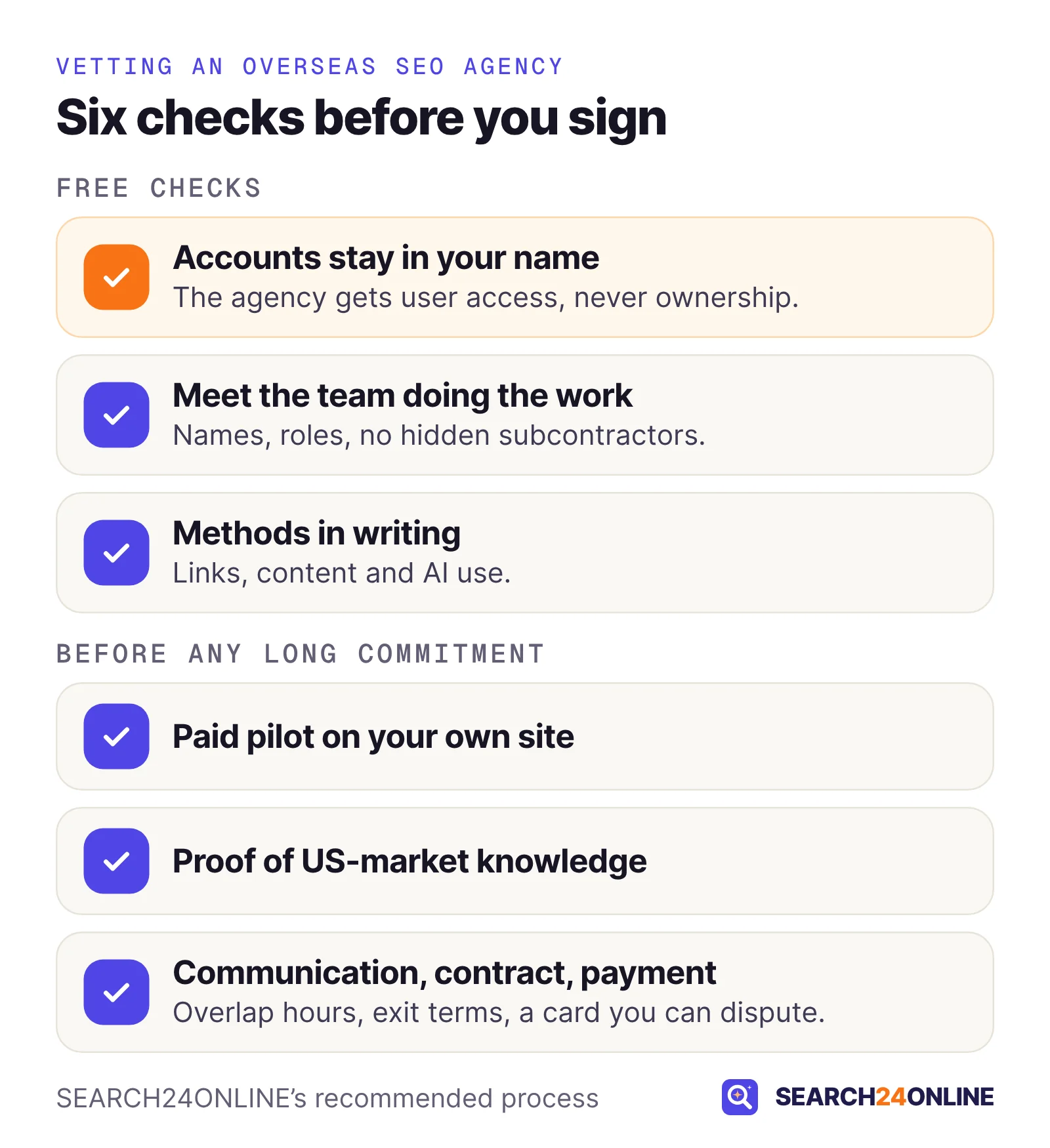
Run six checks, in this order, before committing to anything beyond a short paid trial. The free checks come first, so you only pay for a pilot with agencies that pass them.
- Accounts stay in your nameThe agency works through user access to accounts you own and never owns your Search Console, analytics, Business Profile, domain or website.
- Meet the team that will do the workNames and roles for strategy, writing and technical work, and a written answer on subcontracting.
- Get the methods in writingHow links are earned, who writes content, how AI tools are used and what will change on your site. Vague answers end the process.
- Run a paid pilot on your own siteA small fixed-price project you can judge, such as an audit of key pages.
- Test US-market knowledgeAsk about your customers, competitors and industry rules, and check the pilot for accuracy and tone.
- Settle communication, contract and paymentOverlap hours, reporting, ownership, exit terms, dispute venue and a payment method you can dispute.
An agency that resists any check tells you more than its pitch deck. For warning signs that apply to every provider, keep 12 SEO promises that mean you should walk away open while you talk to them.
Who should own the accounts, and how much access should the agency get?
You should own every account, and the agency should get the least access its current work needs. That matters more with a remote vendor, because if things end badly you may have no practical way to get logins back.
Our agency questions guide covers ownership platform by platform. The short version: you stay owner or administrator, and the agency is added as a user. The part people skip is the access level, which should follow the phase of work.
- While you vet and run a pilot: read-only. Google’s own guidance on hiring an SEO says to grant “read access to Search Console (at this stage, don’t grant them write access).” In Search Console, a restricted user can view most data. A full user can also submit sitemaps, file reconsideration requests and disavow links.
- Once work starts: full user in Search Console, an analytics role that can’t manage users, and a named website login for each person.
- Never: ownership of your domain registrar, hosting account, Business Profile or analytics property.
The FTC’s Start with Security guide for businesses agrees: access on a “need to know” basis, administrative access only where a job requires it, and strong passwords with multifactor authentication. In practice, that means two-step verification on every account and a password manager instead of logins sent by email or chat.
Keep customer data out of SEO work
Most SEO work doesn’t need your customers’ personal information, so lead lists, call recordings and CRM exports should stay with you. Google Analytics policy already prohibits sending Google anything it could use to identify a person, such as names, email addresses and phone numbers, including details that slip into page URLs or form fields.
Healthcare businesses face stricter rules. Under HIPAA, a covered practice must have a written business associate contract with vendors that help with its health care functions and handle protected health information. In guidance on storing electronic health data outside the US, HHS says HIPAA has no offshore-specific requirements but warns that outsourcing overseas “may increase the risks and vulnerabilities to the information” held abroad. It also flags enforceability of privacy and security protections as a special consideration. If an agency will touch call tracking or form submissions, involve your compliance lead before signing.
Plan the exit on day one
Keep a list of every account the agency can reach and at what level, and remove each user when the engagement ends. Search Console is the classic trap: when you remove an owner, their “verification tokens are not deleted or revoked,” so they can re-verify unless you delete the token from your site or DNS.
How do you test work quality and US-market knowledge?
Pay for a small pilot on your own website and judge the output, not the pitch. Sample reports from other clients are hand-picked; work on your site shows how the team thinks about your problems.
Design a pilot you can judge
A useful pilot is small, fixed-price and checkable within weeks:
- An audit of your 10–20 most important pages, with a prioritized list of fixes and the reasoning behind each one.
- A rewrite of one service page, with a brief explaining what searchers want from it.
- Technical fixes from an agreed list, with a change log.
A competent team should find the problems we see most often in audits: important pages missing from Google’s index, internal links that bury key services several clicks deep, several pages chasing the same keyword, and thin or outdated content. If the pilot report is an unprioritized export from an automated tool, you have your answer. Our walkthrough of what an SEO audit includes shows what a good one covers.
Questions that reveal US-market knowledge
Ask questions whose answers you can check:
- Who are our three strongest search competitors in our area, and why do you think they rank?
- How would you set up our Business Profile if we serve customers at their homes rather than at an office?
- Which rules on reviews, testimonials and advertising apply to our industry?
- How will you make sure our content reads naturally to American customers?
One gap carries legal weight. The FTC’s rule on consumer reviews and testimonials, in effect since October 21, 2024, bans fake reviews and buying reviews that must express a particular sentiment, and it allows courts to impose civil penalties for knowing violations. According to the FTC, a business can be liable for buying reviews it “knew or should have known were false,” and agencies and review brokers can be liable themselves. An agency that offers to “help with reviews” without knowing these rules puts the risk on you.
Law firms, healthcare practices and financial firms all face advertising rules a general SEO team may not know. You need an agency that asks about them and builds your review into its workflow.
What communication rhythm works across time zones?
Agree a written rhythm before work starts. Remote relationships tend to fail through silence more than bad intent, and a rhythm makes silence visible early. A setup that works with a team many hours ahead:
- Overlap window: an hour or two, several days a week, when someone senior is available live.
- Weekly written update: done, next, blocked, and what they need from you.
- Monthly review call: results against the goals you agreed, led by the person responsible for your account.
- Response times: a stated window for questions and a faster one for emergencies such as a site outage.
- One named contact: plus a named backup.
- A shared change log: every change to your site, with the date and the reason.
Reporting is where distance shows fastest: a live dashboard of leads, search traffic and completed work tells you far more than a PDF of rankings. Disappointment is common: vcita’s April 2025 survey of 500 US small and midsize businesses found that 40% of those who outsource marketing end up dropping or switching agencies. Sixty percent pointed to a lack of return on investment, and 56% of the churn came within 6–12 months.
So agree in writing what “working” means before you start, and month six becomes a review rather than a surprise. Our guide to what a monthly SEO report should include lists the numbers worth tracking.
If updates are late or vague while the agency is still trying to win your business, they won’t improve after you sign.
What should the contract and payment terms say?
The contract should spell out deliverables, ownership, exit and where disputes are settled, and payments should follow the work. With a vendor abroad these terms carry more weight. This is not legal advice; have an attorney review the agreement.
Clauses worth insisting on
- Scope in units: pages, articles, fixes, links earned and reports per month.
- Ownership: content, code, data and accounts created for you are yours, with copyright assigned in writing.
- Methods: no paid links, fake reviews or mass-produced content, with the right to terminate if they happen.
- Team: named key people, and no subcontracting without your written consent.
- Security and data: confidentiality, security steps and deletion of your data at the end. The FTC advises writing security standards into vendor contracts and verifying them, because “Security can’t be a ‘take our word for it’ thing.”
- Exit: a short notice period, no automatic renewal into a long term, and a written handover list.
- Governing law and disputes: which law applies and where disputes are resolved.
Where disputes get settled
Enforcing a US court judgment abroad is usually slow and costly, which is one reason cross-border contracts often choose arbitration. UNCITRAL lists 172 parties to the New York Convention on foreign arbitral awards, including the United States. For a $1,000-a-month contract, though, arbitration may cost more than it recovers, so your practical protection is payment terms and a notice period that cap what you can lose.
Paying safely
Never get far ahead of the work. Pay monthly in arrears or per milestone, keep upfront payment to a fixed-fee pilot, and fix the currency in the contract.
Prefer a business credit card or a platform that holds funds until you approve the work. In a July 2026 alert, the FTC noted that credit cards “offer more protections and give you the option to dispute charges.” The same alert treats a demand to pay only by bank transfer, wire, cryptocurrency, payment app or gift card as a sign of a scam. Dispute rights on business cards vary, so check your card’s terms.
An agency that will only accept wire or crypto, and only upfront, is one. An unsolicited email offering to get you to the top of Google is the other: Google’s hiring advice says to “be wary of SEO firms and web consultants or agencies that email you out of the blue.”
A worked example: two proposals for a dental practice
Take a two-location dental practice in a mid-sized US city with $1,500 a month to spend.
Proposal A, from a local agency: technical fixes, two page rewrites and one article a month, Business Profile management and a monthly call. Proposal B, from an agency abroad, at the same price: technical fixes, six rewrites and four articles a month, local link outreach, a live dashboard and weekly updates. B offers roughly twice the output, so the practice runs the six checks.
- Accounts: both agree to user access on accounts the practice owns.
- Team: B names its strategist, two writers and a developer. A’s writing goes to freelancers it won’t name. A point to B.
- Methods: B describes outreach to community and professional sites, with examples. A doesn’t offer link building.
- Pilot: both audit the 15 key pages and spot that the two location pages compete for the same searches and the emergency page isn’t indexed. B’s sample rewrite, though, is generic and makes treatment claims the dentists won’t approve.
- Data: B asks for call recordings, which can contain patient details.
Neither wins automatically. B is the better value if call recordings stay out of scope, a dentist reviews every page before it goes live, and the contract allows a short exit. A is safer if nobody has time to review content. The checks decide it, not the location.
Put us through the same checks
Because we work with US clients remotely, we expect these questions: who works on your account, what access we need, how links are earned and what happens when you leave. Our how it works page is a start. To see our work on your own site first, our free SEO + GEO report analyzes your website and gives you password-protected dashboard access within 24 hours. Judge it the way you would judge any pilot: is it about your site, and is it prioritized?
Common questions
Is outsourcing SEO overseas cheaper?
Usually, per hour: Backlinko’s survey of 300+ SEO professionals found US-based SEO services cost 3–5x more than providers in emerging markets. The real saving depends on how much of your time goes into reviewing and correcting work, so compare deliverables you would accept, not hourly rates.
Can an overseas agency do local SEO for a US business?
Yes. Local SEO is mostly work on your website, Google Business Profile and listings, all of which can be done remotely. What matters is whether the team understands your local customers and competitors, which a paid pilot will show.
Should I give an overseas SEO agency my website admin password?
No. Give each person at the agency their own login with the lowest role that does the job, and keep the main admin account yourself. Shared passwords make it impossible to see who changed what, or to remove one person’s access cleanly.
What if an overseas SEO agency stops responding?
Your protection comes from what you set up before signing: accounts in your name, payment in arrears or by milestone, a card you can dispute, and a list of every login the agency holds. Then you can remove their access and move on without losing data.
Do overseas SEO agencies use AI to write content?
Many agencies use AI tools in some way, wherever they are based. Ask how they use it and who edits and fact-checks each piece. Google’s spam policies target pages generated at scale mainly to manipulate rankings, whatever tool produced them.
Sources
- Google Search Central: Do you need an SEO? (last updated June 2026)
- Google Search Central: Spam policies for Google web search
- Search Console Help: Managing owners, users, and permissions
- Google Analytics Help: Best practices to avoid sending personally identifiable information (PII)
- Backlinko: SEO Pricing (survey of 300+ SEO professionals, updated December 2025)
- vcita: 2025 SMB marketing survey on agency churn (press release, July 2025)
- FTC Consumer Alert: A way to spot scams: how someone asks you to pay (July 2026)
- FTC: Start with Security: A Guide for Business (August 2023)
- FTC: Consumer Reviews and Testimonials Rule: Questions and Answers
- HHS: Covered Entities and Business Associates
- HHS: HIPAA FAQ on cloud service providers storing ePHI outside the United States
- UNCITRAL: Status of the Convention on the Recognition and Enforcement of Foreign Arbitral Awards (New York, 1958)
Judge any SEO agency, local or remote, against your real issues.
We’ll analyze your website, create your SEO + GEO report and give you password-protected dashboard access, so you can check every proposal and pilot against what your site actually needs.
Free · No obligation · We only review your public pages.