
SEO for Medical Clinics and Healthcare Practices
How US clinics and practices get found on Google and in AI answers without cutting corners on medical accuracy or patient privacy: who should review your pages, how to structure condition and provider pages, Google’s rules for practitioner profiles, and what the 2024 court ruling did and did not change for tracking pixels.
Key takeaways
- Healthcare SEO is local SEO with a higher bar for trust: Google says its systems give extra weight to content with strong E-E-A-T on topics that can affect people’s health, so clinical pages need a named, qualified reviewer and visible sources.
- A Texas federal court vacated part of HHS’s tracking-technology guidance on June 20, 2024, and HHS dropped its appeal on August 29, 2024. The guidance on patient portals, booking tools, apps and business associate agreements still stands.
- Google allows a separate Business Profile for a public-facing practitioner who is reachable at the location during stated hours, but the practice location needs its own profile, and a solo practitioner in a branded practice shares one named “[brand]: [practitioner name]”.
- Never confirm that a reviewer is a patient. HHS settled with a New Jersey psychiatric practice for $30,000 after its replies to negative reviews disclosed patients’ health information, including one patient’s diagnosis and treatment.
- Many patients now ask AI too: a KFF poll released in March 2026 found 32% of US adults used AI chatbots for health information in the past year.
On this page
What makes healthcare SEO different from other local SEO?
Three things: the trust bar is higher, the privacy rules are stricter, and one location can hold many providers. The foundations (a verified Business Profile, a crawlable site, reviews, consistent listings) are the same as for any local business, and our complete local SEO guide covers them. This article covers what changes when the business treats patients.
Google calls topics that can significantly affect “the health, financial stability, or safety of people” Your Money or Your Life (YMYL) topics. Its systems give extra weight to content with strong E-E-A-T on them: experience, expertise, authoritativeness and trust. A slightly wrong plumbing post costs someone an afternoon; a wrong page about symptoms can hurt someone.
Privacy is the second difference: analytics, ad pixels and booking tools can leak protected health information, and review replies can disclose it in public. The third is structure. A group with eight physicians and three locations has to decide which people and places get pages and profiles, and Google has rules for that.
In audits of practice websites we keep seeing the same pattern: a respected clinic with one thin “Services” page listing twenty conditions, one-sentence provider bios, and a booking form wired to every pixel the last agency installed. Fixing those three things usually matters more than any keyword tweak. Dental practices share most of this; their specifics are in our guide to SEO for dentists.
This guide explains SEO practice and summarizes public guidance from HHS and Google. HIPAA questions about your own site, vendors and workflows belong with your privacy officer or a healthcare attorney. State privacy laws can add obligations on top of HIPAA.
How do you show E-E-A-T on medical pages?
Show who wrote the page, who checked it clinically, when, and what it is based on. Google says E-E-A-T “itself isn’t a specific ranking factor,” but its systems use signals that align with it. Of its parts, “trust is most important.” On a medical site, trust means a reader can verify that a qualified person stands behind the page.
Google’s helpful content guidance asks who created a page, how and why. It recommends accurate bylines where readers expect them and warns against fabricated creator profiles, such as AI-generated headshots or made-up credentials.
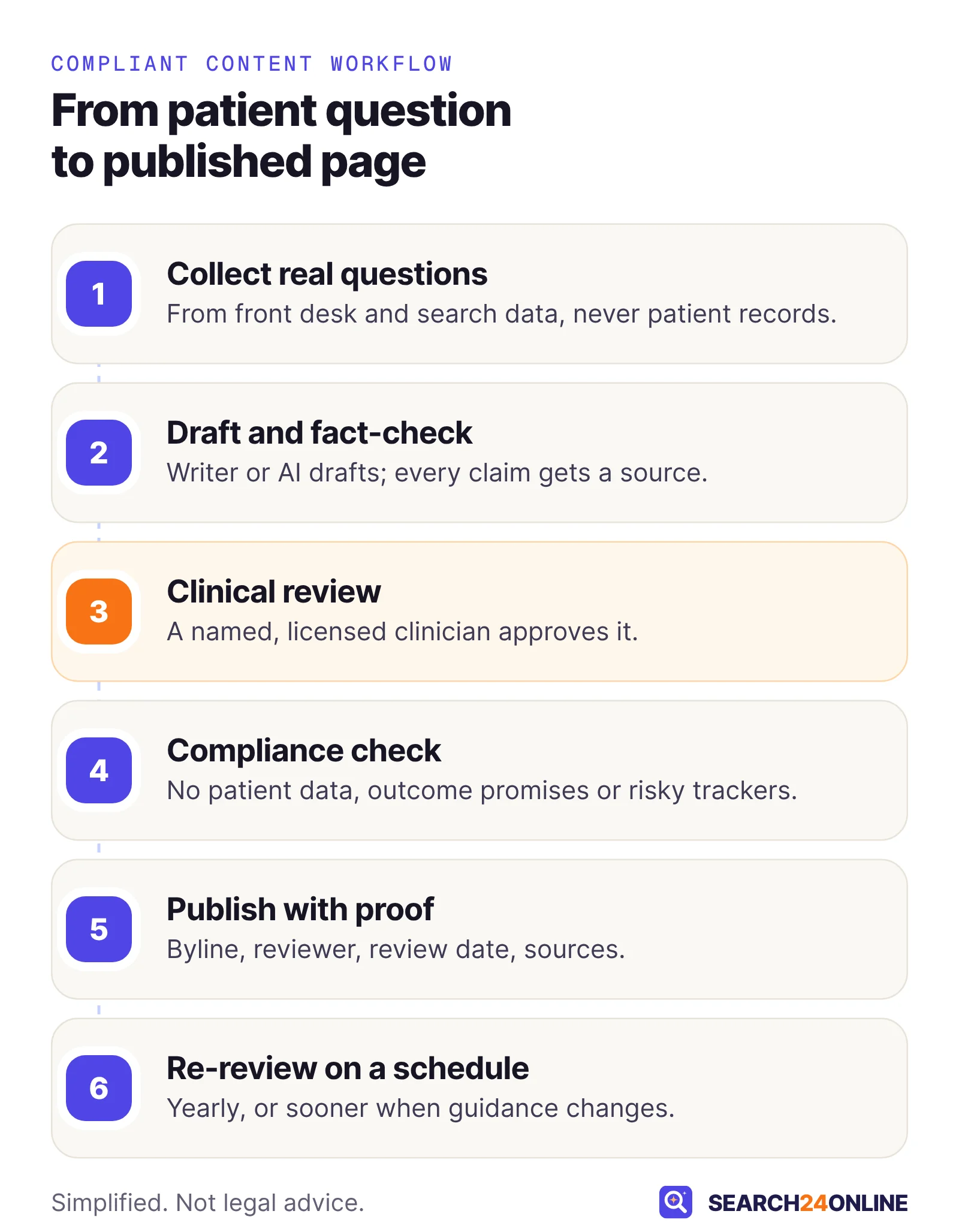
A medical review workflow that holds up
- Start from real questionsAsk the front desk what patients ask on the phone, and check Search Console. Never copy anything from a chart or message thread into a brief.
- Draft and fact-checkA writer, or AI with a human editor, drafts the page. Every clinical claim gets a source from a recognized body: a specialty society, the CDC, the NIH or peer-reviewed research.
- Clinical reviewA licensed clinician in the specialty reads the whole page, corrects it and signs off. Their name links to their provider page.
- Compliance checkNo patient details or identifiable photos, no promised outcomes, no tracking your privacy officer has not approved.
- Publish with proofAuthor, “Medically reviewed by” with name and credentials, review date and sources.
- Re-review on a scheduleOur view: yearly, and immediately when a guideline or your protocol changes. Change the review date only after a real review.
Putting a physician’s name on fifty pages they never read is exactly the kind of signal Google warns about, and it exposes the physician professionally. If the reviewer can only manage four pages a month, publish four pages a month.
How should you structure condition and treatment pages?
Give each condition or treatment you actively treat its own page, written for the decision a patient is trying to make, and link it to the providers and locations that offer it. The single “Services” list is the most common weakness we find: it cannot match the intent of any one search, and it gives Google nothing specific to rank.
A useful condition page answers what a patient wants to know before booking. What is it, in plain language? Which symptoms mean they should be seen, and which mean urgent care? What happens at the first visit, which treatments do you offer, who provides them, where, and how do insurance and referrals work? That is where local practices beat national health publishers. A large medical website can explain plantar fasciitis; it cannot tell a patient that your podiatrists see it at two nearby locations and offer Saturday appointments.
Keep pages from competing with each other
Cannibalization (several pages targeting the same search and splitting Google’s attention) is rife on medical sites. A common situation: an orthopedic group has a knee pain blog post, a “knee pain treatment” page, a “knee specialist” page and three location pages repeating the same knee paragraphs. None ranks well. The fix is one strong page per intent:
| Page type | Search it should own | What it must include | Who reviews it |
|---|---|---|---|
| Condition page | “knee pain”, “torn meniscus symptoms” | Plain-language explanation, when to be seen, treatment options you offer, providers, locations | Specialist clinician, yearly |
| Treatment or procedure page | “knee arthroscopy”, “PRP injection knee” | Who it suits, what happens, recovery, risks, insurance and cost questions, who performs it | The clinicians who perform it |
| Location page | “orthopedic clinic [town]” | Address, hours, parking, providers at this site, services offered here, directions | Practice manager, quarterly |
| Provider page | The provider’s name, “[specialty] doctor [town]” | Credentials, specialties, locations, booking link (more below) | The provider, plus credentialing |
Location pages should link to the conditions treated there, not copy their text. With many sites, see our guide to multi-location SEO.
Avoid outcome promises (“pain-free in one visit”); they read as low trust and may break professional advertising rules. Write for a worried patient, with clinical terms in parentheses for referring providers.
What belongs on a provider page?
Everything a patient, a referring doctor and Google need to confirm who this person is: full name with degree, specialty, board certifications, training, languages, locations, conditions they focus on, and a way to book. Many patients search a doctor’s name after a referral, so these pages earn real traffic.
- One permanent URL per provider, such as
/providers/jane-rivera-md/, linked from every condition, treatment and location page they cover. - Verifiable credentials: license state, board certification, residency and fellowship, matching state boards and directories exactly.
- A real photo and an introduction in the provider’s own words. This is the “experience” in E-E-A-T, and it is hard to fake.
- Consistency with the Business Profile. The same name format, locations and phone number as their Google profile, if they have one.
- Links to the pages they reviewed, connecting your reviewer bylines to their credentials.
Plan for departures. Deleting a departed provider’s page breaks every link to it and sends patients who search the name to a directory. Our default: keep the URL for a while with a note saying which colleagues now see their patients, then redirect it to the relevant specialty or provider listing page.
How do Google’s Business Profile rules work for multi-provider practices?
Google lets an individual practitioner have their own Business Profile if they work in a public-facing role and can be reached directly at the verified location during stated hours, and it names doctors and dentists as examples. Support staff should not have profiles, and a practitioner should not have several profiles for different specializations. These rules are in Google’s guidelines for representing your business on Google.
The three set-ups Google describes
- Several practitioners at one location: Google says the organization should create a profile for the location, “separate from that of the practitioner.” Each practitioner’s profile title should include only their name, not the practice name. Titles and degrees such as Dr. or MD are allowed.
- One public-facing practitioner at a branded practice: Google says it is best to share a single profile, named in the format “[brand/company]: [practitioner name]”.
- Departments: public-facing departments of hospitals and similar institutions that operate as distinct entities can have their own profiles, with names distinct from the main organization. Google’s own example is a hospital’s department of dermatology.
Two other rules catch practices out. A virtual office (a rented address where you do not operate) is not eligible, and an office in a co-working space needs clear signage and staffing during business hours, among other conditions. A therapist subletting a room two afternoons a week should check these first.
What we recommend in practice
Our view: give profiles to established practitioners whom patients search for by name, and skip locums and staff who rotate often. Link each practitioner profile to that provider’s page, not the home page, and the practice profile to the location page. Agree in writing who owns each practitioner profile: Google’s ownership transfer needs the current owner to add you and then transfer ownership, which is awkward after a provider leaves on bad terms.
Practitioner and practice profiles can compete in map results. That is fine while both send patients to your clinic, and a problem when a departed physician’s profile keeps ranking. Our guide to optimizing a Google Business Profile covers categories, photos and verification.
Which schema types should a medical practice use?
Mark up each location with the most specific type that describes it (often MedicalClinic, or Hospital for a hospital facility) and each provider page with IndividualPhysician, then connect them. Schema.org’s medical vocabulary changed in 2024, and many practice sites still carry the old markup.
Schema.org’s release notes show that version 24.0, released January 9, 2024, added IndividualPhysician for a single practitioner and PhysiciansOffice for a doctor’s office as subtypes of Physician, to separate the two meanings the type had carried. It also added usNPI for the 10-digit National Provider Identifier. Schema App’s summary adds a practicesAt property linking an individual physician to the clinic or hospital where they work. Version 24.0 also took Physician out from under LocalBusiness, but version 26.0 (February 12, 2024) restored it as a subtype of MedicalBusiness, so it now sits under both MedicalBusiness and MedicalOrganization.
Google’s local business structured data documentation asks for the most specific LocalBusiness subtype possible, requires only name and address, and does not discuss medical types. Treat this markup as a clear statement of facts for search engines and AI systems, not a route to special search features. A simplified provider page example:
{
  "@context": "https://schema.org",
  "@type": "IndividualPhysician",
  "@id": "https://example.com/providers/jane-rivera-md/#physician",
  "name": "Jane Rivera, MD",
  "url": "https://example.com/providers/jane-rivera-md/",
  "medicalSpecialty": "Dermatology",
  "usNPI": "0000000000",
  "practicesAt": {
    "@type": "MedicalClinic",
    "@id": "https://example.com/locations/riverside/#clinic",
    "name": "Example Dermatology Riverside"
  }
}
Schema App adds that MedicalOrganization suits a large organization with several locations or sub-organizations. Check the current hierarchy on schema.org before choosing types, and test with the Schema Markup Validator.
Google’s local business documentation says review and aggregateRating markup is for sites that capture reviews about other local businesses. Copying your Google rating into your clinic’s schema does not qualify. Our schema markup guide covers the types that matter for small businesses.
What does HIPAA mean for analytics and tracking pixels now?
Less was struck down in 2024 than many marketers assume. HHS guidance issued in 2022 said website trackers could disclose protected health information (PHI): health information that identifies a person. On June 20, 2024, the U.S. District Court for the Northern District of Texas, in American Hospital Association v. Becerra, vacated one part of it: the position that linking a visitor’s IP address to a visit to an unauthenticated public page about specific health conditions or providers was a disclosure of PHI.
HHS filed an appeal and then voluntarily dismissed it on August 29, 2024, according to the American Bar Association’s Health Law Section, so the ruling stands. The HHS page itself notes the court order, says HHS is evaluating its next steps, and shows a content review date of June 26, 2024. As of November 2026 we found no newer replacement guidance on that page.
What the remaining guidance still says
- Logged-in pages: “Tracking technologies on a regulated entity’s user-authenticated webpages generally have access to PHI.” That covers patient portals and telehealth platforms.
- Some public pages too: portal login and registration pages, appointment booking and symptom-checker tools can involve PHI when people enter identifying or health information.
- Apps: information collected by apps that regulated entities offer generally counts as PHI.
- Vendors: a tracking vendor handling PHI for you is a business associate, so you need a business associate agreement (BAA, the contract HIPAA requires) plus a Privacy Rule permission before any disclosure.
- Consent banners are not a fix: HHS says cookie banners “do not constitute a valid HIPAA authorization,” and a privacy policy notice alone does not permit disclosure.
Google is more cautious than the court. Its Analytics help page says Google “makes no representations” that Analytics satisfies HIPAA and offers no BAA for it. It tells HIPAA-regulated customers to keep Analytics tags off authenticated and HIPAA-covered pages, and says public pages related to providing health care are more likely to be covered.
A practical tracking review
- Inventory every tagList each script (analytics, ad pixels, heatmaps, chat, embedded booking) and the pages that fire it.
- Strip trackers from high-risk pagesPortal, login, registration, booking, intake forms, symptom checkers and their confirmation pages, unless your compliance lead has approved a vendor under a BAA.
- Keep health details out of URLs and eventsA thank-you page at
/thank-you?service=hiv-testingsends the service name to every tag on it. Use neutral URLs and generic conversion names such as “appointment request.” - Choose tools on the contractA vendor’s “HIPAA compliant” badge is not a BAA.
- Document the decisionHHS says tracking should be part of your security risk analysis. Write down which pages carry which tags, and why.
In audits we regularly find ad pixels on appointment confirmations with the condition in the URL, usually left over from an old campaign. That is why the inventory comes first.
How do you answer patient reviews without breaking HIPAA?
Write every reply so it would read the same whether or not the person was ever your patient: no names, no confirmation of a visit, no details of care. That holds even when reviewers describe their own treatment. Their disclosure does not authorize yours.
HHS has enforced this. In June 2023 it announced that Manasa Health Center, a New Jersey practice providing adult and child psychiatric services, paid $30,000 after it answered a patient’s negative online review with details of the patient’s diagnosis and treatment. HHS found impermissible disclosures about three other patients in replies to their reviews as well, and placed the practice under two years of monitoring. OCR Director Melanie Fontes Rainer’s comment on the practice was blunt: “Simply put, this is not allowed.”
Reply patterns that stay safe
- Positive review: “Thank you for taking the time to share this. We pass feedback like this on to the whole team.” Do not add “glad your knee is healing.”
- Negative review: “We are sorry to read this. Privacy rules prevent us from discussing anyone’s care online, but we take feedback seriously. Please call our practice manager at [number] so we can talk.”
- A review you believe is false: the same neutral reply. Never argue the facts of a visit in public.
Make one trained person responsible for replies, with approved templates. How to ask for reviews within FTC and Google rules is in our guide to getting more Google reviews.
How do AI health answers change how patients find you?
They absorb general questions and leave the local, specific decisions to you. KFF’s Health Information and Trust tracking poll (1,343 US adults, fielded February 24 to March 2, 2026, released March 25, 2026) found that 32% of adults used AI chatbots for health information in the past year. Among users, 41% cited wanting to look information up before deciding whether to see a provider as a major reason, and 42% of those who asked about physical health did not follow up with a doctor or health professional.
Google is also adjusting what its AI shows for health searches. In January 2026, TechCrunch reported, following a Guardian investigation, that Google had removed AI Overviews for searches about the normal range of liver blood tests. A Google spokesperson said the company does not comment on individual removals, and that an internal clinical team found that in many instances the information was not inaccurate and was supported by high-quality websites.
Our view: generic “what is” content is the least defensible part of a medical site, because AI answers and national publishers already cover it. The pages that keep earning visits and citations are the ones only you can write: who treats what, where, how soon and with which insurance.
Google says there are no additional requirements for AI Overviews or AI Mode: a page must be indexed and eligible to show with a snippet. So keep condition and provider pages indexed, answer common questions in short self-contained passages, and keep hours and accepted insurance identical everywhere. More in our article on appearing in AI Overviews and AI Mode.
Where should a practice start?
Start with risk, then foundations, then content. Privacy problems can cost more than rankings earn, and broken foundations waste new content.
- Month 1: tracking and repliesRun the tag inventory, clean up high-risk pages with your compliance lead, and switch review replies to approved templates.
- Month 1–2: profiles and indexingAudit every location and practitioner profile against Google’s rules, remove duplicates, and check in Search Console that your important pages are actually indexed.
- Month 2–3: provider pagesRebuild them with full credentials, photos and links, then fix the markup to IndividualPhysician and the location types.
- Month 3 onward: condition and treatment pagesStart with the services that matter most to the practice, run each through the review workflow, and merge pages that compete for the same search.
For a starting point, our free SEO + GEO report analyzes your website (indexability, structured data, AI crawler access, business schema and other local trust signals) and ranks every issue from critical to low with how to fix it. It does not review HIPAA compliance; that stays with your compliance team.
Common questions
Is a Meta or Google Analytics pixel on a medical website a HIPAA violation?
It can be, depending on the page and what the tag sends. HHS guidance still says trackers on patient portals and apps generally have access to protected health information and that booking pages can involve it, and Google says not to put Google Analytics on HIPAA-covered pages and does not sign business associate agreements for it. Ask your compliance lead or a healthcare attorney to review each page type.
Does every doctor in our practice need a Google Business Profile?
No. Google allows a dedicated profile for a practitioner who is public-facing and directly reachable at the verified location during stated hours, but does not require one. In our experience, many groups keep profiles for established physicians and skip them for rotating or part-time staff, while the practice location keeps its own profile.
Do medical pages have to be written by doctors to rank?
No, but a qualified clinician should review them. Google says its systems give extra weight to content with strong experience, expertise, authoritativeness and trust on health topics. A skilled writer plus a named, licensed reviewer who actually checks the page is a realistic and honest way to meet that bar.
Can we reply to a patient who mentions their own diagnosis in a review?
Reply without confirming they are a patient or repeating any detail, even if they shared it themselves. HHS has settled with practices whose review replies disclosed patients’ information, including a New Jersey psychiatric practice that paid $30,000. Thank them, state that privacy rules limit what you can say, and invite them to call.
Sources
- HHS: Use of Online Tracking Technologies by HIPAA Covered Entities and Business Associates (content last reviewed June 26, 2024)
- American Bar Association Health Law Section (September 2024): HHS voluntarily dismisses appeal in online tracking technology lawsuit
- Google Analytics Help: HIPAA and Google Analytics
- HHS (June 5, 2023): OCR reaches agreement with New Jersey health care provider that disclosed PHI in response to negative online reviews
- Google Business Profile Help: Guidelines for representing your business on Google
- Google Search Central: Creating helpful, reliable, people-first content
- Google Search Central: AI features and your website
- Google Search Central: Local business (LocalBusiness) structured data
- Schema.org: Release notes (versions 24.0 and 26.0)
- Schema App: Schema.org v24.0 release changes to Physician schema markup
- Schema App Support: Hospital page best practices
- KFF (March 25, 2026): Poll: 1 in 3 adults are turning to AI chatbots for health information
- TechCrunch (January 11, 2026): Google removes AI Overviews for certain medical queries
See how your practice website looks to Google and AI — free.
We’ll analyze your practice website, including indexability, structured data, AI crawler access and local trust signals, create your SEO + GEO report and give you password-protected dashboard access to view it.
Free · No obligation · We only review your public pages.