
How to Get Your Business Mentioned in ChatGPT
ChatGPT names businesses from two places: what its model already learned, and the live web searches it cites. This plan is built on OpenAI’s own documentation, and it ends with a way to test your progress honestly when the answers change from one run to the next.
Key takeaways
- You get mentioned in ChatGPT by being findable and well described, not by asking or paying: ChatGPT search has to be able to crawl your site, and the pages it retrieves for a question have to name you. OpenAI says plainly that placement is not guaranteed.
- The crawler that matters for ChatGPT search is OAI-SearchBot. GPTBot collects training data and ChatGPT-User fetches pages when someone asks; OpenAI says sites that block OAI-SearchBot will not be shown in ChatGPT search answers.
- If you sell products, OpenAI says ChatGPT’s product results are selected independently and are not ads. Shopify stores are included through Shopify Catalog; direct product feeds are limited to approved partners.
- Answers change from run to run: SparkToro’s January 2026 study found less than a 1-in-100 chance of ChatGPT giving the same list of brands twice. Track how often you appear across repeated runs, not your “rank”.
On this page
How does ChatGPT decide which businesses to mention?
ChatGPT mentions a business for one of two reasons: its model learned about it in training, or a live web search during the conversation turned it up. You cannot edit the first directly. The second you can influence, because OpenAI documents how it works.
OpenAI’s help center says ChatGPT “may search the web automatically when your question would benefit from current information.” When it does, it “typically rewrites your query into one or more targeted queries” for the search providers it works with; OpenAI says it “sometimes partners with other search providers.” OpenAI’s own example turns a question about where to eat into the search “top restaurants San Francisco.” ChatGPT then ranks the results “using multiple factors intended to help users find relevant, reliable information” and links the sources it used. The same page adds: “Placement is not guaranteed.”
That example matters more than it looks. A search like “top restaurants San Francisco” mostly returns lists, reviews and directories written by other people. So getting mentioned in ChatGPT depends on two things: your own pages being reachable and clear, and the third-party pages ChatGPT reads describing you accurately. The general mechanics of retrieval and citation are covered in how AI assistants choose the sources they cite. This article is the ChatGPT-specific plan.
Why bother? Pew Research Center’s February 2026 survey found that 44% of US adults say they have used ChatGPT, up from 18% in 2023, and 55% of adults aged 30 to 49. Pew notes that the 2026 question was worded slightly differently. Either way, a lot of your customers now ask it questions before they ask anyone else.
A brand mention is your name in the answer. An AI citation is a link to your page listed as a source. You want both, and you should track them separately: a mention with no citation usually means ChatGPT found you through someone else’s page.
Which OpenAI crawlers need access to your site?
Only one is essential for ChatGPT search: OAI-SearchBot. OpenAI lists four bots, and each does a different job, so each robots.txt rule should be a separate decision. OpenAI says the settings work independently, so you can allow OAI-SearchBot and block GPTBot.
| Bot | What OpenAI says it does | If you block it | Our default for most businesses |
|---|---|---|---|
| OAI-SearchBot | Crawls sites so they can be surfaced in ChatGPT’s search features | Your pages are not shown in ChatGPT search answers, though they can still appear as navigational links | Allow |
| GPTBot | Crawls content that may be used to train OpenAI’s foundation models | Signals that your content should not be used for training; search eligibility is set separately | Your call |
| ChatGPT-User | Visits a page when a user asks ChatGPT or a custom GPT to; not used for automatic crawling or to decide search inclusion | OpenAI says robots.txt rules may not apply, because a person started the visit | Leave alone |
| OAI-AdsBot | Checks landing pages submitted as ads in ChatGPT; visits only those pages | Only matters if you advertise in ChatGPT | Allow if you run ads |
A minimal robots.txt that welcomes ChatGPT search while opting out of training looks like this. The Allow line only matters if another rule in the file would block the bot; drop the GPTBot block if you are happy for your content to be used in training.
# Let ChatGPT search crawl and cite your pages
User-agent: OAI-SearchBot
Allow: /

# Optional: opt out of model training
User-agent: GPTBot
Disallow: /
OpenAI says search-related robots.txt changes take about 24 hours to take effect. If you allow both bots, it may use a single crawl for both purposes. For pages you never want surfaced, OpenAI’s publisher FAQ recommends a noindex meta tag, with a catch: the crawler can only read the tag if it is allowed to crawl the page. Our guide to AI crawlers and whether to block them covers the other companies’ bots.
OpenAI asks site owners to confirm that their host or content delivery network allows traffic from its published OAI-SearchBot IP addresses. In audits we often find a robots.txt that welcomes AI search bots while the hosting company’s bot protection quietly blocks them. Check both.
What has to be true on your own website first?
Your important pages must be crawlable, indexed and specific. OpenAI’s publisher FAQ says “any public website can appear in ChatGPT search,” so there is no application to file. But ChatGPT can only cite what its search providers have indexed, and only quote what the page actually says.
OpenAI does not name the search providers it uses today. Our view: that uncertainty is a reason to make sure both Google and Bing index your key pages. Submit sitemaps in Google Search Console and Bing Webmaster Tools, and check your 20 to 30 most important URLs in each.
The audit findings that keep businesses out
Our team brings over 20 years of digital marketing experience and has served 500+ brands. The businesses missing from AI answers almost always have ordinary SEO problems rather than anything exotic:
- Key pages not indexed. A stray noindex tag, a wrong canonical tag or a page with no internal links. Spot it in Search Console’s Page indexing report and Bing’s URL inspection.
- Answers locked in PDFs, images or tabs. Prices, service areas and specifications that a person can see but a crawler may not read reliably. Put them in plain HTML text.
- One vague page for everything. A single “Services” page that lists eight services in one paragraph cannot win a search for any one of them. Give each service its own page.
- Pages competing with each other. Ten near-identical city pages targeting the same phrase split the signal. Merge them, or give each one genuinely local detail.
Pages worth building or rewriting
Think about the searches ChatGPT is likely to run for your customers’ questions, and give each one a clear answer on your site. For most businesses that means a factual About page: who you are, where, since when and who you serve. Add one page per service or product line, an honest pricing page with ranges, and comparison pages for the decisions buyers actually weigh. Open each with a one- or two-sentence answer, then the specifics.
That is the core of GEO, generative engine optimization, and the same work that helps you rank on Google. There is no ChatGPT-only markup or file to add.
How do you get other websites to describe you accurately?
Make your basic facts identical everywhere, then earn mentions on the sites ChatGPT actually reads for your category. The first is housekeeping you can finish in a few weeks; the second is an ongoing program.
Make your facts match everywhere
When ChatGPT retrieves five pages about a business and they disagree on the address, the services or whether it is still open, it has conflicting evidence. Our view: inconsistency makes an assistant less likely to state facts about you confidently, and more likely to state the wrong ones. Make these match across your site, Google Business Profile, Bing Places, Apple Business, Yelp, industry directories, LinkedIn and social profiles:
- Business name, exactly as written (with or without “LLC”, but the same everywhere)
- Address, service area, phone number and hours
- Primary category and the list of services or product lines
- Founding year, key people and credentials you can back up
A common situation: a family-owned landscaping company that moved three years ago, still listed at the old address on half its directories, with two phone numbers in circulation and a website that says only “serving the greater Phoenix area.” Nothing about that is unusual, and all of it is fixable. Our guide to entity SEO explains how search engines and AI systems tie these facts to one business.
Find the sources ChatGPT already cites
You do not have to guess which third-party sites matter. Ask ChatGPT the questions your customers ask, open the Sources list under each answer, and write down every domain it cites. OpenAI says the Sources button shows cited sources and other relevant links. After a few rounds you will have a list of the review sites, “best of” roundups, directories, trade publications and forum threads that shape answers in your category.
Then work through that list in order of fit:
- Review platforms. OpenAI says price and reviews can factor into which products ChatGPT shows, and that review summaries come from public websites. Ask every happy customer for a review on the platforms that appear in your Sources list.
- Roundups and directories. Where a list is editorial, pitch the writer with facts (what you do, for whom, proof). Where it is a directory, claim and complete your profile.
- Local and trade press. A genuine story, such as a new location, a community project or useful original data, earns mentions that keep working for years.
- Forums and Reddit. Answer questions in your field under your real name and disclose who you work for. In our experience, promotional drive-by posts get removed and do more harm than good.
What if you sell products online?
Then ChatGPT’s shopping results are a second way in, with their own rules. When a question shows shopping intent, ChatGPT can show product options with images, details and merchant links. OpenAI says a product appears when ChatGPT judges it relevant to the request and the user’s context, such as memory and custom instructions. It adds that “product results are selected independently by ChatGPT and are not ads.” Ads exist in ChatGPT, but OpenAI shows them separately.
OpenAI’s shopping help page explains where the data comes from. Product and merchant information comes from third-party providers and merchant-provided metadata. When several stores sell the same item, merchants are ranked by factors such as availability, price, quality and whether the merchant makes or primarily sells the product. Shopify merchants are already integrated through Shopify Catalog, with no extra work required. Other merchants can apply for direct product feed access.
Direct product feeds
OpenAI’s commerce documentation says onboarding product feeds is “currently available to approved partners,” through the form at chatgpt.com/merchants. Approved merchants upload their catalog over SFTP, and OpenAI recommends a full snapshot at least once a day. The feed reference lists nine required fields: item ID, title, description, product URL, brand, seller name, image URL, availability and price. A product is search-eligible by default unless you set it otherwise. Only legal, safe, general-audience products are allowed.
Checkout and the Agentic Commerce Protocol
The Agentic Commerce Protocol (ACP) is the protocol OpenAI uses to connect merchants to ChatGPT for agentic commerce, where an AI agent completes the purchase. OpenAI says building with ACP “is open to all,” but Instant Checkout, the option to pay inside ChatGPT, is available only to approved partners. In that setup OpenAI is not the merchant of record; you keep your own payment provider.
The direction has shifted, though. MacRumors reported in March 2026 that OpenAI was moving its shopping focus to product discovery. OpenAI said Instant Checkout “did not offer the level of flexibility that we aspire to provide.” OpenAI’s shopping help page still says an Instant Checkout option may appear for some eligible products. Our view: for most small and mid-sized stores, clean product data, accurate prices and stock, and genuine reviews matter far more than checkout integration. Our guide to e-commerce SEO and AI shopping covers the product-page side.
How do you test prompts and track mentions honestly?
Run a fixed set of real customer questions on a schedule, repeat each one several times, and report how often you appear rather than where. A single screenshot proves nothing, because ChatGPT’s answers vary from one run to the next.
The variation is large. In a study published in January 2026, SparkToro had about 600 volunteers run 12 prompts 2,961 times across ChatGPT, Claude and Google’s AI. ChatGPT and Google’s AI had less than a 1-in-100 chance of giving the same list of brands in two responses, and the same order came up roughly once in 1,000 runs. How often a brand appeared meant more than its position: one hospital showed up in 69 of 71 ChatGPT answers but was the top mention in only 25. SparkToro’s Rand Fishkin concluded that visibility percentage across many prompts, each run several times, is a reasonable metric. He warned against tools that report a “ranking position” in AI.
Build a prompt set that reflects real buyers
Pull 20 to 30 questions from sales calls, emails, reviews and your search data, in three groups:
- Discovery: “Who are the best commercial roofers in Columbus?” or “What’s a good CRM for a 10-person agency?”
- Comparison: “Is [your brand] or [competitor] better for small offices?”
- Brand facts: “What does [your brand] charge?” or “Does [your brand] work on weekends?” These catch wrong information, which can cost you more than a missing mention.
Control what you can
ChatGPT personalizes answers. OpenAI says it may use saved memories when rewriting a search and an approximate location based on your IP address. Test in a logged-out browser window, which OpenAI says can still use web search, or in Temporary Chat, which OpenAI says won’t access or create memories. Custom instructions still apply in Temporary Chat, so switch them off. For local questions, either test from inside your service area or put the city in the prompt.
Record the same fields every time
For each run, log: the date, the prompt, whether you were mentioned, whether your site was cited, which domains were cited, which competitors were named, and whether the facts about you were correct. SparkToro suggests 60 to 100 runs per prompt for stable numbers, which is unrealistic by hand. Our compromise: five runs per prompt each month, in the same week, with judgments made on the three-month trend rather than one month’s swing.
To show the arithmetic: 30 prompts run five times each gives 150 answers. If you are named in 27 of them, your visibility that month is 18%. That figure is far more honest than “we rank third in ChatGPT.”
Check the traffic, too
OpenAI says ChatGPT automatically adds utm_source=chatgpt.com to referral links, so you can filter for it in Google Analytics or any other analytics tool. Watch which landing pages those visits reach and whether they turn into calls, forms or sales. Our guides to tracking brand visibility in AI answers and seeing ChatGPT traffic in GA4 cover the setup.
The domains ChatGPT cites when it names a competitor and not you are the most useful output of the whole exercise. Each one is a page to get listed on, a writer to pitch or a profile to complete.
What should you avoid?
Anything that fakes the signals instead of earning them. Beyond the ethics, these tactics carry legal and reputational risk, and none of them is documented by OpenAI as working.
- Fake or bought reviews. The FTC’s final rule, announced in August 2024, bans fake reviews and testimonials, including AI-generated ones. It also bans reviews that misrepresent who wrote them, and paying for reviews that must express a particular sentiment. It lets the FTC seek civil penalties against knowing violators.
- Self-serving “independent” review sites. The same rule prohibits misrepresenting a site you control as offering independent reviews of a category that includes your own products. A “best roofers in Columbus” list on a site you secretly own, with you at number one, is exactly that.
- Mass-produced pages. Hundreds of near-identical AI-written pages rarely give an assistant anything worth citing, and they can put your Google rankings at risk too. See Google’s spam policies in plain English.
- Hidden text aimed at AI. Instructions hidden in white text or HTML comments are deceptive to readers, and in our view not worth the risk to your reputation if a journalist or customer spots them.
- Anyone promising placement. OpenAI itself says placement is not guaranteed. A vendor who promises you will be “the answer in ChatGPT” is selling something no one controls.
What does a 90-day plan look like?
Start with access and a baseline, fix your own site, then spend most of your time on consistency and mentions. Measure monthly from the first week, so you can see what changed.
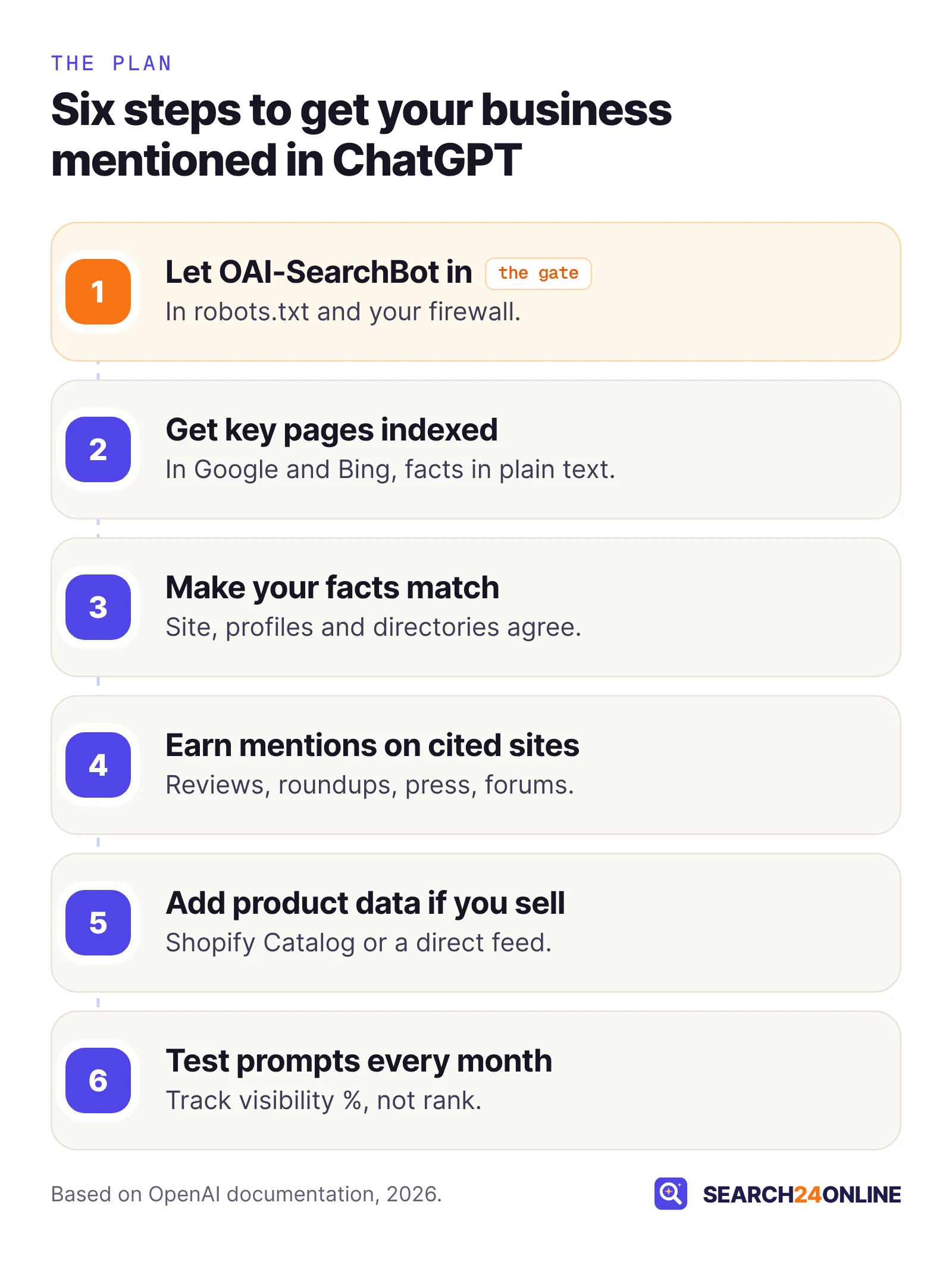
- Week 1: open the doorAllow OAI-SearchBot in robots.txt, ask your host or CDN to allow OpenAI’s published IP addresses, and decide separately on GPTBot.
- Week 1: take a baselineWrite your 20 to 30 prompts, run each five times, and log mentions, citations, cited domains and factual errors.
- Weeks 2 to 4: fix indexing and key pagesConfirm your important URLs are indexed in Google and Bing, move key facts out of PDFs and images, and rewrite your About, service and pricing pages answer-first.
- Month 2: make your facts matchCorrect your name, address, phone, hours and services on every profile and directory you can find, starting with the ones ChatGPT cited.
- Months 2 and 3: earn mentionsWork through your Sources list: reviews, editorial roundups, trade and local press, and genuine forum answers.
- Months 2 and 3: product data (if you sell online)Confirm your Shopify Catalog listing, or apply for direct feed access, and keep prices and stock accurate.
- Every month: retest and adjustRerun the same prompts in the same week, compare visibility and accuracy with your baseline, and check
utm_source=chatgpt.comtraffic.
Access and indexing fixes can register within days or weeks; the mention work takes months. If you would like a head start, our free SEO + GEO report analyzes your website, with password-protected dashboard access within 24 hours. For ongoing work, our plans track 25 AI questions on Starter (Google AI and ChatGPT), 75 on Growth and 200 on Authority, with more assistants added at each level. No one can promise you a mention. You can make sure ChatGPT can find you, and that what it finds is accurate, specific and worth repeating.
Common questions
Can I pay OpenAI to have ChatGPT recommend my business?
No, not in the organic answer. OpenAI says product results are selected independently by ChatGPT and are not ads, and that placement in search results is not guaranteed. ChatGPT does carry ads, but they are shown separately from the answer and its product results.
Should I block GPTBot to protect my content?
That is a business decision, and it does not affect ChatGPT search. OpenAI says GPTBot collects content that may be used to train its models, while OAI-SearchBot decides whether you can appear in search answers, and each robots.txt setting works independently. In our experience, most service businesses allow both because they want to be known, while publishers who license their content are more likely to block GPTBot.
Why does ChatGPT show my colleague a different answer than me?
Because answers are personalized and partly random. OpenAI says ChatGPT may use saved memories when it rewrites a search and an approximate location based on your IP address, and SparkToro found that ChatGPT rarely returns the same list of brands twice for the same prompt.
How long does it take for ChatGPT to pick up changes to my site?
Robots.txt changes take about 24 hours to affect ChatGPT search, according to OpenAI. Content changes count only once your pages are recrawled and re-indexed by the search systems ChatGPT uses, so judge a rewrite after a few weeks, not a few days.
Do I need a product feed to appear in ChatGPT shopping results?
Not necessarily. OpenAI says shopping results use third-party and merchant-provided product data, Shopify stores are already included through Shopify Catalog, and direct feed onboarding is currently limited to approved partners who apply at chatgpt.com/merchants.
Sources
- OpenAI Help Center: Searching the web with ChatGPT
- OpenAI: Overview of OpenAI crawlers
- OpenAI Help Center: Publishers and developers FAQ
- OpenAI Help Center: Temporary Chat FAQ
- OpenAI Help Center: Shopping with ChatGPT search
- OpenAI Commerce docs: Key concepts (Agentic Commerce Protocol)
- OpenAI Commerce docs: Get started
- OpenAI Commerce docs: Product feed reference
- MacRumors (March 25, 2026): ChatGPT revamps shopping features, drops in-app checkout
- SparkToro (January 27, 2026): AIs are highly inconsistent when recommending brands or products
- Pew Research Center (June 17, 2026): Majorities of adults under 50 now use ChatGPT
- FTC (August 14, 2024): Final rule banning fake reviews and testimonials
Want ChatGPT to find and cite your site? Start with a free report.
We’ll analyze your website, create your SEO + GEO report and give you password-protected dashboard access to view it.
Free · No obligation · We only review your public pages.