
How to Get Your Website Cited by Perplexity
Perplexity runs its own web index, has two crawlers that follow different rules, and has published unusually detailed notes on how its ranking works. Here is what its own documentation says, what that means for your pages, and how to check whether it is working.
Key takeaways
- To be cited by Perplexity, a page has to be in Perplexity’s own index (built by its PerplexityBot crawler) and contain a passage that answers part of the question better than the alternatives; Perplexity ranks passages, not just whole pages.
- Perplexity has two visitors with different rules: PerplexityBot follows robots.txt and is the one to allow, while Perplexity-User fetches pages for a specific user question and, by Perplexity’s own description, generally ignores robots.txt.
- Perplexity’s September 2026 Photon post says its ranking caps the gains from repeated terms, so keyword stuffing does not pay; covering the question’s terms in clear, specific passages does.
- Third-party sites carry unusual weight: Profound’s analysis of 680 million citations found Reddit made up 6.6% of Perplexity’s citations, against 2.2% in Google AI Overviews and 1.8% in ChatGPT.
- No paid route to an organic citation is documented. Perplexity’s Comet Plus revenue sharing, announced in August 2025, is for participating publishers, not a way for businesses to buy placement.
On this page
How does Perplexity decide which websites to cite?
Perplexity searches its own web index at the moment you ask, pulls the passages that best match, and links the ones its answer relies on as numbered citations. That is the general pattern for AI assistants, covered in our guide to how AI assistants choose the sources they cite. What makes Perplexity worth its own article is that it has published unusually specific engineering detail about each step.
It runs its own index
Perplexity’s September 2025 engineering post says its index tracks over 200 billion unique URLs. A machine-learning model decides whether each URL needs indexing and when to refresh it, based on the page’s importance and how often it is likely to change. New pages and refreshes of old pages compete for the same crawl budget, and documents from authoritative domains are prioritized for fast storage.
So the first question is not “is my content good?” but “has PerplexityBot crawled it recently?” A page Perplexity has never fetched cannot be cited, however well it ranks on Google.
It retrieves passages, not pages
The same post says Perplexity breaks documents into “self-contained spans” that are retrieved and ranked individually. It searches by keywords and by meaning at the same time, merges the results, then narrows them through fast early scorers and, finally, cross-encoder rerankers (slower models that compare the question and each passage closely). In a March 2026 post about its Search API, Perplexity added that it labels parts of a page as vital, irrelevant or duplicate, and that smaller content budgets produced better answers in its tests.
In plain terms: Perplexity wants the one paragraph that answers the question, and it would rather take less text than more. A long page can be cited for a single good section, and a good page can be skipped if its best answer is buried mid-paragraph.
Pro Search widens the net
Perplexity’s help center describes standard search as “surface-level, 1–2 sources,” while Pro Search runs multiple searches across articles, papers, forums and videos and compiles insights from dozens of sources. The more thorough the mode, the more sub-questions get their own search, and the more chances a specialist page has to be the best answer to one of them.
What is the difference between PerplexityBot and Perplexity-User?
PerplexityBot is the crawler that builds Perplexity’s search index and follows robots.txt; Perplexity-User is a fetcher that visits a page because a user’s question needs it, and generally does not. Perplexity’s crawler documentation says PerplexityBot “is designed to surface and link websites in search results” and recommends allowing it to ensure your site appears.
For Perplexity-User, the same page says: “Since a user requested the fetch, this fetcher generally ignores robots.txt rules.” Perplexity says neither visitor collects content to train AI foundation models. Its help center adds that Perplexity does not build foundation models at all.
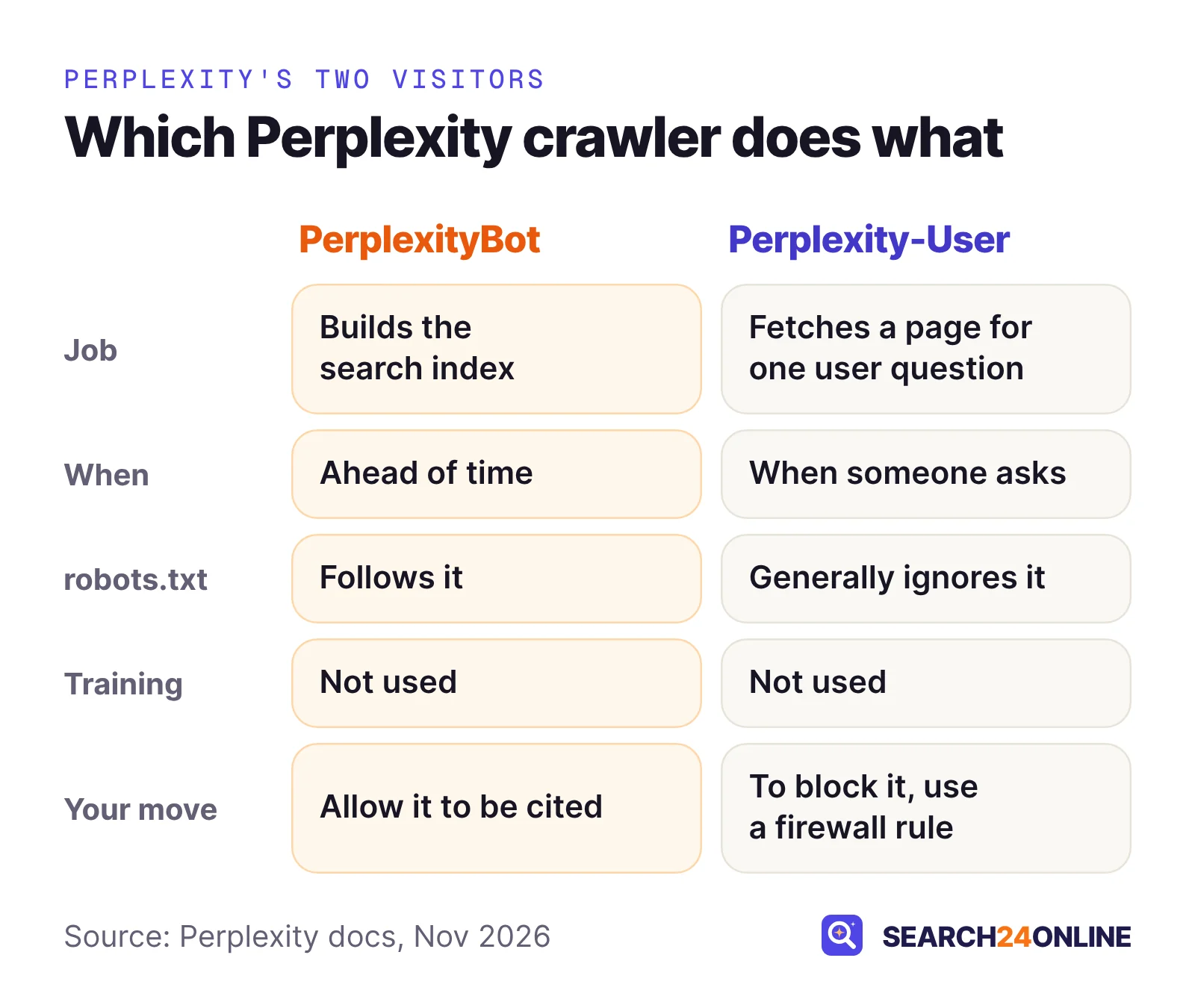
A few practical details from the documentation are easy to miss:
- Robots.txt changes can take up to 24 hours to show up in Perplexity’s systems.
- Blocking is not invisibility. For a site that disallows PerplexityBot, Perplexity says it may still index the domain, the headline and a brief factual summary.
- Both visitors publish their IP ranges as JSON files (perplexity.ai/perplexitybot.json and perplexity.ai/perplexity-user.json), so you can check that a visitor claiming to be PerplexityBot really is.
- Firewalls may need a rule. Perplexity says sites behind a web application firewall may need to allow its bots explicitly, matching both the user-agent and the published IP ranges, and it gives steps for Cloudflare and AWS.
If you want PerplexityBot in while private areas stay out, the robots.txt entry is short. One catch: a crawler that finds a group naming it follows only that group and ignores the general * rules, so repeat any Disallow lines you need:
# Perplexity's search crawler: index the site, skip private areas
User-agent: PerplexityBot
Allow: /
Disallow: /account/
Disallow: /checkout/

# All other crawlers
User-agent: *
Disallow: /account/
Disallow: /checkout/In audits we often find bot protection on the host or CDN challenging AI crawlers that robots.txt explicitly allows. Check your server or CDN logs for PerplexityBot requests that end in 403 errors or challenge pages, and add the allow rule Perplexity describes.
What did Cloudflare report about Perplexity’s crawling?
In August 2025, Cloudflare said Perplexity was reaching content on sites that had blocked its declared crawlers, using an undisclosed browser identity. Perplexity disputed the analysis the same day. Both positions are on the record, and the episode matters to site owners because it shows the limits of robots.txt.
Cloudflare’s post of August 4, 2025, describes new, unindexed test domains whose robots.txt disallowed all crawling; Perplexity still answered detailed questions about their content. Cloudflare counted 20 to 25 million daily requests from the declared Perplexity-User agent and 3 to 6 million from an undeclared one presenting itself as Chrome on macOS, from IP addresses outside Perplexity’s published ranges. It removed Perplexity from its verified bots list and added blocking rules to its managed AI crawler protection, available to all customers.
Perplexity’s reply, published the same day, argued that user-driven agents differ from crawlers because they fetch content only when a real person asks for something specific and do not store or train on it. It also said Cloudflare had misattributed traffic from BrowserBase, a third-party cloud browser service Perplexity says it uses only occasionally.
We are not in a position to settle the dispute, and you do not need to. The practical lessons hold either way:
- Robots.txt is a request that well-behaved crawlers honor, not a lock. Perplexity’s own documentation says its user-triggered fetcher generally ignores it, and OpenAI says the same kind of rule “may not apply” to its ChatGPT-User agent.
- If you need content kept out, use access controls: logins, paywalls or firewall rules from your CDN.
- If you want citations, the dispute changes nothing: allow PerplexityBot and make sure the firewall agrees.
Should your business allow Perplexity’s crawlers?
For most businesses that sell services or products, yes: being cited is a free referral from a buyer’s research session, and blocking removes you from the candidate pool. The answer changes when the content itself is what you sell.
| Type of site | What you gain from citations | What you risk | Our usual advice |
|---|---|---|---|
| Local or service business (law firm, clinic, contractor) | Visibility when buyers compare providers, costs and options | Little: the pages exist to be found | Allow PerplexityBot; check the firewall |
| B2B, SaaS or e-commerce | Inclusion in “best X for Y” and comparison answers | Pricing or specs summarized without context | Allow; keep pricing and specs current and explicit |
| Publisher or paid research (content is the product) | Referral traffic, brand reach, possible revenue share | Answers that replace the visit | Decide deliberately; put paid content behind a login, not just robots.txt |
A common situation: a home services company asks us to “block all the AI bots” after reading about scraping, then wonders a few months later why competitors appear in AI answers and it does not. Training crawlers and search crawlers are different decisions; our guide to AI crawlers and whether to block them goes bot by bot, and publishers weighing a paid model can start with our glossary entry on pay per crawl.
What kind of content does Perplexity cite?
Pages that answer specific questions in short, self-contained sections, with the words a searcher would use, current facts and a clear structure. That follows directly from what Perplexity has published about its retrieval and ranking.
Cover the question’s terms, once and clearly
Perplexity’s Photon post (September 2026) describes the engine that now powers its search pipeline. Candidate scoring looks at how many of the query’s terms a document covers and how often, normalizes for document length and applies “a cap on gains from repeated terms.” Each field of a document is scored separately and combined using field weights. The positions and proximity of matching terms are also stored for ranking.
Our reading, since Perplexity does not name the fields: use the buyer’s actual words in titles and headings, and keep the related terms of an answer close together in the same passage. Repeating a phrase ten times gains nothing past the cap. Writing “commercial roof replacement cost in Columbus” in a heading and answering it in the next two sentences does.
Write passages that survive being cut out
Since Perplexity labels parts of a page as vital or irrelevant and prefers smaller content budgets, a section should make sense on its own. An illustration of the difference, for a commercial cleaning company:
- Hard to cite: “Pricing depends on many factors, which is why we always recommend a walkthrough. Contact us to learn more about our flexible plans.”
- Easy to cite: “Nightly office cleaning in Denver typically costs [your real range] per square foot per visit. The main factors are frequency, floor type and restroom count. We confirm the price after a free walkthrough.”
Fill the bracket with your own real figures. The point is the shape: the answer first, the factors second, the call to action last.
Use tables, lists and HTML, not PDFs and images
Perplexity said in its March 2026 Search API post that its content pipeline now parses tables, nested lists and dynamically rendered content that earlier rules handled poorly. That is good news for comparison tables and spec sheets. In our experience it is still safer to put key facts in plain HTML that loads without scripts, and to never leave prices, service areas or specifications only inside PDFs or images.
Keep it current, and show that it is
Perplexity’s 2025 post says stale content is filtered out early in ranking. Photon delivers updated documents within minutes for verticals with high freshness requirements. For a business site, that means a pricing page last touched in 2023 is at a disadvantage against one updated this year. Update real facts, then change the visible date; changing only the date helps no one.
Questions such as “X vs Y”, “best X for Y” and “how much does X cost” send Pro Search across many sources. A fair comparison page that names alternatives, including when you are not the right fit, gives it a self-contained answer to cite. Our guide to writing content AI assistants want to quote covers the rewriting in detail.
Why do Reddit and review sites matter so much on Perplexity?
Because Perplexity cites them more than other assistants do, so what those sites say about your category often shapes the answer. Profound, an AI visibility analytics company, analyzed 680 million citations from August 2024 to June 2025 and found Reddit was the single most cited source on Perplexity.
The rest of Perplexity’s top 10 in that study included YouTube (2.0%), Gartner (1.0%), Yelp and LinkedIn (0.8% each), Forbes (0.7%), NerdWallet, TripAdvisor and G2 (0.6% each) and PCMag (0.5%). Wikipedia, ChatGPT’s most cited source in the same study, was not in Perplexity’s top 10. Two caveats: Profound sells visibility tracking, and it does not fully describe which queries it used, so read the numbers as direction rather than precise shares.
The pattern still fits Perplexity’s own description of Pro Search reading forums and videos. What to do with it:
- Find your category’s cited sites. Ask Perplexity your buyers’ questions and list the third-party domains it cites: Yelp and TripAdvisor for local, G2 for software, NerdWallet for finance, trade publications for B2B.
- Be accurate where you are listed. Claim and complete those profiles, and keep the facts consistent with your own site.
- Take part in Reddit honestly. Useful answers from an employee who discloses the affiliation can help. Our view: skip fake accounts and planted reviews; they erode the trust that makes those threads worth citing.
How is Perplexity different from ChatGPT and Google AI Overviews?
All three cite pages they retrieved, but each draws on a different index through a different crawler, so the same site can be cited in one and missing from another. The table summarizes what each company documents.
| ChatGPT search | Google AI Overviews and AI Mode | Perplexity | |
|---|---|---|---|
| Crawler that makes you eligible | OAI-SearchBot | Googlebot: the page must be indexed and eligible for a snippet | PerplexityBot |
| Fetcher acting for a user | ChatGPT-User (robots.txt “may not apply”) | Not described in Google’s AI features guide | Perplexity-User (generally ignores robots.txt) |
| Used for model training? | GPTBot, a separate crawler, handles training | Not part of Google’s AI features guide | No: Perplexity says it does not build foundation models |
| Most cited source in Profound’s 2025 study | Wikipedia (7.8%) | Reddit (2.2%) | Reddit (6.6%) |
Google says there are no additional requirements or special optimizations needed to appear in AI Overviews or AI Mode; see what Google actually says about AI Overviews and AI Mode. For ChatGPT, see how to get your business mentioned in ChatGPT. The shared foundation is ordinary SEO done well; the Perplexity-specific work is crawler access, passage-level clarity and the third-party sites it favors.
Can you pay Perplexity or join its publisher program?
You cannot pay for an organic citation, and none of Perplexity’s documentation we reviewed describes a way to. What Perplexity does offer is revenue sharing for publishers, which matters if you run a media site and not much if you run a dental practice.
Perplexity announced Comet Plus on August 25, 2025: a $5 subscription, included in its Pro and Max plans, that gives users access to participating publishers’ content. Perplexity said it distributes the revenue to participating publishers, minus a small portion for compute costs, allocated by three kinds of value: human visits, search citations and agent actions (tasks its AI assistant completes on a site). Publishers are invited to apply by emailing [email protected]. We found no published eligibility criteria or self-service enrollment.
An AI citation is a numbered link to your page shown as a source in the answer. Perplexity’s publisher revenue share pays for citations of partner content; it does not make a page more likely to be chosen in the first place.
How do you know if Perplexity is citing you?
Combine three signals: the answers themselves, your referral traffic and your server logs. We found no Perplexity performance report for site owners, so each signal fills a gap in the others.
- Ask the questions yourselfRun 20 to 30 real buyer questions in Perplexity each month and record which domains are cited and in which position. Answers vary between runs, so track patterns, not single results.
- Watch referral trafficLook for perplexity.ai among referring sources in your analytics, and check which landing pages those visits reach. Our guide to seeing AI assistant traffic in GA4 shows where it appears.
- Read your server logsFilter for the PerplexityBot and Perplexity-User user-agents and confirm the IP addresses against Perplexity’s published lists. PerplexityBot hits show crawling; Perplexity-User hits mean a user’s question led Perplexity to fetch your page.
The third signal is underused. In our view, a cluster of Perplexity-User requests on one URL is a free demand report: people are asking questions your page answers. Compare those URLs with the citations you record in step 1: pages that are fetched often but rarely cited are the first candidates for an answer-first rewrite. For a wider measurement setup across assistants, see how to track brand visibility in AI answers.
What should you fix first to get cited by Perplexity?
Access first, then the pages that answer buyers’ questions, then your presence elsewhere. Across more than 20 years of digital marketing work and 500+ brands, our team has found that sites missing from AI answers usually have the same problems that hold them back on Google.
Pages Perplexity cannot reach
Beyond firewalls, we often find key pages that are poorly linked internally or missing from the XML sitemap, so no crawler reaches them often. Spot it by comparing your sitemap with your logs: important URLs PerplexityBot never requests are the first suspects. Link them from relevant pages and keep the sitemap current.
Many pages, one answer
A regional HVAC company with 40 service pages that all target “HVAC repair”, with only the city name swapped, gives Perplexity 40 near-identical passages and no distinct one to cite. Its pipeline even labels duplicate spans. Consolidate, and give each remaining page a job: costs, brands serviced, emergency hours, financing.
Thin or vague sections
Service pages full of “quality solutions” and “industry-leading” give a reranker nothing to match. Replace adjectives with facts a buyer would ask about: ranges, timelines, standards met, service areas, and a source for any figure.
To have this checked for you, our free SEO + GEO report analyzes your website, and you get password-protected dashboard access within 24 hours. Ongoing Perplexity tracking is part of our SEO + GEO services from the Growth plan up (see pricing). No one can promise a Perplexity citation; you can make sure your pages can be found and deserve one.
Common questions
Does Perplexity use Google or Bing results to find sources?
Perplexity describes its own index: its September 2025 engineering post says the index tracks over 200 billion unique URLs, crawled by PerplexityBot. In our experience, pages that do well on Google tend to have what Perplexity looks for too, but Perplexity has to be able to crawl them itself.
If I block PerplexityBot, can Perplexity still show my site?
Yes, in a limited way. Perplexity’s help center says that for a site that disallows PerplexityBot it may still index the domain, the headline and a brief factual summary. Its crawler documentation adds that the Perplexity-User fetcher, which acts on individual user requests, generally ignores robots.txt.
Does Perplexity use my website to train AI models?
Perplexity says it does not build foundation models, so your content is not used for AI model pre-training, and that neither PerplexityBot nor Perplexity-User collects content for training foundation models. Its answers draw on pages retrieved at the time of the question.
How long does it take Perplexity to notice changes to my site?
Robots.txt changes can take up to 24 hours to take effect, according to Perplexity’s crawler documentation. Content changes count once your page is recrawled, and Perplexity says a model decides when to refresh each URL based on its importance and how often it is likely to change, so there is no fixed timeline.
Why does Perplexity cite Reddit threads instead of my website?
Because Reddit often has the most direct answer to the exact question asked, and Perplexity cites it heavily: a Profound analysis of citations from August 2024 to June 2025 found Reddit was 6.6% of all Perplexity citations. Answer the same questions plainly on your own pages and be present, honestly, where your buyers discuss them.
Sources
- Perplexity Docs: Perplexity Crawlers
- Perplexity Help Center: How does Perplexity follow robots.txt?
- Perplexity Help Center: What is Pro Search?
- Perplexity Research (September 25, 2025): Architecting and evaluating an AI-first search API
- Perplexity (March 11, 2026): Search API: better extraction, dynamic benchmarks
- Perplexity Engineering (September 24, 2026): Photon, building a retrieval and ranking engine from scratch
- Perplexity (August 25, 2025): Introducing Comet Plus
- Cloudflare (August 4, 2025): Perplexity is using stealth, undeclared crawlers to evade website no-crawl directives
- Perplexity (August 4, 2025): Agents or bots? Making sense of AI on the open web
- OpenAI: Overview of OpenAI crawlers
- Google Search Central: AI features and your website
- Profound (June 2025, updated August 2025): AI platform citation patterns
Getting cited by Perplexity starts with your own website.
We’ll analyze your website, create your SEO + GEO report and give you password-protected dashboard access to view it.
Free · No obligation · We only review your public pages.