
How to Write Content AI Assistants Want to Quote
Google says you don’t need to write in a special way for AI, and it’s right: the passages assistants quote are simply clear, specific and trustworthy. Here are nine writing habits that get you there, each with a before-and-after rewrite.
Key takeaways
- AI assistants quote clear, people-first writing: sections that answer their question in the first sentence or two, make sense alone and back claims with specifics. Google says you don’t need to write in a special way for AI search.
- Assistants work with passages, not just pages. Perplexity splits documents into “self-contained spans” that are ranked individually, and Microsoft recommends one- to two-sentence direct answers.
- Evidence helps. In the GEO study (KDD 2024), citing sources, adding quotations and adding statistics improved visibility in AI answers by 30 to 40% on its main measure, while keyword stuffing gave little to no improvement.
- Original information is the part of a page nobody else can supply. Google calls it non-commodity content: expert or first-hand takes that go beyond common knowledge.
- Update facts when they change and date the page honestly. Google’s own checklist flags changing dates to look fresh when the content has not substantially changed.
On this page
What kind of content do AI assistants quote?
The same content a busy customer finds useful: sections that answer a question in the first sentence or two, make sense on their own and back up their claims with specifics and sources. There is no trick to it. Google’s guide to generative AI search says “You don’t need to write in a specific way just for generative AI search,” and calls optimizing for those features “still SEO.”
What has changed is how your writing gets used. Assistants pick individual passages to support each part of an answer. Our explainer on how AI assistants choose the sources they cite walks through the steps; our guide to what Google says about AI Overviews and AI Mode covers Google’s rules. The upshot: one paragraph of yours can be shown, alone, to someone who has never seen your homepage.
Below are the habits that meet that bar, each with a before-and-after rewrite. The examples are for fictional businesses, and their prices and figures are illustrative, not real data.
A passage someone can lift, cite and trust without reading the rest of the page: it names its subject, answers one question and states a fact a reader could check. It is also the passage a skimming customer reads first.
How do you write an answer-first section?
Put the answer in the first one or two sentences under the heading, then explain it. Krishna Madhavan, a principal product manager at Microsoft Bing, describes the ideal snippable answer as “one- to two-sentence responses that directly address a question.” Readers want the same thing: the answer before the background.
Most business pages do the opposite: history and values first, then “call us for a quote” where the answer should be. Here is a fictional Tucson plumber’s water heater page.
Before (example): Water heaters are one of the most important appliances in your home, and our family-owned company has proudly served the community for many years. Many factors go into the cost of a new water heater, and every home is different. Give us a call today to learn about our competitive pricing!
After (example): Replacing a standard 50-gallon tank water heater in Tucson costs $1,600 to $2,400 with us in 2026, installed, including removal of the old unit. Three things move the price: gas or electric, whether the venting or gas line needs updating to current code, and how easy the unit is to reach. Most replacements take one visit of three to five hours.
The first sentence now answers the question people actually ask (how much?) and names the service, the place and the year. The second answers the obvious follow-up: why the range? The invitation to call can stay; it just comes after the answer.
What if the honest answer is “it depends”?
Then say what it depends on, in the first sentence. “It depends on fuel type, venting and access” is an answer; “every home is different” is not. Our view: owners often fear a published range costs them the call, but a page that never answers rarely gets read to the end, let alone quoted.
Should your headings be phrased as questions?
Often, yes, because a heading that matches a real question tells readers and machines exactly what the section answers. Microsoft’s guidance says headings act “like chapter titles that define clear content slices” and suggests replacing labels like “Learn More” with a specific question. Bing’s February 2026 guidance also says “Clear headings, tables, and FAQ sections help surface key information.”
Here is how a fictional lawn care company in Boise might rework its service page headings:
- “Our Services” becomes “Which lawn care services do we offer in Boise?”
- “Pricing Info” becomes “How much does weekly mowing cost?”
- “Learn More” becomes “How soon can you walk on new sod?”
- “Why Choose Us” becomes “Are you licensed and insured?”
Don’t force it, though. “Installation steps” is clear without a question mark. Google’s helpful content checklist asks whether the main heading provides “a descriptive, helpful summary of the content,” and descriptive is the real goal.
The best questions come from customers: sales calls, emails, reviews and Search Console queries. Bing Webmaster Tools’ AI Performance report also shows sample grounding queries, the phrases its AI used to retrieve your content.
How do you make a passage stand on its own?
Name the subject in every section, carry the key context with it and remove references to other parts of the page. Systems that rank passages read them out of context. Perplexity’s researchers describe splitting documents into “self-contained spans, each of which can be individually retrieved and ranked at query time,” and Microsoft recommends “self-contained phrasing” for the same reason.
Words like “it”, “them”, “the second option” and “as mentioned above” all send the reader somewhere else. Here is a section from a fictional bookkeeping firm’s pricing page.
Before (example): As mentioned above, it really depends on your situation. For most of them, the second option works out cheaper, but not always. See the previous section for details.
After (example): For a small business with fewer than 50 transactions a month, our flat monthly bookkeeping package usually costs less than hourly billing. The package covers up to 200 transactions a month; businesses above that get a custom monthly quote based on their volume.
The rewrite names who it applies to, what the options are and where the threshold sits. It makes sense alone in an AI answer, and alone to a customer who jumped straight to the pricing section.
Doesn’t Google say not to chunk content?
It does, and there is no conflict. Google says “There’s no requirement to break your content into tiny pieces for AI to better understand it” and that there is no ideal page length. Self-contained doesn’t mean short: a long guide can have sections that each stand alone, while a page chopped into two-line fragments helps nobody. Microsoft even advises against using bullets for every line.
Read only the heading and the first sentence of each section. If that pair answers the question without help from the rest of the page, the section will hold up when it is quoted alone.
When should you use definitions, lists and comparison tables?
Match the format to the question: a definition for “what is”, numbered steps for “how do I” and a table for “which is better”. Microsoft says lists and tables “break complex details into clean, reusable segments” and work especially well for how-to and comparison questions.
Start definitions with the term itself
A good definition names the term, what kind of thing it is and what sets it apart, then adds what it means for the reader. Marketing copy that skips the definition leaves nothing to quote, as on this fictional accounting firm’s page.
Before (example): Our month-end close service keeps your books in great shape, so you can focus on what you do best.
After (example): A month-end close is the set of steps that finalizes a month’s books: reconciling every bank and credit card account, recording outstanding invoices and bills, and reviewing the results so the monthly financial statements are accurate. For our clients, the close is finished by the 10th business day of the following month.
Use a table when readers compare options
Comparisons buried in a paragraph are hard to read and hard to lift.
Before (example): We offer both hourly and flat-rate moves. Hourly suits some moves, while others prefer flat rate for certainty, depending on size, stairs and distance.
After (example): the same fictional moving company, with one table row per question a customer weighs.
| Hourly quote | Flat-rate quote | |
|---|---|---|
| How the price is set | Crew size times hours worked, plus travel time | One price agreed before move day, after an in-home or video survey |
| Best for | Small local moves where the volume is easy to judge | Full-home moves and anyone who needs a fixed budget |
| What can change the bill | Stairs, long carries, traffic and boxes not packed on arrival | Only items or services added after the survey |
| When you know the final price | After the move | Before the move |
Keep tables, lists and definitions in the page’s HTML text. Microsoft warns that “AI systems may not render hidden content,” such as answers inside tabs, and advises presenting critical details in HTML rather than only in images. Google’s AI features page likewise asks that important content be available in textual form.
Why do original data and first-hand experience get quoted?
Because they are the one part of your page an assistant cannot find anywhere else. Google’s guide asks for non-commodity content, which “provides unique expert or experienced takes that go beyond common knowledge and the ordinary.” It is blunt about the alternative: “Don’t just recycle what others on the internet have already said, or could easily be produced by a generative AI model.”
Its helpful content checklist asks whether content provides “original information, reporting, research, or analysis.” Compare two versions of a fictional pest control company’s termite page.
Before (example): Termites can cause serious damage to your home, so regular inspections are important. Common signs of termites include mud tubes, discarded wings and damaged wood. Contact a professional if you notice any of these signs.
After (example): Of the 412 termite inspections our technicians completed in 2025, 156 (38%) found active termites. In most of those homes, the first sign the owner noticed was discarded wings on a windowsill in spring, not damaged wood, which tended to show up later. (Source: our inspection records, January to December 2025, one inspection per property.)
The first version could appear on a thousand sites, and an AI model could write it unprompted. The second exists only on this company’s website and says how the number was produced. That is what makes it worth citing.
What original data does a small business already have?
- Job records: job counts, typical durations, the most common problems by season or property type.
- Your own prices: real ranges from last year’s invoices and what pushed jobs to the top.
- Measured service levels: response or turnaround times from your scheduling system, not estimates.
- Short customer surveys: with the number of responses and dates stated.
- Field experience: local conditions, building types or industries a generic article can’t know.
Always say how you got a number: the period, the sample and what counts. A figure without a method is just a claim.
Google’s guidance on generative AI content says it is critical to manually fact-check and review all AI-generated content for accuracy before publishing. A made-up figure that an assistant picks up spreads your error, with your name attached.
How should you cite sources and show who knows the subject?
Name the source and year in the sentence that uses the fact, link to it, and make it obvious who wrote the page and why they know. Google’s helpful content checklist asks whether a page presents information in a way that makes you want to trust it, “such as clear sourcing,” “evidence of the expertise involved” and background about the author or site. Bing’s February 2026 guidance says “Examples, data, and cited sources help build trust when content is reused in AI-generated answers.”
Research supports this. The GEO paper by Pranjal Aggarwal and colleagues, accepted to KDD 2024, tested nine ways of rewriting web content on a benchmark of 10,000 queries. Citing sources, adding quotations and adding statistics performed best, improving visibility in generated answers by 30 to 40% on the paper’s main measure. Keyword stuffing offered “little to no improvement.”
Lower-ranked pages gained most: citing sources raised visibility by 115.1% for pages ranked fifth in the search results. In a smaller test of 200 queries on Perplexity, keyword stuffing did about 10% worse than the original pages. These were experiments on 2023–2024 systems, so take the direction, not the exact percentages, as the lesson.
Attribute facts inside the sentence
A quoted sentence travels without its footnotes, so the attribution has to live in the sentence: who, when, what they measured, what they found. Here is the difference, using a real study.
Before: Studies show AI prefers fresh content.
After: An Ahrefs study published in July 2025, which analyzed about 17 million citations, found that URLs cited by AI assistants were on average 25.7% fresher than pages in Google’s organic results.
Show the expertise behind the page
Google’s checklist asks, “Do pages carry a byline, where one might be expected?” Of the qualities it groups as E-E-A-T (experience, expertise, authoritativeness, trustworthiness), it says “trust is most important.” Signals that hold up:
- A real byline linked to a short bio with checkable credentials: licenses, certifications, years in the trade.
- A reviewer line for medical, legal and financial topics.
- An About page that says who runs the business, where and since when.
- Experience in the text. “We see this most in homes built before the 1970s” says more than “experts agree.”
On a fictional plumbing guide, “Posted by admin” becomes “Written by [name], licensed master plumber, 15 years of residential work in Tucson.” And cut empty adjectives: Microsoft notes that terms like “innovative” or “eco” “mean little without specifics.”
How do you keep content fresh without faking it?
Update the facts when they change, show the date honestly and tell search engines when you’ve made a real change. Bing says “Regular updates help ensure AI systems reference the most current version of your content,” and recommends IndexNow, a protocol for notifying participating search engines when pages are added, updated or removed.
Freshness is a tendency, not a rule. In the Ahrefs study above, Google’s AI Overviews were the only platform that cited slightly older content than organic results, and cited content still averaged about 2.9 years old. Ahrefs itself cautions that frequently updated low-quality content won’t help much, and the study shows correlation, not that updating causes citations.
Google’s checklist asks: “Are you changing the date of pages to make them seem fresh when the content has not substantially changed?” Its byline date guidance recommends a prominent visible date, labeled with words like “Last updated”, that matches the dates in your structured data.
Before (example): © 2021 | Prices subject to change.
After (example): Last updated October 12, 2026: added 2026 price ranges and a new section on heat pump water heaters. Reviewed by [name], licensed master plumber.
A one-line note on what changed shows the update was real. Our suggested rhythm (opinion, not a platform rule): pricing pages quarterly or when prices change, service pages twice a year, evergreen guides yearly, and anything citing a law or platform feature as soon as it changes.
What should you avoid when writing for AI answers?
Anything written for a machine instead of a reader. The habits we would remove first:
- Keyword stuffing. In the GEO experiments it gave little to no improvement. Google adds that its AI systems “can understand synonyms and general meanings,” so you don’t need every wording of a phrase.
- Fake FAQ sections. Microsoft notes that direct questions with clear answers mirror the way people search, which only works when the questions are real. Our rule: every FAQ question comes from a customer, a sales call or search data.
- Pages chopped into fragments. Google says there is no need to break content into tiny pieces.
- Near-identical pages for every variation of a search. Google warns that doing this primarily to manipulate rankings or generative AI responses violates its scaled content abuse policy.
- Answers locked in tabs, PDFs or images. Microsoft lists all three among the mistakes to avoid.
- Special files as a shortcut. Google says you don’t need llms.txt or other AI text files for its search; our article on whether llms.txt helps covers other services.
One prerequisite sits outside the writing: the page has to be reachable. OpenAI says sites that opt out of its OAI-SearchBot crawler “will not be shown in ChatGPT search answers.” Our guide to AI crawlers explains which ones to allow.
How do you rewrite an existing page so it is easier to quote?
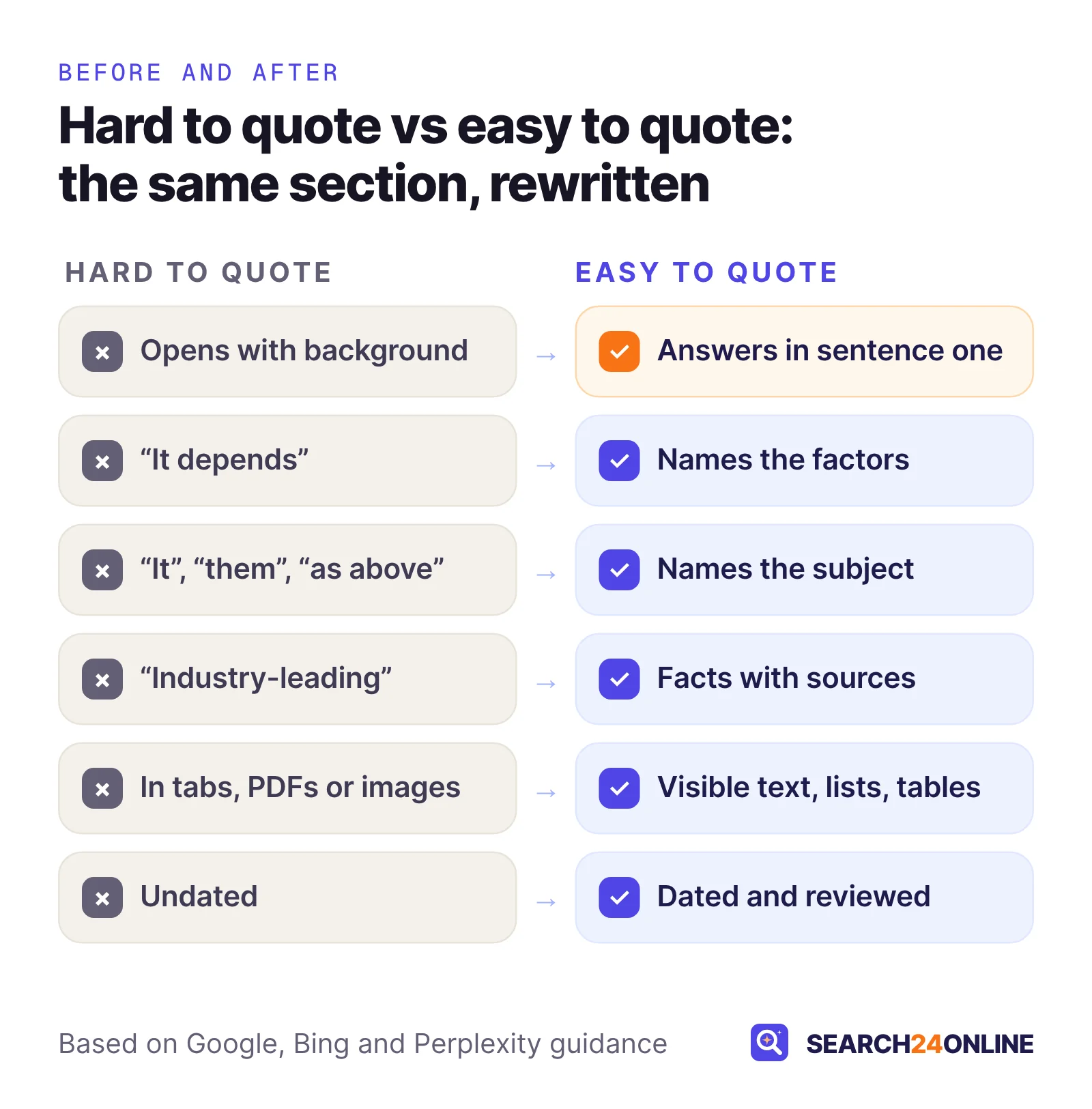
Start with the pages that already bring in traffic or calls, and rewrite them section by section rather than starting from scratch. Our team brings over 20 years of digital marketing experience and has served 500+ brands, and in audits the problem is rarely a missing page. More often it is thin, outdated or poorly structured content, or several pages targeting similar keywords and competing with each other (keyword cannibalization). Merge competing pages first, then rewrite the one that remains.
- Pick five pagesStart with your main service pages and pricing page: they answer what buyers ask just before they call.
- List the questions each page should answerFive to ten per page, from customer emails, sales calls, reviews, Search Console and Bing’s grounding queries.
- Give each question a descriptive headingOne question per section; merge sections that answer the same thing.
- Rewrite every openingAnswer in one or two sentences that name the subject, the place and, where relevant, the price range or timeline.
- Swap adjectives for evidenceReplace each vague claim with a number, a standard met or a first-hand observation, with its source or method.
- Move key facts into textTake prices, specs and comparisons out of images, PDFs and tabs.
- Add the trust layerA byline where one is expected, a real “Last updated” date with a note on what changed, and structured data that matches the visible text.
- Check again in a few weeksEngines must recrawl first. Then ask assistants your questions and note which pages are cited; see how to track brand visibility in AI answers.
No one can promise a citation. What you control is whether your pages deserve to be quoted and whether assistants can find them. For an outside view, our free SEO + GEO report analyzes your website, with password-protected dashboard access to view it within 24 hours. The writing is one part of the broader discipline we cover in what GEO means for business owners.
Common questions
Do I need to write differently for ChatGPT than for Google?
No. Google says you don’t need to write in a specific way for generative AI search, and Microsoft’s guidance recommends the habits that help human readers anyway: clear headings, direct answers and specific facts. One well-written page serves both.
How long should the answer at the top of a section be?
One or two sentences is a good target for the direct answer, followed by the detail that supports it. Microsoft describes snippable answers as one- to two-sentence responses, while Google says there is no ideal page length, so the rest of the section can be as long as the topic needs.
Should every page have an FAQ section?
Only pages where customers really ask several short questions. Bing lists FAQ sections among the things that help surface key information, but questions invented to repeat a keyword add nothing a reader or an assistant can use.
Does structured data make my content more likely to be quoted?
It is not required: Google says there is no special schema for its generative AI features. Microsoft says schema helps machines interpret content, so it is worth adding where it fits, as long as it matches the visible text on the page.
Can I use AI tools to write content I want AI assistants to quote?
Yes, if someone who knows the subject checks every fact and adds what only your business knows. Google calls manual fact-checking of AI-generated content critical and warns that mass-produced pages without added value may violate its spam policies.
Sources
- Google Search Central (updated July 2026): Optimizing your website for generative AI features on Google Search
- Google Search Central: AI features and your website
- Google Search Central (updated October 2026): Creating helpful, reliable, people-first content
- Google Search Central (updated October 2026): Guidance on using generative AI content on your website
- Google Search Central: Influence your byline dates in Google Search
- Microsoft Advertising Blog (October 2025): Optimizing your content for inclusion in AI search answers
- Bing Webmaster Blog (February 10, 2026): Introducing AI Performance in Bing Webmaster Tools Public Preview
- Perplexity Research (September 25, 2025): Architecting and evaluating an AI-first search API
- OpenAI: Overview of OpenAI crawlers
- Aggarwal et al., GEO: Generative Engine Optimization (KDD 2024), arXiv
- Ahrefs (July 2025): AI assistants prefer to cite fresher content (17 million citations analyzed)
Is your content easy for AI assistants to quote? Find out free.
We’ll analyze your website, create your SEO + GEO report and give you password-protected dashboard access to view it.
Free · No obligation · We only review your public pages.