
B2B SEO: How to Get Leads, Not Just Traffic
B2B purchases are made by groups of people over months, and most of their research happens before anyone fills in a form. Here is how to plan keywords, pages and measurement around that, including the vendor research that now starts in AI assistants.
Key takeaways
- B2B SEO produces leads when it answers every member of the buying group at each stage of a long purchase, not when it chases the biggest keywords. Forrester’s 2026 State of Business Buying puts the average decision at 13 internal stakeholders plus nine external participants.
- Most shortlists form before a buyer talks to you. In 6sense’s 2025 study of more than 4,000 buyers, 94% of buying groups had ranked preferred vendors before first contact, and they bought from that early favorite 77% of the time.
- Build bottom-of-funnel pages first: solution, industry, use-case and pricing pages, backed by real case studies. They match searches from people who already have a problem and a budget.
- AI assistants are now part of vendor research. Forrester found 94% of business buyers used AI in their buying process; Gartner found 45% used GenAI during a recent purchase, mainly to gather vendor and product information.
- Measure organic pipeline in your CRM, not only in analytics: GA4’s key-event lookback window defaults to 90 days, while 6sense puts the average buying cycle at about 10 months.
On this page
What makes B2B SEO different from other SEO?
B2B SEO uses the same craft as any SEO, applied to a different kind of purchase: one made by a group, over months, with real money and career risk attached. That changes which searches you target, which pages you build and how you prove the work pays.
Start with who decides. Forrester’s Buyers’ Journey Survey of nearly 18,000 business buyers found that, on average, 13 internal stakeholders and nine external participants influence a buying decision, and procurement professionals are decision-makers in 53% of buying cycles. Each of those people searches for something different. The operations manager wants to know whether you can fix the problem, finance wants to know what it costs, and IT wants to know whether it is safe.
Then consider time. 6sense surveyed more than 4,000 B2B buyers for its 2025 Buyer Experience Report and puts the average buying cycle at about 10 months, down from about 11 the year before. Gartner’s survey of 645 B2B buyers, published in May 2026, found they used an average of seven information sources during a recent purchase, and 67% prefer a buying experience without a sales rep. Most research happens quietly, long before anyone fills in a form.
The numbers are small, too. A search that matters to a B2B firm may show 20 searches a month in a keyword tool, or none. One of those searchers could be worth more than a year of blog traffic, which is why traffic is the wrong headline goal.
A pattern we see in B2B audits: a blog ranks for broad definitions and pulls in thousands of visits from students and job seekers. Meanwhile the service pages that should rank for buying searches are thin, compete with each other or sit four clicks from the homepage. Traffic looks healthy; pipeline doesn’t move.
Who is in the buying group, and what does each person search for?
Plan for four or five roles, because each arrives with different questions and drops out for different reasons. Titles vary by industry and company size, but these roles appear in most complex B2B purchases.
| Role | What they search for | Page that answers them | Proof they want |
|---|---|---|---|
| Champion (owns the problem) | The problem, approaches to solving it, “how to reduce…” | Solution and use-case pages, guides | Examples from companies like theirs |
| Technical evaluator (IT, engineering, quality) | Specs, standards, integrations, security | Technical, security and compliance pages, spec sheets | Certifications, architecture, named standards |
| Finance and procurement | Pricing, contract terms, “[vendor] pricing” | Pricing page, procurement FAQ | Price ranges, payment terms, total cost |
| Executive sponsor | Outcomes, risk, vendor stability | Case studies, thought leadership, About page | Measured results, who runs the company |
| External influencers (consultants, peers, analysts) | Category overviews, “best [service] for [industry]” | Research, industry pages, third-party profiles | Independent mentions, data they can cite |
Two consequences follow. One page rarely serves everyone: a solution page written for the champion frustrates the security reviewer, so link the two. And the people who block deals are often the ones marketing never writes for; procurement deciding in more than half of buying cycles is reason enough to publish the pages procurement needs.
Some participants never identify themselves. The 2025 Edelman–LinkedIn B2B Thought Leadership Impact Report, a survey of 1,934 business executives, looked at “hidden” decision-makers: final decision-makers, often in finance, legal or procurement, whom sales and marketing often overlook. Of these, 55% agree that reviewing thought leadership is one important way they vet vendors.
How do you build a B2B keyword map by role and stage?
Build it from your sales conversations first and keyword tools second. Tools show you the phrases with measurable volume; your sales team, CRM and RFPs (requests for proposal) show you the phrases that come right before a purchase, which are often too specific for any tool to register.
- Mine your own recordsPull the questions from your last 20 sales calls, the objections in lost-deal notes and the requirements in recent RFPs. Every recurring question is a candidate page or section.
- Check what you already appear forSearch Console lists the searches your pages already show up for, including specific ones keyword tools miss.
- Tag each search by stageProblem (they feel the pain), solution (they are exploring approaches), shortlist (they are comparing vendors) or decision (they are checking price, risk and fit).
- Tag it by roleWho would type this? “SOC 2 managed IT provider” comes from a technical evaluator; “managed IT cost per user” comes from finance.
- Give each intent one pageGroup similar searches and assign one URL per group. Two pages chasing the same intent compete with each other (cannibalization), one of the most common problems in the B2B sites we audit.
- Work from the bottom upDecision and shortlist searches first, because they sit closest to revenue. Problem-stage content comes after.
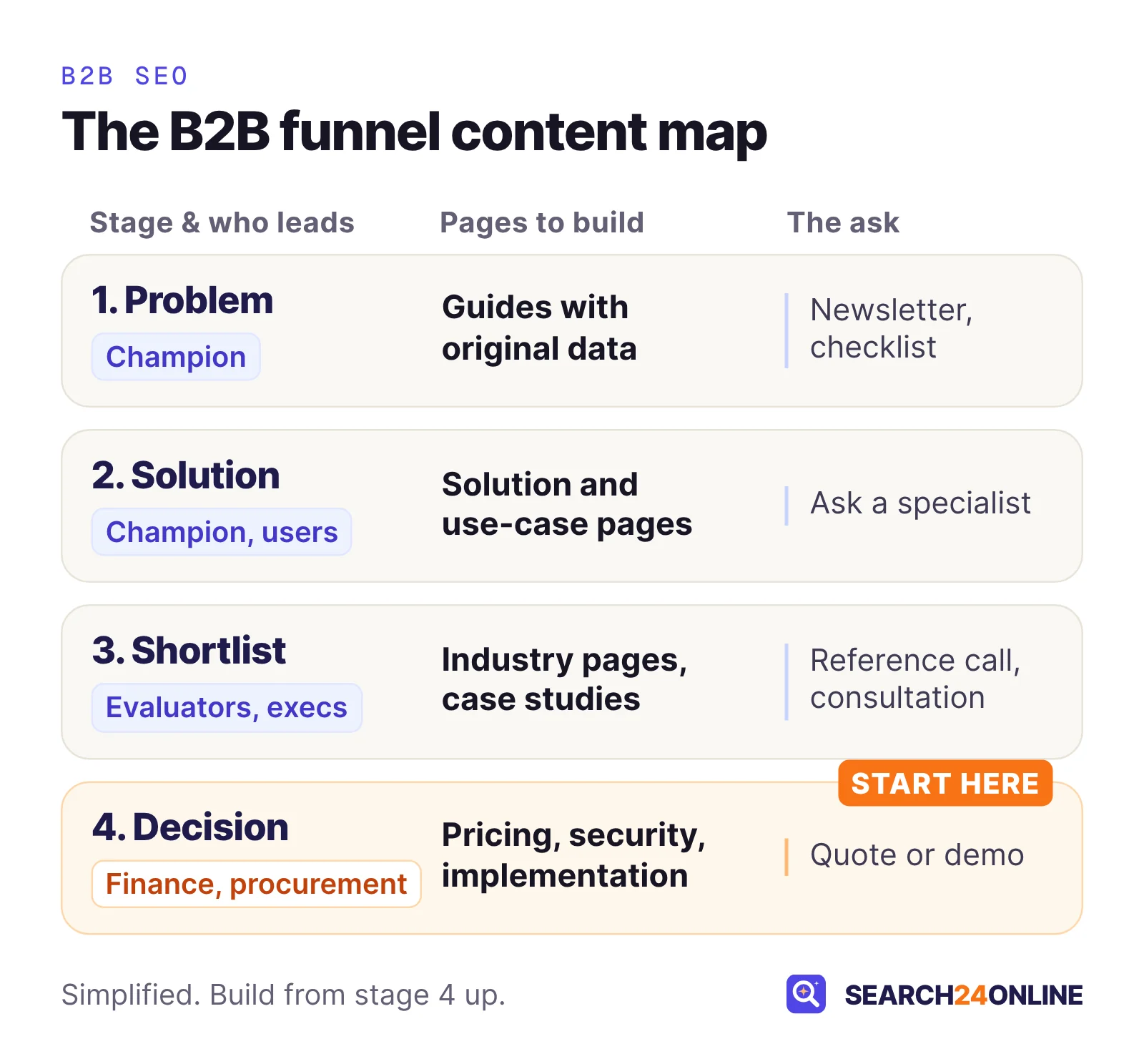
A common situation: a managed IT provider serving clinics and law firms, with one “Services” page and a blog. Mapped by stage, the gaps are obvious. “Ransomware at a small law firm, what to do” is a problem search; “co-managed vs fully managed IT” is a solution search. “HIPAA compliant managed IT provider” plus a region is a shortlist search, and “managed IT pricing per user” a decision search. The last two barely register in keyword tools, yet they are what a clinic manager with a budget types.
Which bottom-funnel pages turn searches into leads?
Five page types do most of the lead generation on B2B sites: solution, industry, use-case and pricing pages, plus case studies (covered below). They answer shortlist and decision searches, and sales can send them to buyers too.
Solution pages
One page per problem you solve or service you sell, named after the outcome rather than your internal product name. Cover who it is for, how it works, what implementation involves, typical timelines, proof and the next step. The usual fault is overlap: “Solutions”, “Services” and “Capabilities” pages all aiming at the same phrases.
Industry pages
An industry page earns its place when it says things only true for that industry: its regulations, workflows, vocabulary and examples. Copies with the industry name swapped are another matter. Google’s spam policies describe doorway abuse as pages “created to rank for specific, similar search queries” that lead to pages “that aren’t as useful as the final destination.”
A quick test: if you replaced “healthcare” with “legal” and the page still read correctly, it isn’t an industry page yet.
Use-case pages
A use case is a job the buyer needs done: “automate invoice matching”, “monitor remote pump stations”. These pages catch solution-stage searches from people who don’t yet know what your category is called. Industrial firms call them application pages; our guide to SEO for manufacturers covers them alongside spec-driven searches.
Pricing pages
Publish as much as you honestly can. Gartner’s May 2026 research found that 70% of B2B buyers prefer a completely digital, self-service buying experience. If your pricing really is custom, publish starting points, typical ranges, what moves the price, minimum engagements and one worked example. Our view: a bare “Contact us for pricing” page ranks for nothing and answers nobody, including the AI assistant a buyer asks what this usually costs.
Software companies also lean on comparison and alternatives pages; the SaaS SEO playbook covers how to write those fairly. For other B2B firms, an honest “how to choose a provider” page, including criteria you don’t win on, serves the same shortlist searches.
What makes B2B thought leadership worth ranking and citing?
Original insight: something buyers cannot get from the top ten search results or an AI summary of them. If anyone with a search engine could have written it, it adds nothing, and Google’s helpful-content guidance asks exactly this: “Does the content provide original information, reporting, research, or analysis?”
Buyers say the same. In the 2025 Edelman–LinkedIn survey, 64% of hidden decision-makers and 65% of target decision-makers said thought leadership is a more trustworthy basis for assessing a company’s capabilities than its marketing materials and product sheets. And 79% of hidden decision-makers said they are more likely to advocate for an RFP proposal from a company that consistently produces high-quality thought leadership.
In B2B, original insight usually comes from four places:
- Your operational data. Aggregated, anonymized patterns from projects, tickets or quotes, such as typical lead times by material. Get client permission where their data is involved.
- Field experience. The mistakes you watch buyers make and the real trade-offs between approaches.
- A point of view you will defend. Where your industry’s standard advice is wrong, and why.
- Named experts. Articles written or reviewed by the engineer, attorney or consultant who knows the subject, with a short bio.
This is also what AI assistants quote: a clear statistic or framework with a named source is easier to lift into an answer than a generic overview. Our guide to writing content AI assistants want to quote covers the format.
How should you build case-study pages?
Give every real case study its own indexable page, structured so a skeptical buyer can check it, and link it from the solution and industry pages it supports. Forrester’s 2026 buying research describes buyers as “far less forgiving of claims without proof,” and a case study is the most direct proof most B2B firms have.
- Client and context: industry, size, region and the situation before you started, named with permission or clearly anonymized.
- The problem in their words: what was at stake and what they had already tried.
- What you did: the approach, timeline, team and the obstacles along the way.
- The outcome: measured results, the period they cover and how they were measured. Say what worked less well, too.
- A client quote, approved in writing.
Real only. Never invent a client, a metric or a quote, and don’t round a 9% improvement up to “double digits”. The FTC’s endorsement guidance states the principle plainly: “An endorsement must reflect the honest opinion of the endorser.” A buying group of a dozen people will check, and one invented detail can end a deal. If a client won’t be named, an anonymized case study (“a 200-bed regional hospital”) works, provided every fact is true and the client has signed off.
Title them by industry and outcome (“Cutting order-to-ship time at a food packaging plant”), not “Client success story #4”. A case study that exists only as a PDF behind a form can’t rank or be cited, so publish the full story as a page and offer the PDF as an extra.
How do you capture leads without driving buyers away?
Match the ask to the stage. Someone reading a problem-stage guide is not ready for a demo; someone on your pricing page may be. One generic “Contact us” button sitewide under-asks ready buyers and over-asks everyone else.
- Problem stage: a newsletter, a checklist or a benchmark summary.
- Solution stage: an assessment tool, a webinar, “ask a specialist”.
- Shortlist stage: a case-study pack, a reference call, a technical consultation.
- Decision stage: a quote request, a pricing calculator, a demo or site visit.
On gating, our view: leave content that should rank and be cited ungated, because search engines and AI assistants can’t read what sits behind a form. Gate only things with clear extra value, like a full benchmark dataset. Keep forms short: name, work email, company and a free-text “What are you trying to solve?” are enough to route a lead.
Offer a person, not just a demo. Gartner found that 69% of B2B buyers prefer to validate AI-generated insights with sales reps. Gartner’s Robert Blaisdell advises sellers to engage “where they can help buyers validate information, reduce risk and move forward with greater confidence.” An “Ask an engineer” option on technical pages promises an answer rather than a pitch, which in our experience suits evaluators better than “Book a demo”.
How do you connect organic search to pipeline in your CRM?
Track organic search through to opportunities and closed revenue in your CRM, at the account level, because the first visit and the signed contract can be months and several people apart. Analytics sees sessions; your CRM sees deals.
The timing problem is concrete. Google Analytics 4 sets a default lookback window of 90 days for key events, with 30 or 60 days as the other choices. Against a buying cycle that 6sense puts at about 10 months, analytics will often credit the last touch (a branded search or a direct visit) and lose the guide someone on the buying team read in month two.
What to set up
- Capture the source on every contact. HubSpot, for example, sets an Original Traffic Source and a Latest Traffic Source on each contact, with values including Organic search and AI Referrals, and associated companies and deals mirror them. HubSpot notes that ad blockers can block its tracking cookies, so treat the field as a strong signal, not a complete record.
- Record the landing page in a hidden form field, so each lead arrives with the page that brought it in.
- Ask. A free-text “How did you hear about us?” field catches what cookies miss: “a colleague sent me your pricing page”, “ChatGPT suggested you”.
- Roll contacts up to the account. When three people from one company arrive through different channels, record all of them on the company and the opportunity, so organic search gets credit for the people it introduced.
- Report four numbers monthly: organic-sourced opportunities, organic-influenced opportunities (any contact touched organic search before the deal closed), the pipeline value of each, and their win rate compared with other sources.
For lead values, phone calls and the full ROI calculation, see how to measure SEO ROI.
Take your last ten closed deals. For each one, can you say who first found you, how, and which pages the buying group read? If not, fix tracking before paying for more content.
How are B2B buyers using AI assistants to research vendors?
Widely, and as a source they rate highly. Forrester’s Buyers’ Journey Survey 2025 found that 94% of business buyers used AI in their buying process, up from 89% the year before. Forrester also reports that twice as many buyers named generative AI or conversational search as a more meaningful or important source of information than any other source, far outpacing vendor websites, product experts and sales.
The surveys asked different questions, which explains the gap: AI use anywhere in the process is broader than GenAI use in one recent purchase. Trust is mixed: in Gartner’s survey, 51% of buyers said they were more likely to encounter misleading information from GenAI, against 49% who said the same of sales reps.
One Forrester finding shapes measurement: 61% of business buyers use private AI tools provided by their organization. Our view: much of that research will never send a click you can see. You can’t count that influence directly, but you can make sure what an assistant finds about you is accurate and complete.
What helps a B2B vendor show up in AI answers
Google says there are “no additional requirements to appear in AI Overviews or AI Mode, nor other special optimizations necessary.” Both features may use query fan-out, running several related searches to build one response. A question like “which managed IT providers in Ohio work with dental practices?” can fan out into searches about industries served, compliance, pricing and reviews. The pages described above are what those searches find.
- State the facts on your own pages: what you sell, which industries and regions you serve, certifications, typical price ranges and implementation times. An assistant can’t cite what you only say on sales calls.
- Describe yourself consistently: the same company description and service names on your site, LinkedIn, directories and review profiles.
- Earn mentions elsewhere: trade publications, association directories, partner pages, analyst coverage. Buyers validate with outside sources, and assistants draw on them too.
- Check what assistants say: ask the questions your buyers ask at each stage and log which vendors appear. Our guide to tracking brand visibility in AI answers sets out a repeatable method, and getting mentioned in ChatGPT covers that assistant specifically.
On Google’s side, Search Console’s Generative AI performance report, available for all websites as of August 31, 2026, counts how many times links to your pages were shown in AI Overviews and AI Mode, page by page. Watch it next to organic-influenced pipeline in your CRM.
Where should a B2B company start?
Start with the pages closest to revenue and the tracking that proves they work. Across the 500+ brands our team has served, struggling B2B sites rarely lack expertise; they lack pages that show it to the right person at the right moment. The order we usually follow:
- Fix the foundationsConfirm your solution, industry and pricing pages are indexed, aren’t competing with each other and can be reached within a couple of clicks from the homepage.
- Set up attributionSource capture, a landing-page field, a “How did you hear about us?” question and account roll-up in the CRM.
- Build the bottom of the funnelCreate or rewrite pages from your keyword map, starting with decision-stage gaps such as pricing and security.
- Publish real case studiesOne page each, linked from the solution and industry pages they prove.
- Add original thought leadership and monitorPublish from your own data and expertise, then review AI answers and organic pipeline every month.
For a baseline, our free SEO + GEO report analyzes your website: indexability, canonicals, on-page basics, structured data and which AI crawlers can read your site. You get private dashboard access within 24 hours. Put it next to your CRM data and the first step usually becomes obvious. For ongoing help, see our SEO + GEO services.
Common questions
How long does B2B SEO take to generate leads?
Nobody can promise a timeline. In our experience, fixing and building bottom-funnel pages on a site Google already indexes tends to produce inquiries sooner than thought leadership, which builds over many months. With 6sense putting the average buying cycle at about 10 months, judge revenue over at least one full cycle.
Should B2B companies target keywords with very low search volume?
Yes, when the person searching is likely to be a buyer. A phrase with 20 searches a month from operations or procurement managers can be worth more than one with 20,000 from students, and many valuable B2B phrases show zero volume in keyword tools simply because they are specific.
Is B2B SEO the same as SaaS SEO?
SaaS SEO is one kind of B2B SEO. The buying-group, bottom-funnel and attribution principles are shared; software companies add comparison and alternatives pages, documentation, integrations and trial signups, which need their own playbook.
Should we publish pricing if every B2B deal is custom?
Publish what you honestly can: starting prices, typical ranges, what moves the price, minimum engagements and a worked example. Gartner’s 2026 research found 70% of B2B buyers prefer a completely digital, self-service buying experience, so a page with no pricing signal at all leaves many of them without an answer.
Can we track B2B leads that come from ChatGPT and other AI assistants?
Partly. Clicks from assistants that pass a referrer can be recorded, and HubSpot, for example, now has an AI Referrals traffic source. Much AI influence produces no click at all, so add a free-text “How did you hear about us?” field to your forms and read the answers.
Sources
- Forrester: The State Of Business Buying, 2026 (Barbara Winters)
- Forrester: B2B Buyers Make Zero-Click Buying Number One (John Buten, January 2026)
- Gartner: Survey Finds 69% of B2B Buyers Turn to Sales Reps to Validate AI-Generated Insights (May 20, 2026)
- 6sense: Insights From the 2025 Buyer Experience Report
- Edelman and LinkedIn: 2025 B2B Thought Leadership Impact Report (PDF)
- Google Search Central: Spam policies for Google web search
- Google Search Central: Creating helpful, reliable, people-first content
- Google Search Central: AI features and your website
- Search Console Help: Generative AI performance report
- Google Analytics Help: Select attribution settings
- HubSpot Knowledge Base: Understand Original and Latest traffic source properties
- FTC: Endorsement Guides, What People Are Asking
Are your solution and pricing pages working for buyers? Check free.
We’ll analyze your website, create your SEO + GEO report and give you password-protected dashboard access to view it.
Free · No obligation · We only review your public pages.